




Is your digital advertising performance shrinking because third-party cookies no longer work reliably, while privacy regulations across the United States and Canada keep getting stricter? Many marketers and agencies are facing the same issues.
With third-party tracking losing effectiveness, marketers face data loss, attribution challenges, and increased compliance risk. Forbes highlights that 66.2% of adults are uneasy about advertisers using their personal information, reinforcing the instability of relying on these methods.
You do not need to give up precision to stay compliant. A stronger and more reliable path exists. The key is to shift from third-party tracking to consented, privacy-safe targeting methods that rely on first-party and server-side data.
This guide explains the strategies that help you protect your ad spend, maintain accurate measurement, and stay compliant in a privacy-first environment in 2026.
Key Takeaways
- Move from browser-based tracking to first-party data and server-side measurement for accurate attribution.
- Use Ingest ID to create high-quality segments built from your own customer insights.
- Use Ingest IQ to collect events on your server and avoid data loss caused by browser limits.
- Use Event IQ to monitor event quality across web, app, and CRM pipelines.
- This combination gives you a precise, privacy-respectful targeting engine that continues to perform even without third-party cookies.
Understanding Cookieless Advertising: Why the Change?
Cookieless advertising refers to the strategies and technologies used to target, measure, and personalize ads without depending on third-party cookies. This shift is not optional; it's a necessary adaptation driven by both technology and regulation.
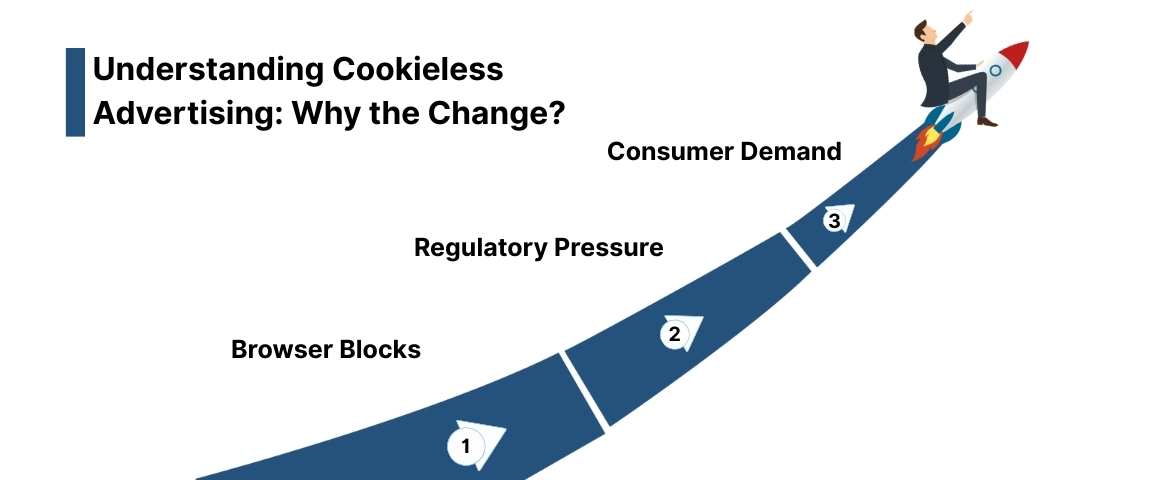
For years, third-party cookies enabled pervasive cross-site tracking, allowing advertisers to follow users from your website to a publisher's site and back again for retargeting. This system is ending due to:
- Browser Blocks: Apple's Safari, Google Chrome, and Mozilla's Firefox have already blocked third-party cookies by default.
- Regulatory Pressure: Sweeping North American laws, including the CPRA/CCPA in California, demand explicit user consent and give consumers control over their data, making opaque third-party tracking a massive legal liability.
- Consumer Demand: A McKinsey survey found that 41% of consumers don't want advertisers using tracking cookies. Respecting this sentiment builds the trust that drives long-term customer loyalty.
Moving to cookie-free targeting solutions is about replacing reliance on external data with proprietary, consent-driven data assets.
How Cookieless Targeting Works
Cookieless targeting replaces the passive, ubiquitous third-party cookie with active, privacy-preserving identifiers and modeling techniques. The core mechanics shift the burden of identity from the browser to your business's data infrastructure.
The Two Pillars of Cookieless Identity
The industry now relies on two key identity methods to accurately recognize users:
- Deterministic Matching: This is the most accurate method, relying on verified, consented personal information (like a hashed email address or a unique first-party ID) to directly identify a user across different touchpoints.
- Probabilistic Matching: This method uses algorithms and machine learning to infer a user's identity based on non-PII signals (like device type, IP address, and browser characteristics), extending reach where deterministic data is unavailable.
Deterministic vs. Probabilistic Matching
The industry now relies on two key identity methods to accurately recognize users in a privacy-first way:
| Feature | Deterministic Matching (e.g., Ingest ID) | Probabilistic Matching (e.g., Modeling) |
| Primary Identifier | Hashed, consented PII (Email, Phone) or First-Party ID (Ingest ID) | Non-PII signals (IP address, browser type, device fingerprint) |
| Data Type | High-quality and consent-driven first-party data. | Aggregated and inferred data. |
| Accuracy | High: Directly linked to a verified user. | Lower: Infers identity based on patterns/likelihood. |
| Reach | Limited to users who are logged in or have provided PII. | Broader: Can reach unknown or non-consenting users. |
| Best For | Retargeting, personalization, and high-value conversion attribution. | Audience extension, top-of-funnel campaigns, and filling data gaps. |
Key Cookieless Technologies of 2026
To understand the cookieless future, marketers must embrace and master these foundational cookie-free targeting solutions:
- First-Party Data: Information collected directly through your website, app, CRM, or email. It is consented, accurate, and forms the basis for deterministic targeting methods supported by tools like Ingest ID.
- Zero-Party Data: Information users share intentionally, such as survey answers or preference selections. This data is transparent and high-intent and supports more meaningful personalization.
- Contextual Advertising: A targeting method based on the content users are viewing rather than their browsing history. It aligns naturally with regulatory expectations in the United States and Canada.
- Universal IDs: Privacy-safe identifiers, such as UID2, created with encrypted email-based authentication. These IDs help maintain addressability across approved platforms while honoring user consent.
Also Read: How To Navigate Cookieless Retargeting in 2025
Now that you have a clear view of the technologies shaping the cookieless ecosystem, the next step is understanding how to apply them in real targeting scenarios. This is where strategy becomes just as important as technology.
Effective Targeting Strategies for the Privacy-First Era for 2026
As third-party cookies continue to decline across all major browsers, you need targeting strategies that rely on data you control, operate within privacy standards in the United States and Canada, and deliver reliable performance even as cross-site identifiers disappear. The following strategies show how marketing teams can achieve this while improving accuracy, compliance, and operational efficiency in 2026.
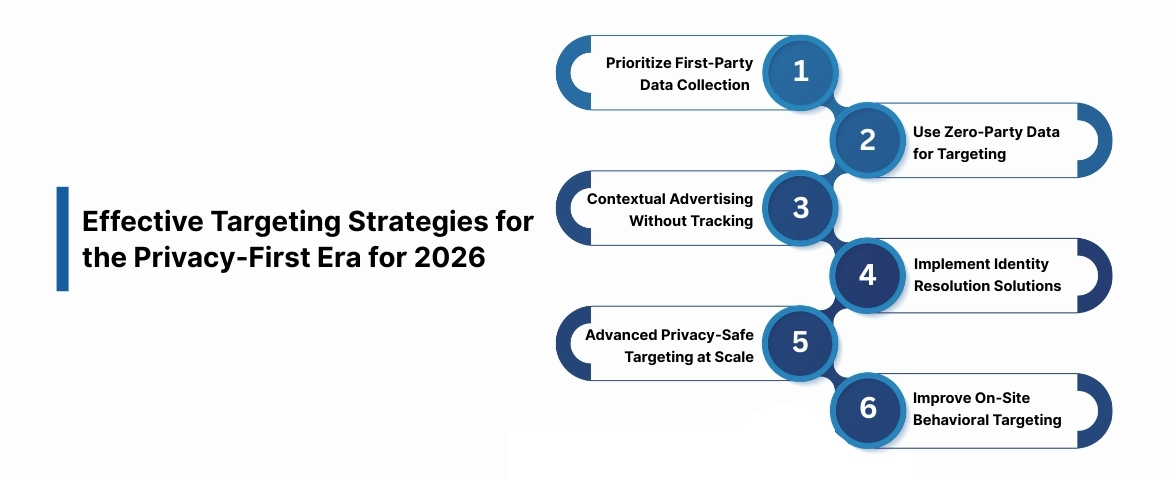
1. Prioritize First-Party Data Collection and Server-Side Tracking
First-party data remains the strongest asset for targeting because it comes directly from your customers with clear consent.
Why It Matters
- It is highly accurate because it reflects real customer behavior on your own properties.
- It helps you maintain compliance since data is collected with explicit consent.
- It forms the foundation for segmentation, attribution, lookalike modeling, and personalization.
How To Execute This Strategy
- Implement server-side tracking (Ingest IQ) to capture complete event data without interference from ad blockers or browser limits.
- Unify data from web, app, email, and CRM inside your Customer Data Platform (Event IQ).
- Assign first-party identifiers using Ingest ID, which helps you track repeat interactions, devices, and conversion journeys without cross-site cookies.
Business Impact
- More stable measurement
- Reduced data loss
- Stronger audience quality
- Higher ROAS due to better targeting precision
Is your first-party data accurate enough for reliable targeting? Use Ingest Labs' platforms to centralize and refine your customer data for maximum precision. Learn how Ingest IQsimplifies server-side tracking now!
2. Use Zero-Party Data to Strengthen Intent-Based Targeting
Zero-party data gives you insights directly from your customers. Because users willingly provide this information, it is considered the cleanest and most privacy-aligned data for targeting.
Examples of Zero-Party Data Sources
- Preference centers
- Surveys
- Signup flows
- Product quizzes
- Loyalty program profiles
A Practical Example for E-commerce: An online retailer asks users, "What is your primary style preference (e.g., casual, formal, or athleisure)?" The answer is zero-party data that allows for hyper-relevant product recommendations and ad targeting, making it a powerful cookie-free targeting solution.
How It Supports Targeting
Zero-party data helps you in:
- Understand buying motivations
- Deliver accurate product recommendations
- Improve the relevance of email and ad campaigns
- Maintain personalization without invasive tracking
Business Impact
- Higher engagement rates
- Stronger trust
- Better alignment between user intent and ad messaging
Note: A 2023 Deloitte study found that 82%of fast-growing companies are moving toward first-party data strategies that also incorporate zero-party data collection.
3. Apply Modern Contextual Advertising for Relevance Without Tracking
With contextual advertising, the ads you serve are based on what someone is looking at right now, not what they’ve viewed before. Today's contextual targeting uses AI and machine learning to analyze sentiment, video content, and real-time trends to make sure that your ad placement is highly relevant and brand-safe.
Why It Works in a Cookieless World
- It relies on content signals, not personal data
- It meets privacy expectations without consent banners
- It works across the open web, including environments where tracking is limited
How To Implement
Use contextual platforms that evaluate:
- Page sentiment
- Visual content
- Video context
- Real-time trends
- Natural language patterns
Business Impact
- Safer placements
- Broader reach
- Higher brand suitability
- Consistent compliance across US and Canadian regulations
To understand which contextual approaches are driving engagement and conversions, you can track these interactions through Event IQ. The no-code Tag Manager lets you set up event tracking for contextual ad interactions, email clicks, or influencer-driven visits. This gives you clear performance insight while keeping your data collection fully privacy-aligned.
4. Adopt Identity Resolution and Universal ID Solutions
Even without third-party cookies, you can achieve cross-site addressability through consented identity frameworks. These systems use encrypted identifiers, commonly based on hashed emails.
Examples
- Unified ID 2.0 (UID2)
- LiveRamp RampID
- Publisher-specific login IDs
How They Work
When a user provides their email to a publisher, it is instantly hashed and encrypted into a universal ID. This ID can be matched across different sites and platforms for targeting, lookalike audience creation, and frequency capping, all while remaining privacy-conscious.
Why This Matters
- Supports frequency management
- Enables lookalike modeling
- Supports attribution across channels
- Respects user consent
Business Impact
- Better reach than cookie-based methods
- More accurate audiences
- Future-proof identity management
Note: These cookie-free targeting solutions are rapidly gaining traction in the US and Canada as the infrastructure for the open web.
5. Use Advanced Privacy-Safe Targeting Methods for Enterprise Scale
Large marketing teams and agencies benefit from more sophisticated tools that maintain precision without exposing personal information.
A. Data Clean Rooms
Data clean rooms are secure, neutral environments that allow two or more parties (e.g., an advertiser and a publisher) to match and analyze anonymized customer data without sharing the underlying raw data.
Use Cases:
- Attribution
- Audience overlap
- Media mix modeling
- Custom segment creation
Benefits:
- No raw data is exchanged
- Compliant with CCPA, CPRA, and Canadian laws
B. Walled Gardens and Retail Media Networks
Platforms such as Google, Meta, Amazon, and major retailers operate on logged-in data, so they already function without third-party cookies.
Your Strategy:
- Pass hashed conversion data through Ingest IQ when configured, so your signals remain consistent with platform requirements.
- Use platform-level lookalikes based on your first-party inputs
- Use Event IQ to unify campaign data for cross-channel reporting
C. CTV and In-App Advertising
CTV and mobile apps never relied on cookies. They use device IDs such as IDFA or AdID.
How to connect exposure to outcome:
- Capture CTV impression logs
- Match them to on-site server-side events
- Use Ingest ID to unify user actions across devices
D. Collaborate With Trusted Data Partners
Second-party data partnerships help you expand your targeting capabilities when third-party cookies are no longer available. By exchanging anonymised insights with reputable partners, you strengthen your existing first-party data and reach audiences you may not otherwise access.
Use Case
You can work with complementary businesses to share privacy-safe data signals. For example, a retail brand can collaborate with a payment provider to understand broader purchase trends, or an airline can partner with a hotel chain to build higher-intent travel segments without exposing personal data.
Benefit
These partnerships help you fill the gaps left by third-party cookies. You gain access to richer behavioral insights and new audience pools while staying fully compliant with privacy regulations, since no raw data is exchanged.
Business Impact
- Expanded reach through high-quality partner audiences
- Better segmentation accuracy from enriched data
- More efficient media spend due to stronger targeting inputs
- Reduced dependence on walled gardens
- Greater resilience in a cookieless environment
Working with trusted partners gives you a scalable way to enhance your first-party data and maintain strong targeting performance without traditional cross-site tracking.
Note: A recent study in IBIMA Publishing found that 69.2% of marketers see AI as significantly enhancing targeting accuracy, allowing businesses to anticipate user preferences and behaviors even without cookies.
6. Strengthen On-Site Behavioral Targeting for Real-Time Personalization
Your own website or app remains the most controlled and accurate environment for targeting.
Use Cases
- Product recommendations
- Abandonment recovery
- Repeat buyer segmentation
- Dynamic promotions based on behavior
Execution
- Capture all behavior using server-side tracking
- Feed unified events into Event IQ
- Build segments that update in real time
- Trigger on-site or off-site campaigns based on those signals
Business Impact
- Higher conversion rates
- More relevant experiences
- Reduced reliance on third-party data
These strategies give you a solid framework for succeeding in a privacy-first environment, but they also introduce new operational and measurement challenges. Preparing for these limitations helps you build a stronger, more practical cookieless roadmap.
Also Read: How to Set Up a Customer Retargeting Campaign
Challenges in a Cookieless World
While the path to compliance offers immense benefits, the transition presents concrete challenges for digital marketing teams and e-commerce businesses.
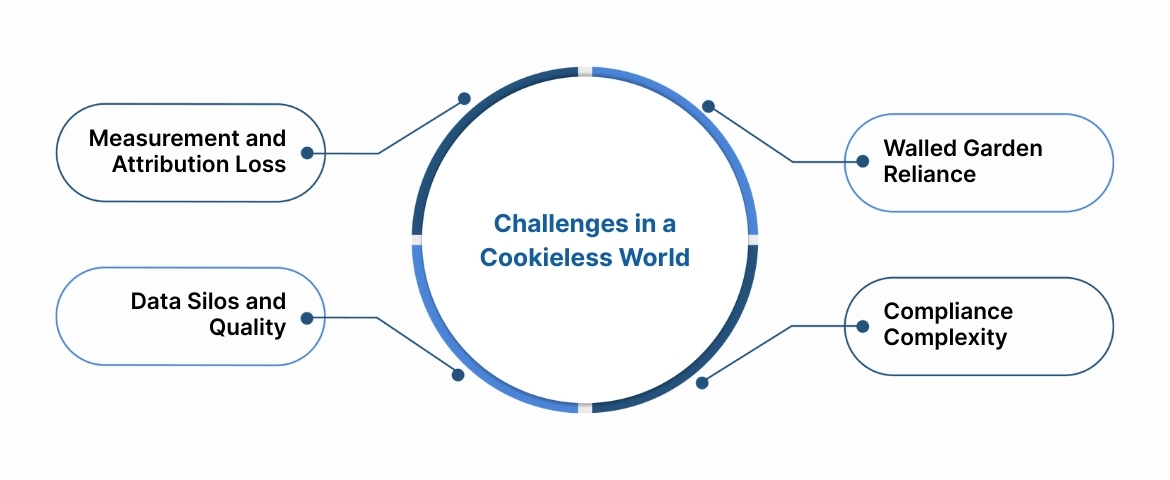
- Measurement and Attribution Loss: You lose visibility into multi-touch journeys when third-party cookies disappear. This affects how you measure ROAS across platforms and makes traditional attribution models less reliable.
- Walled Garden Reliance: As open web tracking declines, you may find yourself relying more heavily on platforms such as Google, Meta, and Amazon for targeting. This can increase media costs and reduce transparency in performance reporting outside those ecosystems.
- Data Silos and Quality: You might already have valuable first-party data, but bringing it together is often difficult. CRM records, email engagement data, and analytics insights can remain disconnected, which prevents you from building complete customer profiles for segmentation.
- Compliance Complexity: You must manage new technical frameworks, including server-side tracking, while ensuring that each data signal aligns with evolving privacy laws across US states and Canada.
To overcome these obstacles, you need cookie-free targeting solutions that offer both technical simplicity and strong compliance controls. This is where Ingest Labs helps you establish a reliable foundation for accurate, privacy-first advertising.
How Ingest Labs Empowers Your Cookieless Advertising
To transition confidently into a cookieless environment, you need a set of integrated tools that simplify the technical work behind accurate, privacy-first targeting. Ingest Labs delivers three core solutions that help you maintain precision, compliance, and reliable conversion data without third-party cookies.
1. Ingest IQ: Precision Server-Side Tracking
Server-side tracking is the foundation of modern measurement. With Ingest IQ, your data collection moves from the user's browser to your secure server environment.
- Accurate Attribution: You capture customer signals more consistently across browsers and devices when using server-side tracking, which improves your Enhanced Conversions and strengthens machine learning performance on platforms such as Google and Meta.
- Bypass Browser Restrictions: Since data is collected server-side, you avoid issues caused by browser limits and ad blockers. This ensures that your conversion events remain complete, reliable, and compliant.
2. Ingest ID: First-Party Identity Resolution
To maintain deterministic targeting without cookies, you need a stable, privacy-compliant identifier. Ingest ID gives you this capability.
- Unified Customer View: Ingest ID maintains the first-party identifier you supply (such as a hashed login), helping you link events consistently across sessions and devices.
- High-Value Segmentation: This identifier enhances your internal segmentation and allows you to build precise, high-intent audiences for your campaigns.
3. Event IQ: Event Quality and Schema Monitoring
Event IQ helps monitor event quality and schema consistency across your systems, but it is not a CDP and does not unify customer profiles.
- Real-Time Data Orchestration: Event IQ merges information from Ingest IQ, your CRM, mobile app, and other sources. This gives you a complete customer profile that updates in real time and supports stronger personalization.
- Regulatory Confidence: Event IQ can surface issues in event quality and schema adherence, but managing consent and data rights must be handled within your own systems. This reduces compliance risk and simplifies complex data governance tasks.
Conclusion
As third-party cookies disappear, your ability to measure performance and reach high-value audiences depends on the strength of your first-party data. You need accurate event collection, privacy-safe identity resolution, and a unified view of the customer journey to keep your campaigns effective and compliant with US and Canadian regulations.
Ingest Labs gives you the tools to make this transition successful. Ingest IQ captures complete, server-side event data. Ingest ID provides a persistent first-party identifier for accurate attribution. Event IQ unifies your customer data and makes sure that every signal aligns with changing privacy laws. Together, they give you a reliable, compliant, and high-performing foundation for cookieless advertising.
If you are ready to protect your data, strengthen your targeting, and improve ROAS in a privacy-first world, connect with Ingest Labs and book a quick demo. Our platforms are built to solve the exact challenges you face today and help you grow confidently in the cookieless era.
FAQs
1. What is the risk of not adopting cookieless targeting solutions?
You risk losing measurement accuracy and exposing your business to compliance penalties. Third-party tracking is no longer reliable, and failing to modernize can lead to wasted ad spend and legal issues.
2. How does server-side tracking support retargeting without cookies?
Server-side tracking captures first-party events reliably. You can then create audience lists, hash them securely, and share them with platforms like Google or Meta for compliant retargeting.
3. Is contextual advertising a full replacement for behavioral targeting?
Contextual targeting covers reach and relevance, but high-precision targeting still depends on first-party data, unified IDs, and on-site behavior.
4. What is the most important compliance step for agencies in the US and Canada?
You must maintain a clear, auditable process for obtaining consent and managing data rights. Event IQ supports this by ensuring your data flows follow opt-outs and user rights requests.
5. Do cookie-free websites still allow accurate analytics?
Cookie-free websites can still deliver accurate analytics when you use server-side tracking and first-party data tools.
6. How can I personalize marketing without cookies?
You can personalize experiences using first-party and zero-party data collected directly from your audience. With tools such as Ingest ID and Event IQ, you can build consented customer profiles, segment users in real time, and deliver relevant messaging without depending on third-party cookies.