




Cookie banner requirements now affect how you collect, process, and activate marketing data across every digital touchpoint. If your website uses analytics, advertising pixels, or personalization tools, your consent framework already carries legal exposure. Regulators in the United States and Canada increasingly treat consent failures as governance failures rather than simple design errors.
This guide explains how cookie banner requirements apply to your business, what regulators expect, and where organizations often fail. You will learn how to structure compliant banners, avoid enforcement risks, and align consent management with data operations that support revenue, reporting, and accountability.
Key Takeaways
- Cookie banner requirements differ dramatically by jurisdiction, GDPR demands explicit opt-in consent before any tracking, CCPA requires opt-out mechanisms, and PIPEDA falls between them, making a one-size-fits-all approach risky.
- Regulators aggressively enforce dark pattern prohibitions in cookie banners, unequal button sizes, pre-checked boxes, and hidden rejection options trigger fines and enforcement actions from privacy authorities worldwide.
- Server-side tracking combined with first-party data collection offers privacy-compliant alternatives to traditional browser-based cookies, giving you more control while meeting regulatory requirements.
- Global Privacy Control signals are legally recognized in California and multiple US states, requiring automatic respect for user opt-out requests regardless of banner design.
- Consent acceptance rates typically range from 30–80% depending on industry and implementation quality, while well-designed, compliant banners can exceed 80%.
What Is a Cookie Banner?
A cookie banner is the notification that appears when visitors land on your website. It informs users about the cookies and tracking technologies your site uses, explains your data collection purposes, and asks for permission before placing cookies on their devices.
Cookie banners differ fundamentally from privacy policies. They're interactive; users must actively respond by accepting, declining, or customizing preferences. The banner sits between your business’s data needs and the user’s right to make informed privacy choices.
Different regulatory frameworks dictate what must appear in the banner and how users interact with it. In GDPR territories, banners block tracking until consent is given. In CCPA regions, banners typically disclose practices and offer opt-out options. Canadian PIPEDA requirements fall between these approaches, allowing implied consent for some uses while demanding explicit consent for sensitive tracking.
Knowing what a cookie banner is only explains the surface. Understanding why regulators scrutinize them reveals how banners influence compliance, trust, and data operations.
The Purpose of Cookie Banners
Cookie banners serve three critical functions: satisfying legal requirements, establishing transparency with users, and providing mechanisms for collecting valid consent.
From a compliance perspective, cookie banners are your evidence that users knew what data you were collecting and agreed to it. When regulators investigate practices, they examine banners, consent logs, and user preference records. A compliant banner supports a business during audits and enforcement investigations.
From a user trust perspective, transparent cookie banners signal that your business respects privacy. Users increasingly expect clear disclosure about tracking, and businesses that provide it build stronger customer relationships. This trust can contribute to stronger customer retention and higher-quality first-party data.
From an operational perspective, cookie banners control what data you collect. They enforce user preferences by blocking non-essential cookies when users decline consent and enabling tracking only for accepted categories.
Once the role of cookie banners is clear, the business implications become unavoidable. This is where consent moves from a legal requirement to a core part of risk management and data governance.
Why Do You Need a Cookie Banner on Your Website?
At a surface level, the answer is regulatory obligation. From a business perspective, the reason runs deeper. A cookie banner determines whether your organization can legally collect, analyze, and activate marketing data without exposing itself to compliance, revenue, or reputational risk. As privacy enforcement increases across the US and Canada, consent management has become part of core data governance, not a legal formality.
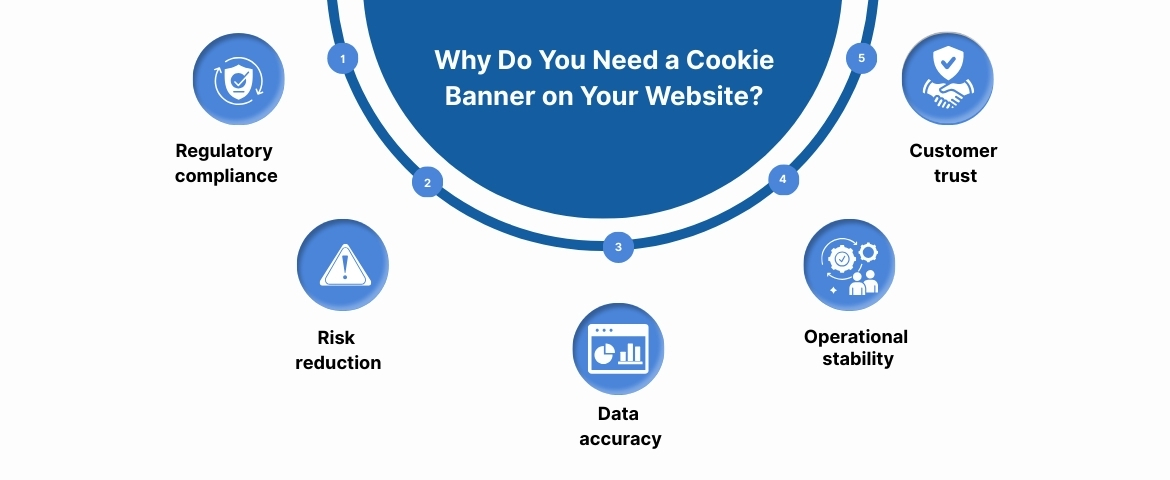
Key reasons your business needs a cookie banner include:
- Regulatory compliance: If your website collects browsing behavior, device identifiers, location data, or marketing signals, consent laws apply. CPRA governs California users, GDPR applies to EU visitors, and PIPEDA covers Canadian residents.
- Risk reduction: Operating without a compliant banner can trigger penalties even without intent. The Todd Snyder enforcement case resulted in a $345,178 fine due to a misconfigured consent tool that blocked opt-out access.
- Data accuracy: Consent-backed data reflects clearer user intent and withstands regulatory scrutiny. It withstands audits, improves attribution reliability, and supports confident decision-making across analytics and personalization.
- Operational stability: Non-compliant tracking pollutes customer data platforms, distorts reporting, and weakens campaign targeting.
- Customer trust: Clear consent choices signal respect for privacy, increasing repeat engagement and long-term brand credibility.
A cookie banner protects more than compliance status. It safeguards data integrity, supports sustainable marketing performance, and reinforces your organization's commitment to responsible data practices.
Those business risks don’t exist in isolation. They are shaped by overlapping laws across regions, each with different expectations for consent, disclosure, and enforcement.
Legal Landscape and Requirements
Cookie banner requirements vary across jurisdictions, but regulators across North America and Europe share a common expectation. Businesses must provide clear notice, meaningful choice, and enforceable consent controls before processing personal data. Understanding these legal models helps you design cookie banner compliance that withstands audits, complaints, and regulatory scrutiny. The regulatory environment follows three primary frameworks:
GDPR framework (EU and UK)
GDPR sets the strictest cookie banner requirements. It applies to any website collecting data from EU or UK residents, regardless of business location. Consent must be explicit, informed, and freely given before non-essential cookies activate. Pre-checked boxes, implied consent, and cookie walls are prohibited. Regulators enforce GDPR alongside the ePrivacy Directive, treating cookie violations as serious compliance failures. Fines can reach €20 million or 4% of global annual revenue.
CCPA and CPRA framework (California)
CCPA and CPRA follow an opt-out model. Businesses may collect data by default but must disclose collection practices and provide clear opt-out mechanisms, including “Do Not Sell or Share My Personal Information” links. Cookie banners are not explicitly mandated under CCPA or CPRA, but they remain a practical way to meet disclosure and opt-out obligations. These laws apply to for-profit organizations meeting revenue or data volume thresholds. Penalties range from $2,500 per unintentional violation to $7,500 per intentional violation, with expanded enforcement rules effective January 1, 2025.
PIPEDA framework (Canada)
PIPEDA requires meaningful consent, meaning users must understand what data is collected and why. Explicit consent applies to marketing and behavioral tracking, while implied consent may apply to limited analytics use. Penalties can reach CAD $100,000 per violation, with proposed Bill C-27 expected to strengthen enforcement and increase fines.
Cookie banner requirements reflect more than legal formality. They define how your business proves accountability, maintains data quality, and sustains trust across regulated markets. Strong cookie banner compliance aligns legal obligations with operational discipline, reducing risk while supporting long-term data governance.
Teams often pair consent management with server-side data enforcement to maintain accurate attribution and compliance across analytics and advertising systems. Event IQ helps unify consent signals and behavioral data downstream.
Understanding the regulatory models is only useful if you know how they translate into execution. These core requirements define what regulators actually look for during audits and investigations.
Key Legal Requirements for Cookie Banners
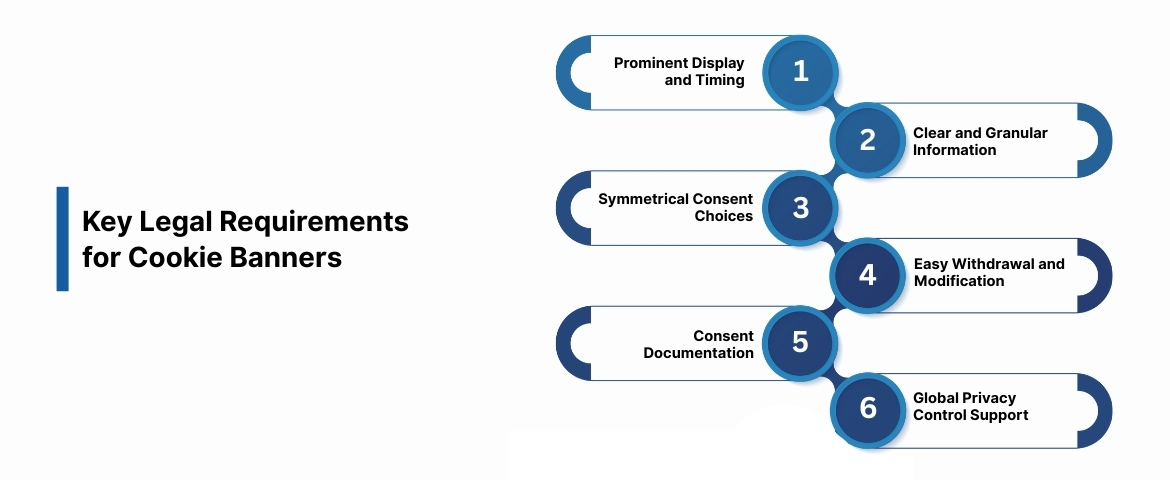
Compliant cookie banner requirements share common threads across jurisdictions despite different regulatory models. Understanding these requirements prevents costly mistakes.
1. Cookie Banner Requirements: Prominent Display and Timing
Your banner must appear before users interact with tracking technologies. Under GDPR, this means prior to any non-essential cookies being set. Under CCPA/PIPEDA, it means disclosure at collection points. Banner placement matters; centered banners with clear visual hierarchy outperform bottom-placed banners with minimal contrast.
2. Cookie Banner Requirements: Clear and Granular Information
Users must understand what cookies you use, why you're collecting data, and how long data persists. Granular information breaks cookies into categories: strictly necessary (always allowed), analytics, marketing, and functional.
Effective cookie banner requirements communicate cookie names and purposes, data retention periods for each category, third-party vendors involved in data processing, links to privacy policies, and user rights, including data access and deletion.
3. Cookie Banner Requirements: Symmetrical Consent Choices
Accept and Reject buttons must be equally prominent, equally sized, and equally colored. This cookie banner requirement receives intense regulatory scrutiny. The FTC and European privacy authorities have issued millions in fines for asymmetrical design.
Google's €150 million GDPR fine specifically targeted making reject options less visible than accept options.
4. Cookie Banner Requirements: Easy Withdrawal and Modification
Users must change preferences anytime. Under GDPR, this is mandatory. Under CCPA/PIPEDA, it supports user trust and compliance. Implement a revisit mechanism, a small button or cookie preference icon, staying visible, allowing users to update consent without leaving the site.
Users shouldn't need to contact support to modify cookie preferences. Withdrawal must be as easy as initial consent. If users needed one click to accept, they need one click to withdraw.
5. Cookie Banner Requirements: Consent Documentation
Maintain detailed logs showing when users gave consent, what information they saw, and the choices they made. GDPR does not mandate a fixed retention period; it requires keeping consent records only as long as their purpose remains valid.
Retention periods vary by use and applicable laws, often aligning with national requirements and deleting data once the purpose ends.
These logs become critical during regulatory investigations. They prove you obtained valid consent and demonstrate the specific terms users agreed to. Consent Management Platforms automate this logging, creating timestamped records of every consent decision.
6. Cookie Banner Requirements: Global Privacy Control Support
Global Privacy Control (GPC) signals are now legally recognized under CCPA, CPRA, and laws in Colorado, Connecticut, Virginia, and other states. GPC allows users to send automated opt-out signals via their browsers.
Cookie banner requirements increasingly include detecting and honoring GPC signals automatically where legally required. When users have GPC enabled, your systems must treat that as a valid opt-out request and process it immediately. Non-compliance risks enforcement from state regulators viewing GPC support as a core compliance obligation.
Even when businesses attempt to meet these requirements, design decisions often undermine compliance. This is where many organizations fail by unintentionally crossing into dark pattern territory.
Dark Patterns in Cookie Banners and How to Avoid Them
Dark patterns in cookie banners are manipulative design choices that push users toward accepting cookies against their real intent. Regulators across the EU, UK, and North America have clearly stated that these practices violate consent laws, and enforcement actions are increasing rapidly. In 2026, avoiding dark patterns is no longer best practice; it's a compliance requirement.
Common dark patterns to eliminate
- Pre-ticked boxes that assume consent instead of requiring an active choice
- Hidden or hard-to-find reject buttons that make refusal more difficult than acceptance
- Confusing or vague language that obscures what users are actually agreeing to
- Multi-step rejection flows, while acceptance takes one click
- Countdown timers or urgency messaging that pressure users into quick decisions
- Cookie walls that block access unless all cookies are accepted
Design solutions that comply
- Symmetrical buttons for accept and reject options with equal size and prominence.
- Clear, plain language such as "Accept all cookies" and "Reject all non-essential cookies."
- One-click rejection is available on the first banner layer.
- Default off toggles for non-essential cookies in customization views.
- Persistent preference storage so rejected cookies remain rejected on return visits.
Regulators like the FTC and CNIL have made it clear: dark pattern enforcement is accelerating, and penalties are rising. Designing fair, transparent cookie banners protects users and your business from costly compliance risks.
Avoiding dark patterns requires more than good intentions. It demands structured implementation, technical enforcement, and ongoing monitoring across your data stack.
Implementing Cookie Banners in Your Organization
Implementing a cookie banner isn't just a legal checkbox; it's a system-level decision that impacts compliance, data quality, and user trust. A successful approach balances regulatory requirements with operational efficiency, which is why most organizations rely on Consent Management Platforms (CMPs) to standardize and automate consent handling.
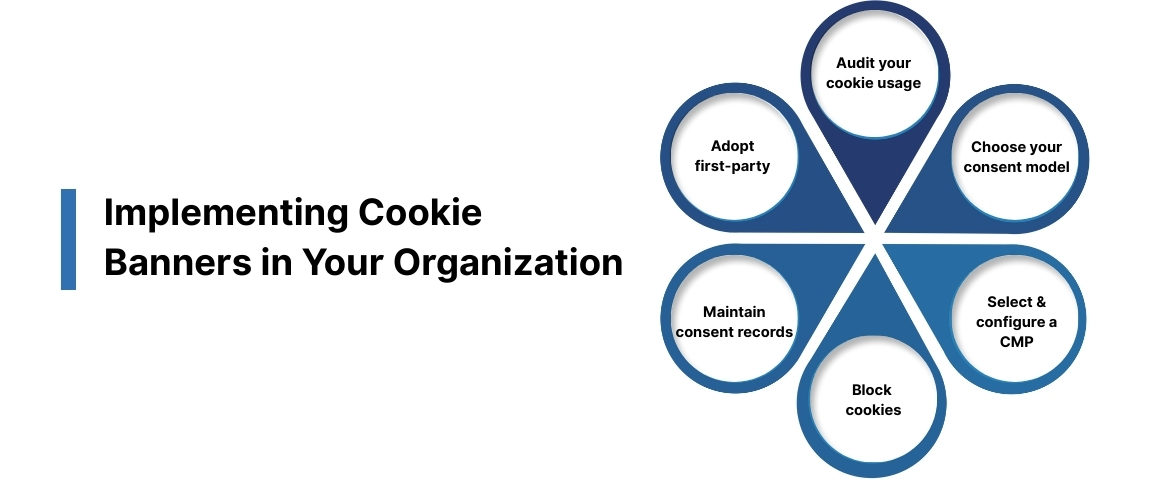
Step 1: Audit your cookie usage
Identify every cookie and tracking technology on your site. Classify them as strictly necessary, functional, analytics, or marketing. This audit defines what must be disclosed and often reveals unnecessary tracking you can remove, reducing both risk and complexity.
Step 2: Choose your consent model
Decide between geo-targeted consent (different rules per region) or a global GDPR-level standard. Geo-targeting offers flexibility, while global consent simplifies operations. The right choice depends on your customer geography and data needs.
Step 3: Select and configure a CMP
Choose a CMP that supports GDPR, CCPA, and emerging privacy laws, integrates with your tools, and offers automated scanning. Configuration matters—misconfigured banners can still result in fines, even on certified platforms.
Step 4: Block non-essential cookies before consent
Analytics, marketing, and functional cookies must not load until consent is given. Tools like Google Consent Mode v2 and server-side tracking help enforce this technically and reliably.
Step 5: Maintain consent records and monitor compliance
Store consent logs detailing what users saw and chose. Regular monitoring and automated scans help catch violations early.
Step 6: Adopt first-party and server-side strategies
First-party data and server-side tracking reduce reliance on cookies, improve data reliability, and simplify compliance.
Done right, cookie banner implementation strengthens trust, improves data quality, and keeps your organization audit-ready as regulations evolve.
Unify consent data and identity with Ingest ID so preferences are consistently enforced across every digital touchpoint and downstream system.
Conclusion
Cookie banner compliance has become a foundational requirement for digital businesses operating across North America. With GDPR's strict opt-in model, CCPA's opt-out approach, and PIPEDA's balanced requirements, correct and transparent implementation is critical. Regulators actively penalize dark patterns, and most compliance failures stem from poor execution, not the lack of tools.
Ingest Labs provides privacy-first, server-side data tools that help organizations respect, log, and consistently apply consent across tracking systems while maintaining data accuracy. Your cookie banner reflects your commitment to privacy and data ethics.
Need scalable, compliant consent management without sacrificing marketing insights? Contact us to see how Ingest Labs can help.
FAQs
Q: Do I need a cookie banner if I only use essential cookies?
If you use only strictly necessary cookies, banner requirements are minimal, but analytics, marketing, or functional cookies trigger compliance obligations. Many businesses underestimate non-essential cookies, so conduct a full audit before assuming your website does not require a banner today.
Q: Can I use the same cookie banner for all regions?
Using one global banner is possible, but GDPR opt-in and CCPA opt-out rules conflict and affect data collection outcomes significantly. Geo-targeted banners adjust consent by region, improving compliance and performance, though they require more advanced consent management tooling platforms today.
Q: What's the difference between opt-in and opt-out consent models?
Opt-in consent blocks tracking until approval, while opt-out allows tracking by default with refusal options for users in most regions. Opt-in yields lower volumes but higher-quality data, while opt-out delivers broader collection with stronger transparency obligations for regulated digital businesses.
Q: How do I ensure my banner complies with GDPR if I have EU visitors?
Use geolocation-based rules, symmetrical buttons, no pre-checked boxes, granular categories, and block non-essential cookies before consent is legally required today. Certified CMPs must log consent, honor GPC signals, and undergo regular audits to maintain GDPR compliance across evolving regulatory environments.
Q: What happens if a visitor rejects cookies, but my website still tracks them?
Tracking users after rejection violates consent laws, ignores GPC signals, and exposes businesses to serious regulatory penalties across multiple jurisdictions. Technical enforcement must persist across visits, and audits should verify rejected users remain completely untracked for ongoing compliance assurance programs.
Q: Can dark patterns in cookie banners actually result in fines?
Dark patterns like hidden rejects or pre-ticked boxes directly trigger enforcement and multimillion-dollar fines from global privacy regulators worldwide today. Review banner designs with compliance experts to avoid manipulative practices before deployment and protect brand trust, revenue, users, and reputation.
Q: How long should I store consent records?
Consent records should be retained for at least five years, as long-term documentation protects businesses during investigations by privacy regulators globally. Automated CMPs store timestamped records securely, making audits easier and defensible years later for complex regulatory inquiries, disputes, and reviews.