



If you work in digital marketing, analytics, or growth, you’ve likely run into two terms that show up in almost every data conversation: Customer Data Platform (CDP) and Data Management Platform (DMP). At a glance, they sound like different versions of the same solution. Many teams assume the only distinction is the type of campaigns they support. That assumption is where the trouble starts.
Across e-commerce, SaaS, and performance-driven brands, teams are under pressure to rebuild their tracking and attribution workflows as cookies fade and privacy laws tighten. In this environment, choosing the wrong platform creates more than a minor setback. It can limit visibility, distort customer journeys, weaken audience targeting, and expose your organization to compliance gaps.
This blog explains those differences in clear terms and helps you decide which platform aligns with the way your business collects, protects, and uses customer data in 2025.
Key Takeaways
- CDPs use first-party and zero-party data to build persistent customer profiles for personalization, retention, attribution, and compliance.
- DMPs rely on third-party and anonymous data to power broad programmatic reach and upper-funnel advertising.
- CDPs strengthen long-term customer understanding, while DMPs support short-term scale. Many businesses use both to balance relevance and reach.
- Server-side tracking and identity resolution are now essential, helping CDPs stay accurate as cookies disappear and privacy rules tighten.
What Is a Customer Data Platform (CDP)
A Customer Data Platform (CDP) is a first-party data system built to collect, organize, and activate customer information across every interaction point. It pulls data from sources you already manage, such as your website, app, CRM, support tools, and backend systems, and turns those raw events into persistent, person-level profiles that update in real time.
Where many tools store fragments of user behavior, a CDP creates a single, durable customer view. This includes identity stitching, consent handling, historical activity, and the signals needed for accurate segmentation. The output is a reliable data foundation that supports personalization, lifecycle automation, and measurement across channels.
Core Capabilities of CDP
A modern CDP supports capabilities that extend beyond storage:
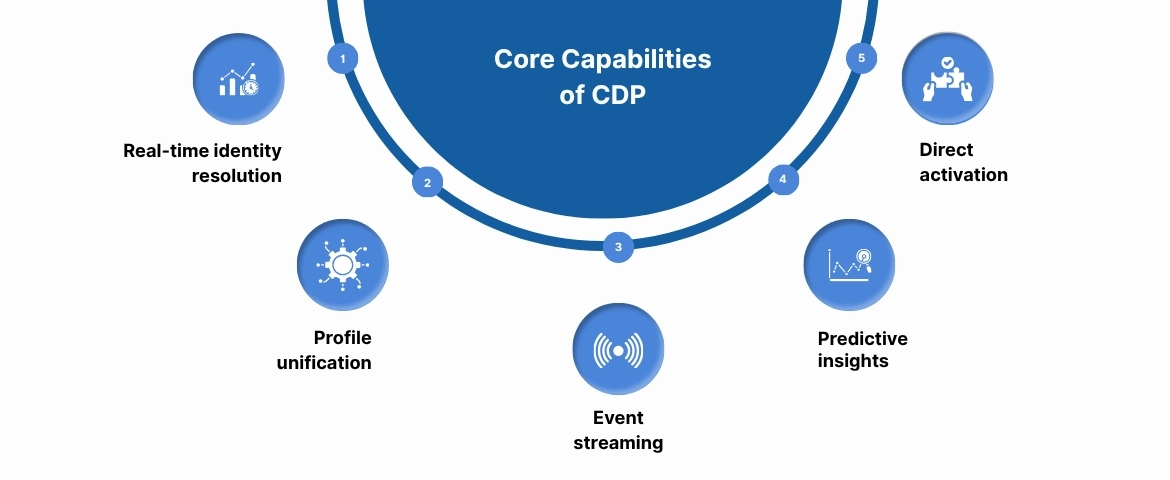
- Real-time identity resolution: Matches customer identifiers across web, app, email, and backend systems.
- Profile unification: Combines events, traits, and history into a single, continuously updated profile.
- Event streaming: Sends clean, structured events to analytics, ads, and internal systems without client-side fragility.
- Predictive insights: Uses behavioral patterns to forecast churn, conversions, or product intent.
- Direct activation: Pushes segments to ad platforms, email tools, personalization engines, and BI systems.
These capabilities make a CDP a long-term data layer rather than an adtech-only tool.
Who Uses CDPs
CDPs serve teams that rely on accurate, durable customer understanding:
- Growth teams looking to optimize journeys and attribution
- CRM teams building targeted lifecycle programs
- Lifecycle marketers driving personalized engagement
- E-commerce and SaaS teams unifying product and marketing data for better decision-making
Each of these teams needs clean, consented, identity-resolved customer data, something a CDP is uniquely designed to provide.
What Is a Data Management Platform (DMP)
A Data Management Platform (DMP) is a system built to collect and organize large volumes of anonymous audience data, mainly for advertising use cases. Unlike CDPs, which rely on persistent, person-level identifiers, DMPs work with short-lived data such as cookies, device IDs, and third-party audience attributes.
Historically, DMPs powered programmatic advertising by helping marketers build broad audience segments, enrich them with third-party datasets, and deliver targeted campaigns across ad networks. Their strength lies in reach rather than precision, which made them essential in the era of cookie-based advertising.
As browsers restrict tracking and regulators tighten data rules, the traditional DMP model faces limits. However, it still plays a role in campaigns that depend on anonymous, large-scale audience targeting.
Core Capabilities of DMP
A DMP focuses on functions tied to advertising and audience reach:
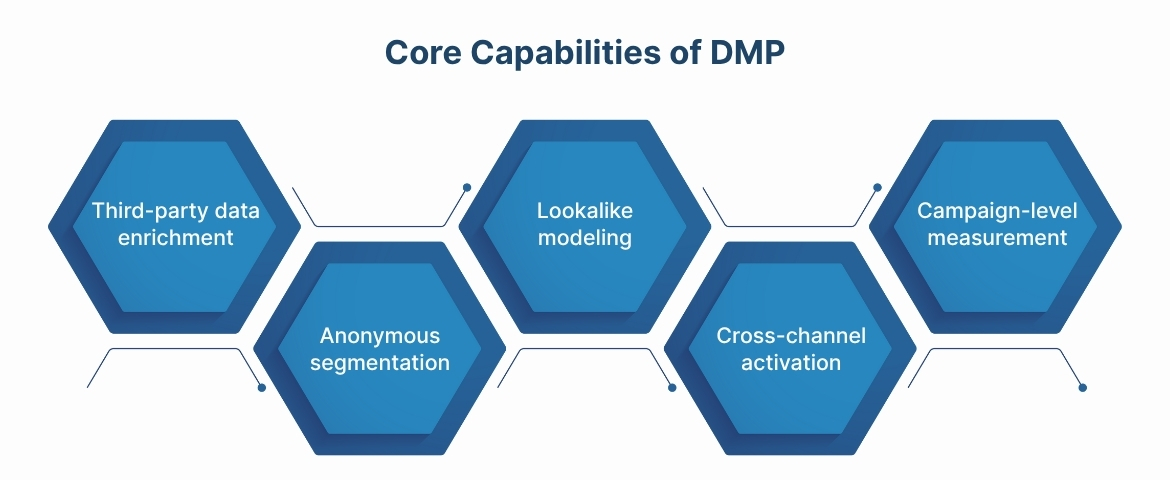
- Third-party data enrichment: Adds demographic or interest-based attributes from data brokers.
- Anonymous segmentation: Creates audience groups using cookie- and device-level behaviors.
- Lookalike modeling: Identifies prospects similar to your existing converters.
- Cross-channel activation: Sends audience segments to programmatic platforms and ad networks.
- Campaign-level measurement: Provides high-level insights across impressions and ad performance.
Who Uses DMPs
DMPs serve teams focused on paid media performance and large-scale audience targeting:
- Performance marketers running display and programmatic campaigns
- Media buyers handling cross-channel ad spend
- Agencies managing targeting for multiple brands
- Paid acquisition teams building top-of-funnel reach
These teams rely on DMPs when they need broad, anonymized segmentation rather than individualized customer understanding.
CDP vs DMP: The Key Differences That Matter Today
CDPs and DMPs both process customer data, yet the logic behind how they collect, store, and activate that data is fundamentally different. These differences shape how marketers target audiences, measure performance, and maintain compliance as the industry shifts toward privacy-first models. Below is a breakdown of the distinctions that influence real-world outcomes for marketing and analytics teams.
1. Data Sources
A CDP draws primarily from first-party and zero-party data that customers share directly through websites, apps, CRM records, support tools, and offline systems. This data includes behavioral signals, purchase history, and profile attributes tied to identifiable users. Because the data comes from owned sources, teams get information that is accurate, consented, and directly relevant to how customers interact with their brand.
A DMP leans heavily on third-party and pseudonymous data sourced from partner networks, external data brokers, and advertising platforms. The system receives cookies, device identifiers, browsing categories, and other probabilistic signals. These records are useful for a broad audience reach, but their external origin makes them less reliable and more vulnerable to privacy restrictions.
Example: An online furniture store uses its CDP to combine purchase history, support chats, and loyalty data to understand which customers prefer modern designs. The same store uses a DMP to reach a large pool of anonymous users labeled as “home décor enthusiasts” based on browsing activity across unrelated websites.
2. Data Retention
A CDP retains data over long periods, allowing teams to track multi-year buying patterns, analyze lifecycle behavior, and build segments that reflect the full customer relationship. Because profiles persist, marketers gain visibility into recurring habits, high-value cohorts, and product interests that emerge over time.
A DMP keeps data for a short duration, commonly around sixty to ninety days, because it focuses on real-time audience availability in advertising platforms. The value of the data decreases quickly as user interests evolve and cookie identifiers expire. It supports rapid campaign adjustments rather than long-term analysis.
Example: A car brand uses its CDP to identify customers who upgrade their vehicles every 4 years, based on 10 years of service and purchase records. Its DMP focuses only on users who searched for car reviews in the past month, which helps short-term retargeting but offers no long-term visibility.
3. Identity and Tracking
A CDP builds identity-resolved profiles using deterministic identifiers such as email addresses, customer IDs, login data, and consented device links. Since these identifiers are stable, the system can merge sessions, channels, and touchpoints into a single profile without guesswork. This creates a reliable view of each customer’s journey.
A DMP tracks anonymous audiences through cookies, device IDs, and inferred classifications. Because the data lacks personal identifiers, each user is represented as a temporary record that may change or disappear when cookies are cleared. The system can identify patterns at the group level but cannot connect actions back to a specific individual.
Example: A travel company’s CDP recognizes that a logged-in user checked flights on mobile, compared desktop prices, and booked through the app. Its DMP only sees that a user in an “international travel interest” bucket viewed several travel blogs in the past week.
4. Privacy and Compliance
A CDP operates within a clear consent framework because it works with data users who knowingly share. Modern CDPs include controls for consent capture, suppression, data deletion, and regulatory reporting. This structure helps teams stay aligned with GDPR, CCPA, and other privacy requirements without interrupting their workflows.
A DMP faces stricter limitations because it depends on third-party and cookie-based data that users often did not directly authorize. Sourcing practices vary across networks, making it harder to guarantee compliance. As browsers restrict tracking, the amount of usable data inside DMPs continues to decline.
Example: A subscription brand uses its CDP to honor opt-outs, delete user data upon request, and adjust journeys based on updated consent preferences. Meanwhile, its DMP loses significant reach when Safari and Chrome block third-party cookies for users who never opted into tracking.
5. Activation
A CDP activates data across owned and paid channels by pushing identity-resolved profiles to CRM tools, email platforms, analytics systems, personalization engines, and advertising APIs. Because every activation uses consistent, verified user data, customers receive coherent messaging across the entire experience.
A DMP activates data inside paid media ecosystems such as DSPs and ad exchanges. Advertisers use its anonymous segments to reach large prospect audiences across display networks. Activation is optimized for reach rather than individualized relevance.
Example: A SaaS company uses its CDP to trigger onboarding emails, product tips, renewal nudges, and paid media retargeting from a single unified profile. At the same time, its DMP powers campaigns that target “B2B software researchers” across advertising networks to expand top-of-funnel reach.
6. Accuracy and Long-Term Value
A CDP maintains accuracy because it relies on verified identifiers and consented behavioral signals. As the platform accumulates data, the quality of predictions, personalization models, and segmentation improves. This makes the CDP a durable foundation for attribution, retention, and lifecycle marketing.
A DMP loses accuracy as cookies expire and third-party data becomes harder to validate. Audience pools shrink, probabilistic matches weaken, and campaign performance becomes less predictable. The short lifespan of data limits its strategic value, especially in environments where privacy rules continue to expand.
Example: An e-commerce brand uses its CDP to run predictive models across years of purchase and browsing behavior, helping identify customers at risk of churn. Its DMP struggles to maintain a stable audience for retargeting as browser-level restrictions remove most third-party tracking identifiers.
CDP vs DMP: Quick Comparison Table
| Category | CDP (Customer Data Platform) | DMP (Data Management Platform) |
|---|---|---|
| Primary Data Sources | First-party and zero-party data from websites, apps, CRM, support systems, product analytics, and offline events | Third-party and pseudonymous data from data brokers, partner networks, and ad exchanges |
| Data Characteristics | Structured and identifiable; tied to real customers | Anonymous, probabilistic, and aggregated |
| Data Retention | Long-term storage supports multi-year profiles and historical analysis | Short-term retention (60–90 days); optimized for recent activity |
| Identity Model | Deterministic identity resolution using email, customer IDs, and login data | Anonymous buckets based on cookies and device IDs; relies on probabilistic matching. |
| User Profiles | Persistent profiles that accumulate behavior, preferences, and consent | Temporary segments without personal identifiers |
| Privacy Alignment | Built around consent, user rights, and GDPR/CCPA compliance | Challenged by cookie loss and limited transparency in third-party data sourcing |
| Activation Channels | Email, CRM, personalization systems, analytics tools, server-side ads | DSPs, ad exchanges, retargeting platforms, programmatic media |
| Use Case Strengths | Personalization, lifecycle automation, attribution, retention, and customer insights | Broad reach, prospecting, lookalike modeling, top-of-funnel ads |
| Accuracy Over Time | Improves as profiles grow with verified signals | Decreases as cookies degrade and third-party data shrinks |
| Typical Users | Growth teams, CRM teams, lifecycle marketers, e-commerce, and SaaS teams | Performance marketers, media buyers, agencies, and paid acquisition teams |
When Should a Business Choose a CDP?
A CDP becomes the stronger choice in scenarios where customer understanding, identity accuracy, and long-term data ownership drive performance. Here are the situations where a CDP fits naturally:
- First-party data strategy: A CDP is the right fit for teams building a durable, consented data foundation from website, app, CRM, and product activity.
- Personalized customer journeys: Ideal for brands that depend on tailored emails, onsite experiences, and lifecycle flows powered by identity-resolved profiles.
- Reliable attribution: E-commerce and SaaS teams use CDPs to connect events across devices and channels for accurate conversion tracking.
- Unified marketing + product insights: Useful for SaaS companies bringing product analytics, CRM data, and marketing signals into one customer record.
- Privacy-aligned data operations: CDPs simplify consent tracking, data rights management, and audit readiness.
- Real-time activation: Strong choice for teams automating onboarding, abandonment workflows, loyalty messages, and other time-sensitive actions.
When Is a DMP Still Useful?
Although DMPs face limitations in a privacy-restricted ecosystem, they still offer value in scenarios where broad, anonymous reach is the primary objective. Their ability to work with large pools of pseudonymous data makes them suitable for advertisers focused on scaling campaigns quickly and efficiently. These are the scenarios where a DMP remains relevant:
- Broad programmatic advertising: DMPs support large-scale reach across DSPs and ad exchanges using high-volume anonymous audiences.
- Top-of-funnel growth: Effective for awareness campaigns that prioritize scale over identity-level precision.
- Third-party audience enrichment: Helpful for advertisers relying on interest-based or category-based segments sourced from external networks.
- Short campaign cycles: Suitable for seasonal promotions or short-run offers where short-term audience data is sufficient.
- Multi-brand agency workflows: Agencies use DMPs to maintain shared, anonymized audience clusters that can be reused across clients.
How to Choose the Right Platform for Your Business
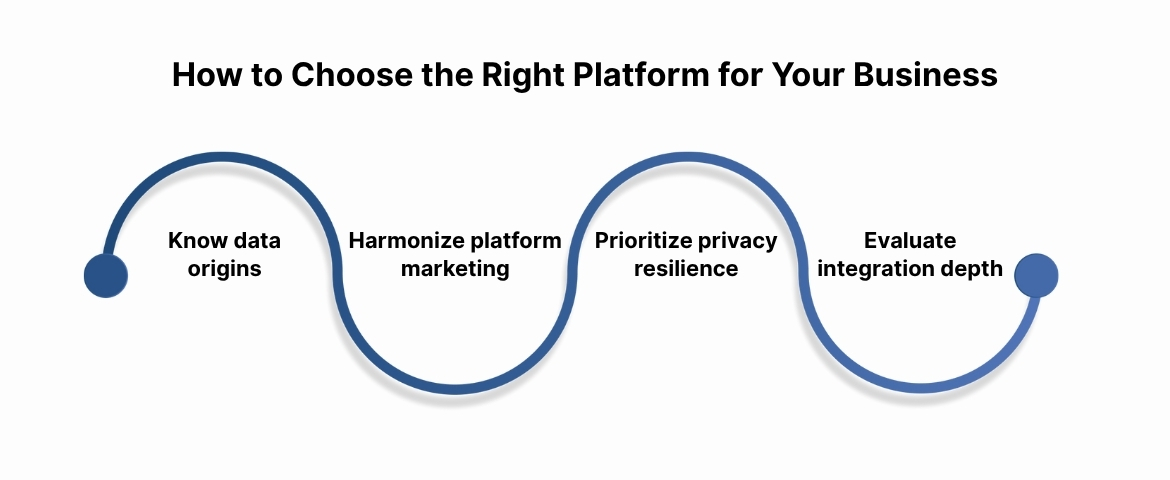
Selecting between a CDP and a DMP comes down to how your organization collects data, what you expect from your marketing engine, and how prepared you need to be for privacy changes. A thoughtful evaluation prevents teams from investing in a system that won’t scale with their data strategy.
1. Understand where your data comes from
Start by mapping the sources that feed your marketing and analytics workflows. A CDP is the stronger fit if your stack depends on website activity, app events, CRM records, product usage, or customer support data. These signals originate directly from your users and benefit from a platform built around identity resolution and consent tracking.
A DMP fits better if your growth strategy leans on third-party audiences, interest categories, or broad demographic clusters sourced from external networks.
2. Align the platform to your marketing objectives
Different goals require different data foundations. A CDP supports personalization, lifecycle automation, retention programs, predictive insights, and any initiative that needs a unified customer profile.
A DMP supports large-scale prospecting, awareness-driven campaigns, and reach-focused programs where precision matters less than volume.
Teams running both upper-funnel and retention-focused programs often use a CDP for owned channels while relying on a DMP to expand their advertising footprint.
3. Factor in privacy and long-term resilience
Modern data governance demands tools that can prove where data came from and how it is used. CDPs excel here because they operate on first-party and zero-party data with transparent consent mechanisms. They give teams the controls needed to honor deletion rights, update preferences, and maintain clean audit trails.
DMPs offer reach but face structural limits as browsers restrict third-party tracking and regulators tighten cross-site data sharing.
4. Evaluate integration depth and scalability
A useful data platform is one that connects cleanly to your existing tools and scales with your growth.
A well-architected CDP offers real-time syncing, open APIs, and the ability to pass consistent customer profiles into email platforms, analytics tools, CRMs, personalization engines, and server-side advertising endpoints.
A DMP needs strong integrations with DSPs and ad exchanges, especially if paid media is your primary demand driver.
Conclusion
CDPs and DMPs solve different problems. CDPs use first- and zero-party data to build identity-resolved customer profiles for personalization, attribution, and lifecycle marketing. DMPs rely on third-party, anonymous data to deliver broad audience reach across programmatic and paid media.
Many businesses use both: a CDP anchors customer understanding across email, CRM, web, and product experiences, while a DMP expands top-of-funnel prospecting. Together, they create a full-funnel strategy that balances relevance with reach.
As privacy rules tighten and client-side tracking fades, teams need data foundations that stay accurate, compliant, and resilient. That’s where Ingest Labs fits. Ingest Labs isn’t a CDP; it strengthens your CDP by delivering server-side events, durable identity, and unified first-party streams. By handling event delivery and identity stitching, Ingest Labs gives your CDP cleaner data and gives paid channels accurate conversion signals, helping your organization maintain consistency, improve attribution, and prepare for a cookieless world without rebuilding your stack.
Explore how Ingest Labs helps teams build reliable, privacy-first customer data pipelines. Contact Today.
FAQs
1. Is a CDP the same as a CRM?
No. A CRM manages sales interactions and pipeline data, while a CDP unifies behavioral, transactional, and product-level events from every customer touchpoint. A CDP supports marketing, analytics, and product teams—not just sales.
2. Can a CDP replace a DMP?
A CDP can replace parts of a DMP’s functionality, especially for retargeting and personalization, but it cannot fully replicate broad third-party audience reach. Many companies still use a DMP for upper-funnel campaigns while relying on a CDP for customer-level engagement.
3. Do CDPs support paid advertising platforms?
Yes. Modern CDPs can send server-side events, conversion signals, and audience segments to ad platforms like Meta, Google, and TikTok. This improves accuracy even when cookies degrade.
4. Are DMPs becoming obsolete with the loss of third-party cookies?
DMPs are losing some effectiveness, but not disappearing entirely. They remain useful for large-scale, anonymous reach in programmatic environments. Their role is shrinking, but they are still relevant for advertisers focused on broad prospecting.
5. How does server-side tracking improve CDP performance?
Server-side pipelines reduce data loss, bypass browser restrictions, and preserve identity signals that client-side scripts often miss. This gives the CDP cleaner events, more complete profiles, and more reliable attribution.