




Why do B2B teams collect large amounts of customer data, yet still struggle to turn it into insights they can use every day? Customer data sits across marketing tools, sales systems, analytics platforms, and support channels, making it difficult to understand the full buying journey.
This lack of visibility slows decisions, obscures buying intent, and forces teams to rely on reports that arrive after critical moments have passed. In B2B, the problem grows as purchases involve multiple decision-makers, long sales cycles, and privacy rules that limit common tracking methods.
The real challenge is not the volume of data, but making insights available at the moment teams need to act. This blog explains how B2B Customer Data Platforms help teams bring data together and activate insights in real time across marketing and sales.
Key takeaways
- B2B Customer Data Platforms help teams turn scattered customer data into insights they can act on across marketing and sales.
- Unlike traditional tools, B2B CDPs focus on long buying cycles, multiple decision-makers, and account-level visibility.
- Insight activation depends on first-party data, real-time processing, and privacy-compliant data collection.
- B2B CDPs close the gap between reporting and action by making insights available when buyers show intent.
- Platforms like Ingest Labs support insight activation by unifying first-party data while reducing operational and technical complexity.
What is a B2B Customer Data Platform (CDP)?
A B2B Customer Data Platform is a system that unifies first-party customer data from multiple sources into a single, actionable view for marketing and sales teams.
Unlike CRMs or analytics tools, a B2B CDP focuses on how buyers behave across time, channels, and decision stages. It relies primarily on first-party data, which supports more reliable insights as third-party tracking continues to decline.
What Makes B2B CDP Insight Activation Different?
B2B insight activation looks different from B2C because buying behavior follows a slower, more complex path.
1. Accounts matter more than individuals. B2B CDPs track activity across companies, not just single users, helping teams understand account-level intent.
2. Multiple decision-makers shape each purchase. Insights must connect actions from several stakeholders to show real buying progress.
3. Sales cycles stretch across weeks or months. B2B CDPs preserve data over time, preventing insight loss between early interest and final decisions.
4. Sales and marketing depend on shared signals. Activated insights support alignment by giving both teams access to the same customer context.
5. Privacy regulations limit how data can be collected and activated, increasing reliance on first-party, consent-aware data.
These differences explain why insight activation in B2B requires more than dashboards or delayed reports.
Next, let’s look at how B2B CDPs actually turn raw data into insights teams can act on every day.
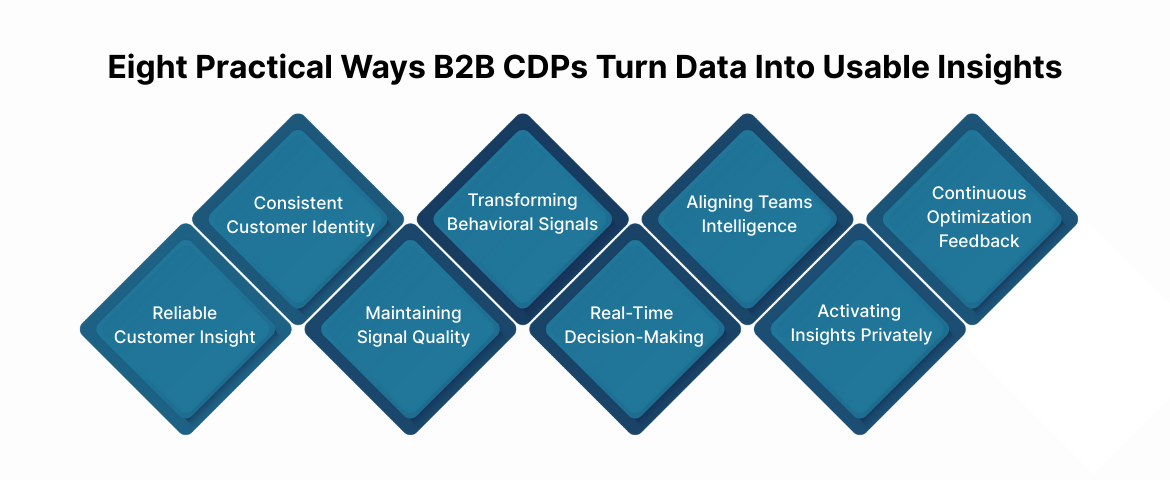
Eight Ways B2B CDPs Turn Customer Data Into Usable Insights
B2B organizations generate large volumes of customer data, but leadership value comes from how quickly and reliably teams can act on it. B2B Customer Data Platforms support this shift by strengthening data quality, preserving context, and supporting timely decision-making across teams.
1. Creating a Reliable Foundation for Customer Understanding
B2B CDPs bring customer data from websites, applications, marketing tools, and internal systems into one controlled environment. Platforms that support server-side data collection, such as Ingest IQ, help reduce data loss caused by browser restrictions and inconsistent tagging.
This foundation improves confidence in reported activity and supports clearer decision-making at the leadership level. Without dependable data inputs, insight activation remains unreliable and difficult to scale.
2. Establishing Consistent Customer and Account Identity
Enterprise teams often struggle to connect activity across devices, sessions, and platforms. B2B CDPs address this by assigning consent-aware, first-party identifiers that persist across sessions and devices.
This approach helps leadership teams understand engagement across people, roles, and time. Accurate identity resolution strengthens attribution and improves confidence in pipeline and performance reporting.
3. Preserving Signal Quality Across Long Buying Journeys
B2B decisions rarely follow a single session or channel. B2B CDPs maintain customer context across extended sales cycles, capturing early interest and later evaluation signals together.
This continuity allows leaders to assess momentum and engagement trends at the account level. Insights become more predictive when they reflect the full decision timeline rather than isolated touchpoints.
4. Turning Behavioral Data Into Meaningful Engagement Signals
Raw activity data has limited value without interpretation. B2B CDPs analyze user actions to identify patterns that indicate intent or readiness.
Leadership teams gain clearer visibility into which accounts are progressing and which are stalling. These insights support better prioritization without requiring manual analysis or assumptions.
5. Enabling Timely Decision-Making With Real-Time Data Access
Delayed insights limit strategic response. B2B CDPs process and surface data as events occur, enabling faster adjustments to outreach and engagement strategies.
This real-time access supports informed decisions during active buying windows, giving leaders visibility into current buying conditions rather than delayed summaries.
6. Aligning Teams Around Shared Customer Intelligence
Disconnected systems often lead to inconsistent interpretations of customer readiness.
B2B CDPs provide a shared view of engagement across marketing, sales, and analytics teams.
This alignment reduces friction and improves coordination across revenue functions. Leadership teams gain confidence that decisions rely on a consistent understanding of customer behavior.
7. Supporting Insight Activation Within Privacy Constraints
Data privacy expectations continue to shape how organizations operate. B2B CDPs rely on first-party data and consent-aware processes, similar to those supported by Ingest Labs’ privacy-aware platform design.
This approach lowers risk while preserving the ability to measure and optimize engagement. For leadership, this balance supports growth without exposing the organization to compliance concerns.
8. Creating Feedback Loops for Ongoing Optimization
Activated insights improve when teams measure outcomes and adjust strategies over time. B2B CDPs track responses to campaigns, outreach, and engagement across channels.
These feedback loops help refine targeting, messaging, and resource allocation. Over time, insight activation evolves from operational support into a sustained performance advantage.
With insight activation in place, the next step is applying these signals to drive measurable business outcomes.
Also Read: CDP vs DMP Comparison Guide for Modern Marketing Teams
In the following section, we’ll examine how B2B CDPs translate activated insights into revenue impact, retention, and growth.
Five Ways B2B CDPs Turn Insights Into Real Business Impact
Activated insights matter only when they influence outcomes across revenue, retention, and growth. B2B Customer Data Platforms support this shift by connecting signals to action.
1. Powering Account-Based Marketing With Behavioral Intelligence
Account-based strategies depend on understanding how accounts engage over time. B2B CDPs reveal which companies show consistent interest across content, product pages, and digital touchpoints.
These insights help marketing teams focus resources on accounts that demonstrate real buying signals. As a result, outreach becomes more relevant and aligned with where buyers stand in their decision process.
2. Triggering Real-Time Sales Alerts and Nurture Sequences
Timing plays a critical role in B2B conversions. B2B CDPs enable teams to respond when accounts reach meaningful engagement thresholds.
Sales teams receive alerts when activity indicates readiness, while marketing can adjust nurture paths automatically. This coordination reduces delays and increases the chance of engaging buyers at the right moment.
3. Orchestrating Omnichannel Engagement at Scale
B2B buyers interact across email, websites, ads, and sales conversations. B2B CDPs help teams maintain consistency across these channels by using shared customer insights.
Messaging aligns with current engagement rather than generic assumptions. This coordination improves buyer experience while reducing confusion and message overlap.
4. Activating Propensity Scores for Pipeline Prioritization
Not all accounts deserve equal attention at the same time. B2B CDPs use engagement patterns to estimate which accounts are most likely to progress.
These scores help teams prioritize outreach, allocate effort, and forecast the pipeline more accurately. Leadership teams gain clearer visibility into where resources will have the greatest impact.
5. Enabling Predictive Churn Prevention and Expansion Plays
Customer behavior often signals risk or opportunity before outcomes appear. B2B CDPs track changes in engagement that indicate declining interest or growing adoption.
These insights support proactive retention efforts and timely expansion outreach.
Teams move from reactive responses to planned, data-informed actions.
Platforms like Ingest Labs support this level of insight activation by unifying first-party data, enabling real-time access, and supporting privacy-safe decision-making across teams.
With the business impact established, the next step is to ensure that insight activation remains effective over time.
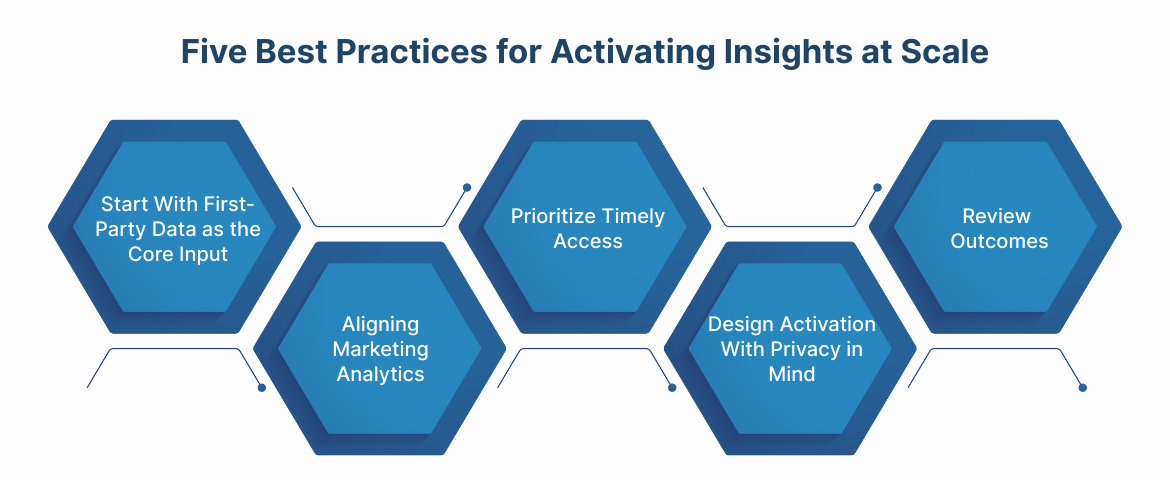
Five Best Practices for Activating Insights at Scale
Activating insights is not a one-time setup. It requires clear structure, reliable data, and consistent use across teams. These best practices help B2B organizations sustain insight quality and turn data into repeatable business impact.
1. Start With First-Party Data as the Core Input
First-party data provides the most reliable view of customer behavior. It comes directly from owned channels such as websites, products, and applications.
Using this data reduces dependency on unstable tracking methods and improves long-term accuracy. A strong first-party foundation ensures insights remain usable as privacy standards evolve.
2. Align Marketing, Sales, and Analytics Around Shared Signals
Insight activation breaks down when teams rely on different data sources. Organizations should define a shared set of customer signals that guide decisions across teams.
This alignment reduces confusion and improves coordination during handoffs. When teams act on the same signals, insights lead to faster and more consistent outcomes.
3. Prioritize Timely Access Over Perfect Reporting
Delayed insights often lose their value. Teams should focus on making key signals available when buyers are active.
Real-time access supports faster response and better decision timing during active buying moments. Clear, timely signals often drive stronger results than detailed reports delivered too late.
4. Design Activation With Privacy in Mind
Privacy requirements influence how insights can be collected and used. Teams should build activation strategies that respect consent and regional regulations.
This approach protects customer trust while preserving data quality. Privacy-aware design ensures insight activation can scale without increasing risk.
5. Review Outcomes and Refine Activation Regularly
Insight activation improves through ongoing evaluation. Teams should review which signals lead to engagement, conversion, or drop-off.
This feedback helps refine targeting, timing, and engagement strategies. Regular review turns insight activation into a continuous improvement process.
When teams follow these practices, insight activation becomes more consistent and easier to scale across the organization.
Also Read: The Difference Between Client-Side and Server-Side Tracking
However, sustaining insight activation across teams requires infrastructure that supports data reliability, speed, and privacy by design.
How Ingest Labs Supports Insight Activation
Activating insights at scale often breaks down due to unreliable data collection, fragmented customer identity, delayed visibility, and growing privacy constraints.
These challenges make it difficult for teams to maintain consistent insight activation across long buying cycles and multiple engagement channels.
Ingest Labs addresses these obstacles by providing a unified, first-party data foundation designed for real-time insight activation in privacy-regulated environments. Our platform simplifies how teams collect, connect, and activate customer data without adding operational or technical complexity.
Ingest Labs supports insight activation through:
- Server-side tracking with Ingest IQ to improve data reliability and reduce signal loss caused by browser limitations
- Persistent first-party identifiers with Ingest ID to maintain accurate customer and account context across sessions and devices
- Real-time event tracking and intelligence via Event IQ to surface meaningful engagement signals as they occur
- Built-in privacy-aware workflows and consent handling to support alignment with regulations such as GDPR and CCPA
- Seamless data integration and orchestration across analytics tools, CRMs, and marketing platforms
- Low-code and no-code implementation options that reduce dependency on engineering teams and speed up execution
Together, these capabilities help organizations apply insight activation practices consistently while maintaining data accuracy, privacy compliance, and operational efficiency.
Conclusion
Customer data is no longer the core problem for B2B teams; acting on it at the right time is. When insights remain scattered across tools or locked in delayed reports, teams miss chances to act when buyer interest is highest.
B2B CDPs help close this gap by bringing data together, keeping it reliable, and making insights usable across marketing and sales. They support better timing, clearer priorities, and stronger alignment across revenue teams.
However, as privacy rules tighten and buying journeys grow more complex, insight activation depends less on collecting more data and more on using existing data well.
If you’re exploring better ways to activate insights across your teams, you can schedule a demo with Ingest Labs to see how first-party data, real-time visibility, and privacy-aware design come together in practice.
FAQs
1. Is a B2B CDP necessary if we already use a CRM?
CRMs manage known leads and accounts, while B2B CDPs unify behavioral, anonymous, and first-party data across channels to activate real-time insights beyond sales workflows.
2. How long does it take to see value from a B2B CDP?
Many teams begin seeing improvements in data quality, attribution, and engagement within weeks, depending on implementation scope and data maturity.
3. Can small or mid-sized B2B teams benefit from CDPs?
Absolutely. Modern B2B CDPs are designed for lean teams, removing engineering dependencies while enabling enterprise-grade data activation and compliance.
4. How do B2B CDPs handle data privacy and consent?
B2B CDPs built for regulated markets embed consent management, data governance, and privacy controls directly into data collection and activation workflows.
5. What’s the difference between a B2B CDP and a data warehouse?
A data warehouse stores data. A B2B CDP unifies, enriches, and activates that data in real time across marketing, sales, and engagement channels.