




Attribution analytics helps you understand which campaigns, channels, and messages actually move prospects toward conversion and revenue. When you treat attribution analytics as a core measurement discipline, you stop guessing and start funding the touchpoints that truly pay off.
This guide explains how attribution analytics works, which models you can use, and how to ensure measurement compliance with US and Canadian privacy rules. You will also see how platforms like Ingest Labs simplify multi-channel attribution using first-party data and server-side tracking, without heavy engineering overhead.
Key Takeaways
- Attribution analytics assigns credit for conversions and revenue to specific touchpoints across a customer journey, based on a defined model.
- Rule-based models help you start fast, but they trade accuracy for simplicity. First-touch and last-touch give a narrow view, while linear, time-decay, U-shaped, and W-shaped spread credit differently.
- Advanced attribution needs more than models. Data-driven methods and incrementality tests help you separate "credited" from "caused," especially when channels overlap.
- Privacy laws such as GDPR and CCPA/CPRA require consent-aware tracking and clear disclosure, which affects how you collect and use attribution data.
- In this evolving privacy environment, server-side data via Ingest IQ, unified profiles with Ingest ID, and rich insights from Event IQ enable more stable, compliant attribution.
What is Attribution Analytics?
Attribution analytics is the process of assigning credit for a conversion or revenue outcome to specific marketing touchpoints along the customer journey. Teams decide which touchpoints count, select an attribution model, and apply that model to distribute credit across channels such as search, social, email, and paid media.
From a business point of view, attribution analytics answers two questions: which activities actually drive profitable conversions, and how should you allocate future spend across your portfolio. Instead of simply looking at last-click reports, attribution analytics helps you see where awareness, mid-funnel engagement, and repeat purchases are coming from.
Once attribution analytics is defined, the real question becomes how it changes the way you fund channels, justify spend, and explain results to stakeholders.
Moving beyond last-click reporting requires tying revenue to real customer journeys using first-party identifiers such as Ingest ID and multi-touch analysis in Event IQ.
Why Attribution Analytics Matters for Your Business
You invest heavily across paid search, paid social, organic content, marketplaces, affiliates, and email. Attribution analytics shows which investments drive incremental conversions, allowing you to reallocate budget with confidence. Without attribution analytics, you often overfund last-touch channels and underfund prospecting or mid-funnel campaigns that actually drive long-term revenue.
Attribution analytics also matters because your board and finance partners want proof that marketing spends tie to revenue and margin. When you present channel performance using a clear attribution model, you can defend spend levels, negotiate higher budgets, and shut down tactics that only look good in siloed dashboards.
From a privacy standpoint, attribution analytics forces you to rethink how you collect and process user-level data in the US and Canada. Laws like GDPR and CCPA/CPRA require consent, opt-outs, and transparency, so you need attribution analytics that runs on first-party identifiers instead of opaque third-party cookies.
Knowing why attribution analytics matters is only useful if you understand how the data flows from user actions to reporting and decision-making.
How Does Attribution Analytics Work?
Attribution analytics starts with event data: page views, clicks, ad impressions, sign-ups, purchases, and other tracked actions across your touchpoints. Your tools record these events with identifiers, time stamps, channels, and campaign parameters so you can reconstruct journeys for each user or account.
Next, you define what counts as a conversion: a purchase, a qualified lead, a subscription start, or another key event. Attribution analytics then connects each conversion back to the user's previous touchpoints and applies your chosen attribution model to assign credit.
In many setups, you split the process into:
- Data collection: Capturing events through tags, SDKs, or server-side tracking with Ingest IQ.
- Identity resolution: Connecting events using first-party identifiers such as Ingest ID or CRM IDs.
- Modeling and reporting: Assigning credit and analyzing results in tools like Event IQ or BI platforms.
Attribution analytics pulls all three pieces together, so you see, for example, that one sale should count 40 percent to paid search, 30 percent to email, and 30 percent to paid social.
After data is collected and identities are resolved, the attribution model determines how credit gets distributed across the journey.
When browser cookies fall short, server-side tracking and first-party identity resolution provide more stable attribution as browsers and privacy rules evolve. Tools like Ingest IQ and Ingest ID are built for this exact shift.
Attribution Modeling Frameworks & How They Compare
Attribution analytics relies on modeling frameworks. You use these frameworks to assign credit to interactions in the customer journey.
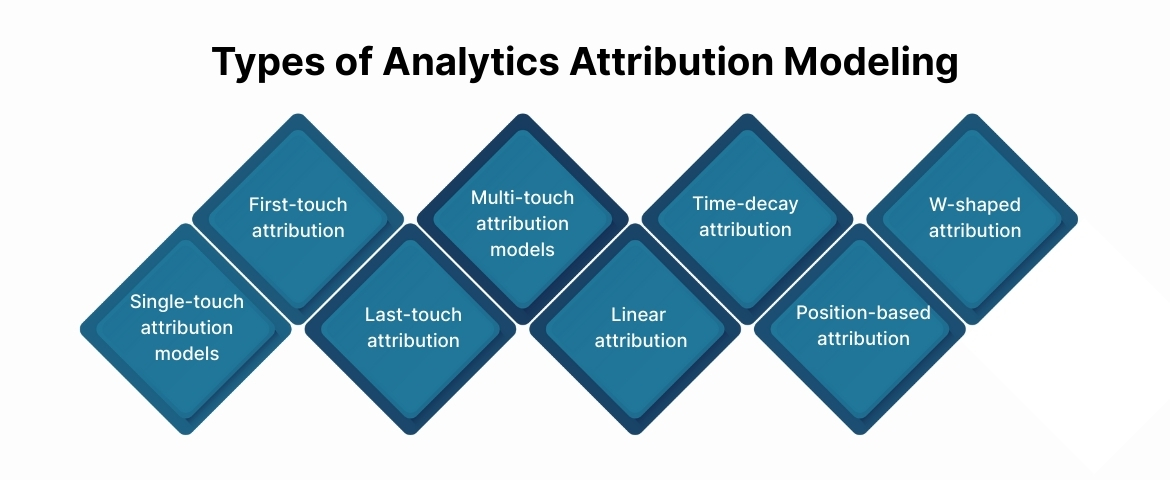
You track touchpoints like emails, video views, display ads, and content downloads. Models help you quantify their role in conversions. These models differ by approach. Attribution models fall into single-touch and multi-touch categories.
Single-touch attribution models
Single-touch models assign all credit to one touchpoint. You use them for short, direct customer journeys. They help you spot top or bottom funnel drivers.
First-touch attribution
First-touch attribution gives 100 percent credit to the initial tracked interaction.
- You spot channels that build awareness.
- You bring new prospects into your funnel.
Cross-device behavior and cookie deletions make true first-touch hard to capture. Privacy rules under CCPA add opt-out requirements that limit tracking. Long sales cycles over 90 days weaken this model.
Last-touch attribution
Last-touch attribution credits the final interaction before conversion 100 percent.
- You identify tactics that trigger purchases.
- You optimize bottom-funnel spend.
It overlooks early nurturing efforts. Under CCPA, you must honor opt-outs for sharing data used in these reports.
Multi-touch attribution models
Multi-touch models spread credit across several touchpoints. You apply them to complex, non-linear journeys. They reflect how multiple channels contribute.
Privacy laws complicate precise credit assignment. GDPR requires consent for tracking, and CCPA and CPRA introduce expanded opt-out rights and enforcement requirements that complicate precise attribution, especially when consent signals are missing. Offline factors remain hard to include.
Linear attribution
Linear attribution divides credit equally among all touchpoints.
- You see every channel's involvement.
- You get a simple multi-touch view.
It treats a quick social view the same as a deep demo. You can stream linear model data from Event IQ for consent checks.
Time-decay attribution
Time-decay attribution weights recent touchpoints higher.
- You credit actions near conversion more.
- You match short sales cycles.
Early brand efforts get less weight. Decay rates may not fit your cycle. CCPA opt-outs affect recent event data.
Position-based attribution
Position-based attribution gives 40 percent each to first and last touchpoints. It shares 20 percent across the middle.
- You value start and close interactions.
- You balance ends of the journey.
Mid-funnel nurturing suffers. You can test this in Event IQ with US consent data.
W-shaped attribution
W-shaped attribution credits 30 percent each to first touch, lead creation, and opportunity creation. It spreads 10 percent elsewhere.
- You highlight key B2B stages.
- You track longer cycles.
Post-opportunity touches get low weight. Implementation grows complex.
To effectively apply attribution analytics, it's crucial to choose the right model while avoiding common pitfalls that can distort results.
Common Attribution Analytics Mistakes to Avoid
Attribution analytics is a powerful tool, but it's easy to make mistakes that can skew results and mislead decision-making. To get the most out of your attribution strategy, avoid these common pitfalls.
- Overrelying on Last-Touch Attribution: Last-touch attribution often ignores critical touchpoints earlier in the funnel, leading to an incomplete view of the customer journey.
- Ignoring Data Quality: Relying on inaccurate or incomplete data can result in faulty insights and poor budgeting decisions.
- Not Accounting for Privacy Laws: Failing to comply with privacy regulations like GDPR and CCPA can result in data loss or invalid attribution, leaving gaps in your tracking.
- Choosing the Wrong Model for Your Sales Cycle: Some models work better for short sales cycles, while others are suited for longer ones. Using the wrong model can misrepresent your data.
- Lack of Cross-Channel Integration: Attribution across separate tools and platforms without proper integration can lead to fragmented data and a disjointed understanding of performance.
To avoid these mistakes, take a thoughtful approach to model selection, ensure data quality, and stay compliant with privacy standards to generate accurate insights. By doing so, you'll be able to optimize your marketing spend with confidence.
After understanding common attribution mistakes, selecting the appropriate rule-based model will help refine your strategy for better results.
Choosing the Right Rule-Based Attribution Model
You rarely start with data-driven attribution because you may not yet have the volume, quality, or consented data needed for reliable models. Instead, you begin with rule-based attribution analytics that match your sales cycle and marketing mix.
For example, if you run heavy prospecting and want to reward awareness, first-touch attribution analytics will highlight channels that introduce new users into your funnel. If your sales cycles are short and your remarketing is strong, last-touch attribution analytics might align better with actual business impact.
Linear attribution works well when many touchpoints contribute roughly equal weight, and you want to avoid overemphasizing any single interaction. Time-decay models are suited to long buying cycles where touches closer to conversion matter more, such as B2B pipelines or high-ticket consumer products.
When you pick a rule-based model for your attribution analytics, you should consider:
- Typical journey length from first touch to conversion.
- Number of channels and campaigns in play.
- Stakeholders you need to convince, such as finance or sales.
Advanced attribution techniques
As data quality and consent coverage improve, teams can move beyond rule-based models toward more advanced attribution techniques. Advanced approaches allow you to estimate incrementality, understand offline and online together, and adapt to privacy constraints.
Multi-touch and algorithmic models
Multi-touch attribution assigns partial credit to several touchpoints in the journey rather than a single first or last interaction. Within multi-touch attribution, you can still apply rule-based models like linear, time-decay, U-shaped, or W-shaped distributions, or move to data-driven models.
Algorithmic attribution analytics, often called probabilistic or data-driven attribution, uses statistical modeling to infer how likely each touchpoint is to contribute to conversion. These models often analyze massive sets of journeys to estimate each channel's marginal contribution, which can reduce bias from arbitrary rules.
Incrementality and experiments
Attribution analytics tells you how to share credit across known touchpoints, but it does not always show whether a campaign drives incremental results. To answer that, you can pair attribution analytics with incrementality tests such as geo experiments, holdout groups, or matched market tests.
Many advanced teams use attribution analytics to generate hypotheses, then confirm those hypotheses with controlled experiments. For example, you might see that paid social gets a consistent share of credit in your attribution analytics, then run a geo split where you pause campaigns in some regions to measure the difference in conversions.
Privacy-aware attribution in the US and Canada
In the US and Canada, privacy laws like CCPA/CPRA and state-level opt-out rules shape how customer data can be collected and used for attribution measurement. Under GDPR, you need opt-in consent before placing marketing cookies or tracking pixels that identify users, while CCPA/CPRA and similar US state laws focus on opt-out rights, data selling, and sharing restrictions.
This regulatory environment reduces the reliability of third-party cookies and cross-site tracking, which directly affects traditional attribution analytics. To keep measurement stable, you need to:
- Rely on first-party identifiers, consent logs, and server-side tracking.
- Maintain clear privacy notices and "Do Not Sell or Share My Personal Information" controls where required.
- Honor opt-out signals such as Global Privacy Control (GPC) and browser-level preferences that affect tracking eligibility.
If privacy rules and browser limits are eroding your attribution analytics, you can use Ingest ID for first-party identifiers and Event IQ for consent-aware audiences and reporting while still keeping your legal team comfortable.
Conclusion
Attribution analytics provides a structured way to determine which marketing efforts deserve more budget, which need refinement, and which should be retired. When you embed attribution analytics into your planning with first-party data, server-side tracking, and unified reporting, you can confidently optimize budgets and justify strategic decisions.
You also need to accept that attribution analytics now sits inside a privacy-first world in the US and Canada, especially when you target residents of California or operate at scale. That means your attribution analytics must rely on first-party data, consent-aware tracking, and secure data flows, not on brittle third-party cookies and ungoverned pixels.
Contact us to see how Ingest Labs delivers accurate, privacy-aware attribution measurement using first-party identifiers, server-side tracking, and unified event insights tailored to your marketing goals.
FAQs
1. How is attribution analytics different from basic reporting?
Attribution analytics assigns conversion credit across touchpoints, while basic reporting usually shows isolated metrics like clicks or last-click conversions per channel. With attribution analytics, you understand the contribution of each step in the journey, instead of treating the final interaction as the only driver.
2. Which attribution model should you start with?
You usually start attribution analytics with a simple rule-based model that matches your sales cycle and data quality, such as last-touch or position-based. As your first-party data improves, you can test linear or time-decay models and eventually add data-driven attribution analytics where volumes and consent make results more reliable.
3. Do you need data-driven attribution for smaller budgets?
You can still benefit from attribution analytics with rule-based models if your budget or data volume is modest. Data-driven attribution analytics becomes more useful when you have large, consistent datasets across channels and want to understand marginal contribution more precisely.
4. How do GDPR and CCPA affect attribution analytics?
GDPR requires clear, prior consent for marketing cookies and tracking, which restricts how you collect user-level data for attribution analytics. CCPA and related US state laws focus on opt-out rights and data selling, so you must honor requests not to track or share personal information and adjust attribution analytics workflows accordingly.
5. Where does a platform like Ingest Labs fit into your attribution strategy?
Platforms like Ingest Labs give you server-side tracking, first-party identifiers, and unified event streams, which strengthen attribution analytics while keeping privacy in mind. By centralizing events through Ingest IQ, tying them to Ingest ID, and analyzing them in Event IQ, you can run consistent attribution analytics across channels without relying on brittle browser tag.