




Affiliate marketing is an important aspect of modern digital strategies, with 83% of marketers using affiliate programs to boost brand recognition. Yet simply running a program isn’t enough. Without proper measurement, marketers risk misjudging performance, overpaying commissions, or missing high-value opportunities.
Affiliate analytics provides the insights needed to separate high-performing partners from underperformers, track ROI accurately, and optimize campaigns for both engagement and revenue. From click-through rates and conversion percentages to lifetime value and fraud detection, understanding which metrics matter, and how to interpret them, is essential for maximizing program efficiency.
This guide dives into the top affiliate analytics metrics every program should monitor, helping marketers make data-driven decisions and scale affiliate efforts confidently.
Key Takeaways
- Accurate affiliate analytics helps identify top-performing partners and eliminate low-quality or fraudulent traffic.
- Key metrics like CTR, conversion rate, AOV, ROAS, and LTV reveal true affiliate performance and long-term value.
- Advanced tracking, like server-side events, UTMs, attribution models, ensures clean, reliable data across channels.
- Continuous monitoring detects anomalies, prevents inflated clicks, and protects payouts and ROI.
- Ingest Labs provides unified, validated affiliate data for transparent reporting and scalable program growth.
What Is Affiliate Analytics? Key Metrics
Affiliate analytics is the process of tracking, measuring, and analyzing performance across an affiliate program so marketers can understand which partners, campaigns, and channels drive real results. It ensures that clicks, conversions, and commissions reflect genuine engagement, not inflated or misattributed activity.
Without proper affiliate analytics, programs risk paying for low-quality traffic, missing high-performing partners, or misunderstanding which campaigns generate actual revenue.
Key metrics often monitored include:
- Click-through rates (CTR) from affiliates
- Conversion rates on referred traffic
- Revenue generated per affiliate
- Customer lifetime value (LTV) from referred users
- Fraudulent or duplicate referrals
Modern affiliate programs span multiple channels like email, social, content, PPC, and influencer campaigns.
Without accurate analytics, marketers can’t answer critical questions such as:
- Which affiliates are driving the most revenue?
- Which campaigns generate high-quality traffic?
- Are conversions genuine or inflated by accidental clicks or fraud?
- Which affiliates or channels need optimization or incentive adjustments?
- How much of the affiliate spend delivers real ROI?
At its core, affiliate analytics helps brands answer:
- Which partners consistently deliver value?
- Are conversions properly attributed across campaigns?
- Which marketing channels produce the best ROI?
- Where should commission strategies or incentives be adjusted?
- Are there fraudulent or low-quality traffic sources affecting performance?
Affiliate Analytics vs Affiliate Tracking
Affiliate tracking captures clicks, leads, or sales, but affiliate analytics goes further: it interprets that data to guide decisions, optimize campaigns, and improve ROI.
| Aspect | Affiliate Tracking | Affiliate Analytics |
| Purpose | Log clicks, leads, or sales | Measure performance and optimize ROI |
| Output | Raw events and conversions | Dashboards, insights, metrics, alerts |
| Where it runs | Client-side or platform reports | Analytics platforms, dashboards, BI tools |
| Impact | Shows activity but not performance quality | Enables decisions based on true value and trends |
| Use cases | Attribution, reporting, basic payments | Optimization, partner strategy, fraud detection |
Think of affiliate tracking like counting the number of cars entering a parking lot. Analytics is figuring out which cars actually purchased tickets, stayed for the duration, and represent valuable visitors. Tracking shows volume; analytics shows value.
With a clear understanding of affiliate analytics, marketers can move beyond simple click and conversion counts to optimize their programs for genuine performance, accurate attribution, and scalable ROI.
Affiliate Tracking Strategies for Better Analytics
To ensure accurate analytics, marketers should implement a mix of tracking strategies that capture clicks, conversions, and engagement across the affiliate lifecycle:
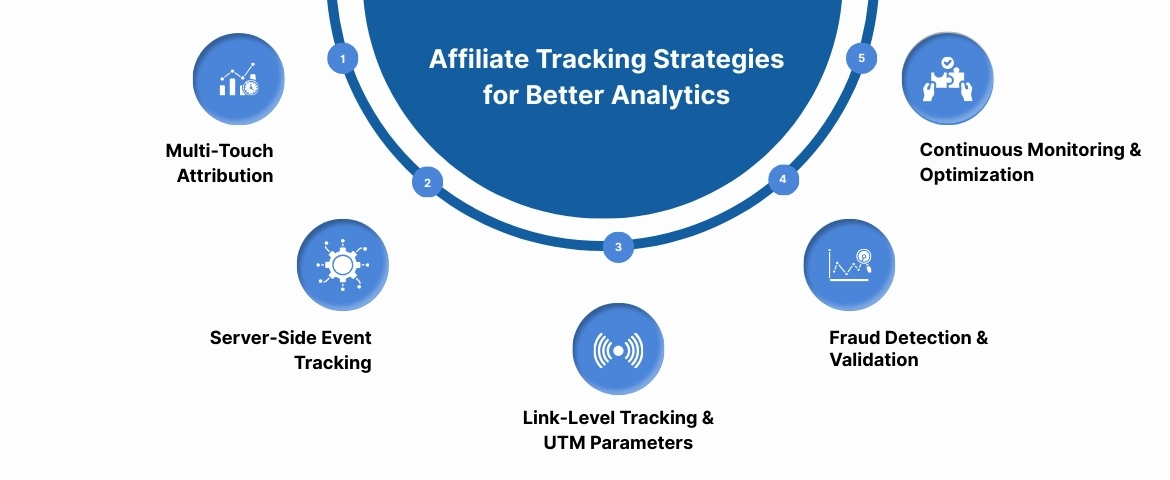
Multi-Touch Attribution
- Tracks every interaction along the customer journey—from affiliate click to purchase.
- Assigns fractional credit to multiple affiliates if a user interacts with more than one partner before converting.
- Helps marketers understand which partners influence conversions indirectly, not just the last click.
Server-Side Event Tracking
- Moves critical tracking from client-side scripts to server-side infrastructure.
- Prevents ad blockers, script errors, or bot interference from corrupting affiliate metrics.
- Ensures reliable capture of conversions, lead submissions, and post-click actions.
Link-Level Tracking & UTM Parameters
- Unique links per affiliate and campaign allow precise tracking of traffic sources.
- UTM tags capture campaign, channel, and content-level data for deep performance insights.
- Facilitates easy integration with analytics platforms and attribution tools.
Fraud Detection & Validation
- Implements anomaly detection to identify suspicious patterns such as repeated clicks, unusually high conversions, or impossible navigation behavior.
- Protects against cookie-stuffing, self-referrals, and automated traffic from skewing results.
- Maintains integrity of partner payouts and ROI calculations.
Continuous Monitoring & Optimization
- Regularly audits affiliate performance metrics including conversion rates, engagement, revenue, and average order value.
- Flags affiliates whose traffic quality declines or shows unusual patterns.
- Supports ongoing optimization, incentive adjustments, and program scaling decisions.
By combining accurate affiliate analytics with strategic tracking, marketers can ensure program transparency, maximize ROI, and maintain high-quality partner relationships.
Similar Read: Setting Up Offline Conversion Tracking in Google Ads
Now that you have a good understanding of affiliate analytics and its metrics, let’s look at how it works.
How Affiliate Analytics Works
Affiliate analytics isn’t just a dashboard, it’s a multi-layered system that tracks affiliate performance across campaigns, partners, and channels, then validates, cleans, and interprets data before it informs marketing decisions.
A great setup blends event tracking, attribution rules, server-side validation, and continuous monitoring, all while focusing on the metrics that matter most:
Client-Side Tracking: Engagement & Click Metrics
Client-side tracking captures the first interaction from affiliate links, banners, or referral clicks. Key metrics include:
- Clicks / Click-through rate (CTR): How many users clicked an affiliate link and the percentage of total impressions.
- Unique visitors per affiliate: Tracks distinct users driven by each partner.
- Engagement metrics: Time on page, scroll depth, and interactions initiated via affiliate referrals.
- Bounce rate from affiliate traffic: Measures initial engagement quality from affiliate sources.
These metrics help marketers understand which affiliates generate genuine interest, but client-side tracking alone can be blocked by ad blockers or lost across devices.
Network, Device, and Source Verification: Traffic Quality Metrics
Affiliate analytics also examines technical signals to verify traffic quality. Metrics include:
- IP reputation and geolocation: Flags traffic from suspicious or high-risk sources.
- Device & browser distribution: Detects abnormal device or OS patterns among affiliate-driven visitors.
- Referral source validation: Confirms which affiliate domains or links drove actual sessions.
These metrics ensure accurate attribution and prevent inflated numbers from non-human traffic.
Behavioral Pattern Analysis: Conversion & Fraud Metrics
Analyzing patterns over time helps spot anomalies and optimize campaigns. Metrics include:
- Conversion rate per affiliate: The percentage of referred visitors completing a purchase or desired action.
- Average order value (AOV): Evaluates the quality of conversions from each affiliate.
- Lead quality / engagement depth: Combines pageviews, scroll depth, or actions per visit to measure actual engagement.
- Click-to-conversion time: Flags unusually fast conversions that may indicate fraud.
AI-driven anomaly detection can automatically identify outliers in these metrics at scale.
Server-Side Validation: Revenue & Attribution Metrics
Server-side analytics provides the most reliable view of affiliate performance. Key metrics include:
- Verified conversions: Only conversions passing all validation rules count toward performance.
- Commissionable actions: Ensures affiliates are rewarded correctly for legitimate sales or leads.
- Deduplicated conversions: Prevents double-counting across campaigns or sessions.
- Cross-session attribution: Connects affiliate referrals with durable first-party identifiers across devices.
This layer ensures that even if client-side scripts fail, the revenue and conversion metrics entering analytics are accurate.
Event Governance, Cleanup, and Routing: Reporting Metrics
Accurate affiliate analytics requires governance to maintain clean reporting. Metrics include:
- Rejected / quarantined events: Tracks how many suspicious clicks or conversions were flagged.
- Schema compliance rate: Ensures all events meet required data formats.
- Attribution accuracy: Confirms that dashboards, ROI, and commission reports reflect real affiliate contributions.
- Channel consistency: Ensures GA4, Amplitude, Salesforce, and other platforms report the same metrics.
This layer ensures dashboards, partner payouts, and ROI calculations remain reliable.
Continuous Monitoring & Optimization: Performance Metrics
Affiliate campaigns evolve, and analytics must adapt. Metrics monitored include:
- Traffic spikes / anomalies per affiliate: Detects unusual surges.
- Revenue per affiliate: Tracks contribution to total sales and ROI.
- Conversion trends over time: Identifies affiliates whose performance improves or declines.
- Cross-channel consistency metrics: Confirms that affiliate-driven traffic and conversions are accurately reported across systems.
By combining these metrics with tracking and governance, marketers can optimize campaigns, reward top-performing affiliates, and detect fraud before it impacts revenue.
Similar Read: What Data is Google Analytics Unable to Track
Now that you have a better idea of how affiliate analytics works, let’s explore why it’s essential for driving informed marketing decisions.
Why Affiliate Analytics Matters for Marketers
Affiliate marketing is one of the fastest-growing channels for customer acquisition, but without accurate analytics, programs risk inefficiency, wasted spend, and misaligned incentives.
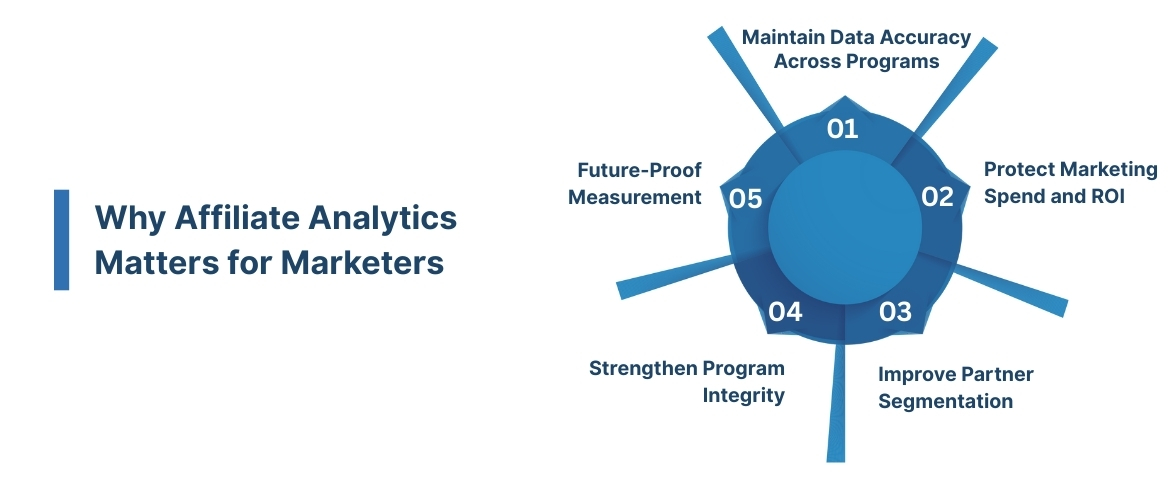
Affiliate analytics ensures marketers can differentiate high-performing affiliates from low-quality or fraudulent traffic, optimize commission structures, and make data-driven decisions. Without it, programs face inflated performance metrics, misattributed revenue, and suboptimal partner management.
Here’s why affiliate analytics is essential today:
Maintain Data Accuracy Across Programs
- Tracks actual clicks, leads, and sales driven by affiliates versus inflated or bot-driven traffic.
- Provides clarity on which campaigns genuinely deliver ROI and which appear successful only due to volume spikes.
- Ensures dashboards, partner reporting, and revenue attribution reflect real customer interactions.
Protect Marketing Spend and ROI
- Prevents overpayment to affiliates generating low-quality or non-human traffic.
- Reduces wasted ad spend from misattributed leads or conversions.
- Enables marketers to prioritize high-performing partners and channels that deliver genuine conversions.
Improve Partner Segmentation and Performance Management
- Identifies top-performing affiliates and campaigns to optimize incentive programs.
- Flags underperforming affiliates or suspicious traffic patterns for review.
- Supports personalized communication and bonuses based on accurate, human-only conversion data.
Strengthen Program Integrity and Compliance
- Detects fraudulent clicks, self-referrals, or cookie-stuffing schemes.
- Ensures affiliates adhere to program guidelines, protecting brand reputation.
- Reduces risk of invalid lead generation that could result in compliance issues or financial loss.
Future-Proof Measurement
- Works reliably even as cross-device tracking, cookie restrictions, and privacy regulations evolve.
- Uses first-party data, server-side validation, and durable tracking signals to maintain continuity.
- Supports scalable analytics strategies across multiple channels, partners, and campaigns.
Affiliate analytics isn’t just a reporting tool, it’s a framework for measurable, accountable growth that ensures marketing dollars drive real value.
Want affiliate analytics that are accurate, durable, and truly performance-ready?
Ingest Labs helps brands maintain clean, trustworthy affiliate data by filtering invalid clicks, fake referrals, and non-human activity before it reaches your reporting stack. When only real user interactions are measured, affiliate teams can see which partners actually drive revenue, optimize payouts confidently, and prevent budget leaks caused by inflated or manipulated traffic.
Challenges of Affiliate Analytics (And How to Fix Them)
Affiliate analytics looks simple on the surface, but accurately measuring partner performance is far more complex. Inconsistent tracking, inflated clicks, and fragmented data often make it difficult for brands to understand which affiliates actually drive value. Without clean, unified measurement, metrics like clicks, conversions, ROAS, and LTV become unreliable.
Below are the most common analytics challenges in affiliate programs—and how to solve them effectively:
Inflated Clicks and Non-Human Activity
Many affiliate programs see suspicious spikes in clicks or traffic patterns that don’t translate to real engagement. Bots, forced clicks, cookie stuffing, and incentivized traffic can all inflate top-funnel metrics while delivering little to no revenue.
Solution: Use multi-layer validation on every click, including device fingerprinting, event timing, referrer checks, and behavioral scoring. Filtering invalid traffic before it enters your analytics ensures impressions, clicks, and CTR reflect real user interest—not manufactured activity.
Unclear Attribution Across Partners
Affiliate conversions often overlap with paid search, social ads, email, or direct traffic. Without accurate attribution rules or clean UTMs, multiple channels claim the same conversion, making it impossible to see which affiliate truly contributed.
Solution: Standardize attribution models, require clean tracking parameters, and create unified rules that apply across all traffic sources. Consistent attribution logic gives teams transparency into real affiliate influence throughout the funnel.
Fragmented Data Across Platforms
Most brands rely on multiple tools: affiliate networks, analytics platforms, CRM systems, payout tools, and ad platforms. Each measures clicks and conversions differently, leading to mismatched numbers and confusing partner reports.
Solution: Centralize affiliate analytics through a single, authoritative data layer. A unified dataset ensures impressions, clicks, conversions, and revenue are counted the same way everywhere, creating clean reporting for partners and internal teams.
Under-Reporting Due to Tracking Loss
Privacy changes, browser restrictions, blocked cookies, ad blockers, and cross-device journeys can all cause legitimate conversions to go unattributed. This makes high-performing affiliates look weaker than they are and undermines trust in the program.
Solution: Adopt privacy-safe tracking methods like server-side events, first-party attribution, and durable identifiers. These reduce tracking loss and ensure conversions are logged even when client-side scripts fail.
No Systematic Fraud Detection
Affiliate fraud evolves constantly with fake leads, coupon hijacking, last-click sniping, and automated clicks all erode ROI. Many programs detect issues only after payouts are made, losing revenue in the process.
Solution: Implement real-time quality checks that monitor patterns like sudden traffic spikes, abnormal conversion timing, repeated device IDs, or click-to-conversion ratios outside expected norms. Continuous monitoring helps you catch fraud before it affects payouts.
Limited Visibility Into Post-Conversion Metrics
Most affiliate dashboards stop at “conversion.” They don’t show LTV, refund rates, churn, repeat purchases, or cohort behavior, which are metrics that matter most for determining long-term partner value.
Solution: Integrate post-purchase data into your affiliate reporting. Tracking LTV, retention, and refund-adjusted revenue lets brands reward partners who bring loyal, high-quality customers, not just volume.
Accurate affiliate analytics drive fair payouts, stronger partnerships, and smarter investment. When teams standardize tracking, unify data, validate clicks, and monitor traffic quality, every metric like CTR, AOV, ROAS, LTV, and contribution becomes reliable enough to guide confident decisions.
Related Read: Event Tracking Tools for Google Analytics
Wrapping Up
Accurate affiliate analytics is one of the most important yet consistently underestimated pillars of performance marketing. When tracking breaks, data fragments, or invalid clicks slip through, every metric from ROAS to partner payouts becomes unreliable. Small discrepancies early in the journey snowball into misreported revenue, misaligned commissions, and poor decisions across teams.
Ingest Labs helps brands bring stability, clarity, and precision to affiliate measurement through a unified data infrastructure. Ingest IQ captures all affiliate events server-side, validating each click and conversion before it enters reporting. Ingest ID maintains durable, first-party identifiers so partner attribution stays consistent across browsers, devices, and privacy environments. Event IQ audits event flows in real time, flags suspicious patterns, corrects broken tracking, and ensures affiliates receive credit only for verified, high-quality conversions.
Together, these capabilities transform affiliate analytics from a patchwork of inconsistent tracking into a dependable, audit-ready system that supports accurate payouts, genuine partner insights, and scalable growth.
If you want clean, trustworthy affiliate data and fully transparent partner reporting, Ingest Labs can help. Book a demo today.
FAQs
1. How can monitoring affiliate traffic quality metrics prevent cost inefficiencies?
Tracking detailed traffic quality metrics, such as bounce rate, session duration, and page depth specific to affiliate-driven visitors, helps identify low-quality or bot traffic early. This prevents paying commissions on unproductive clicks and enables focusing resources on affiliates driving engaged, conversion-ready audiences.
2. Why is it important to measure affiliate-driven customer lifetime value (LTV) rather than just initial conversions?
Initial conversions show immediate results, but tracking LTV reveals the long-term revenue an affiliate generates by driving loyal customers. This metric justifies strategic investment in top-performing affiliates and enables refining commission tiers to reward sustained value rather than one-off sales.
3. What role do engagement-driven KPIs play in optimizing affiliate program health?
Measuring affiliate engagement through activity levels, communication responsiveness, and promotional frequency allows programs to spot declining affiliates early. Engaged affiliates typically generate more consistent results, so nurturing and reactivating inactive affiliates can increase overall program stability and growth.
4. How can conversion velocity inform faster decision-making in affiliate campaigns?
Conversion velocity tracks the speed from click to conversion, highlighting which affiliates or campaigns produce quick returns. Fast velocity can indicate high-intent traffic or campaign effectiveness, guiding timely budget reallocations to maximize ROI.
5. How do multi-touch attribution metrics enhance insights beyond last-click attribution?
Multi-touch attribution assigns credit to affiliates across the entire customer journey, not just the final touchpoint. This reveals hidden contributors in awareness and consideration phases, helping marketers reward downstream and upper-funnel affiliates accurately and optimize the full funnel rather than just direct sales.