




Are your ad results getting harder to explain, even when spend keeps rising? One day cookies work, the next they don’t, and suddenly your reports feel incomplete. With tracking signals fading, many marketers are questioning what still works.
Here’s the shift you can’t ignore. A recent US survey found that 54% of advertisers plan to spend more on channels like connected TV due to privacy laws and signal loss. Budgets are moving, but measurement is getting tougher. Without reliable data, scaling these channels becomes risky.
That’s where this blog helps. We break down what Google cookie deprecation really means and how it impacts your marketing performance. Stick till the end to learn practical steps to stay measurable and compliant in a cookieless future.
In A Nutshell:
- Google cookie deprecation changes how you track users, pushing marketers toward privacy-first, first-party data strategies.
- First-party data, server-side tracking, and consent management become essential for reliable measurement and personalization.
- Contextual advertising and identity-based approaches help maintain relevance without relying on third-party cookies.
- Consent management and ethical data collection are critical to maintain compliance and customer trust.
- Investing in identity resolution, CDPs, and clean rooms helps brands stay measurable and data-driven in a cookieless world.
What Is Google Cookie Deprecation and Why It Matters
Google cookie deprecation refers to Chrome’s long-running plan to limit or remove third-party cookies used for cross-site tracking. These cookies have long tracked users across sites for targeting, measurement, and personalization. While the plan has shifted, the impact on how you collect and use data is already real.
Chrome controls a large share of browser usage, which makes Google’s decisions hard to ignore. At a high level, Google cookie deprecation means:
- Less cross-site tracking through third-party cookies
- Greater focus on privacy-led advertising models
- More pressure on first-party and consented data strategies
As Google adjusted its approach, the reasons behind the original decision became clearer. Understanding those reasons helps you prepare for what comes next.
Why Did Google Remove Third-Party Cookies in Chrome?
Google’s original plan to remove third-party cookies was driven by privacy goals, but execution proved complex. Several forces shaped the shift in direction.
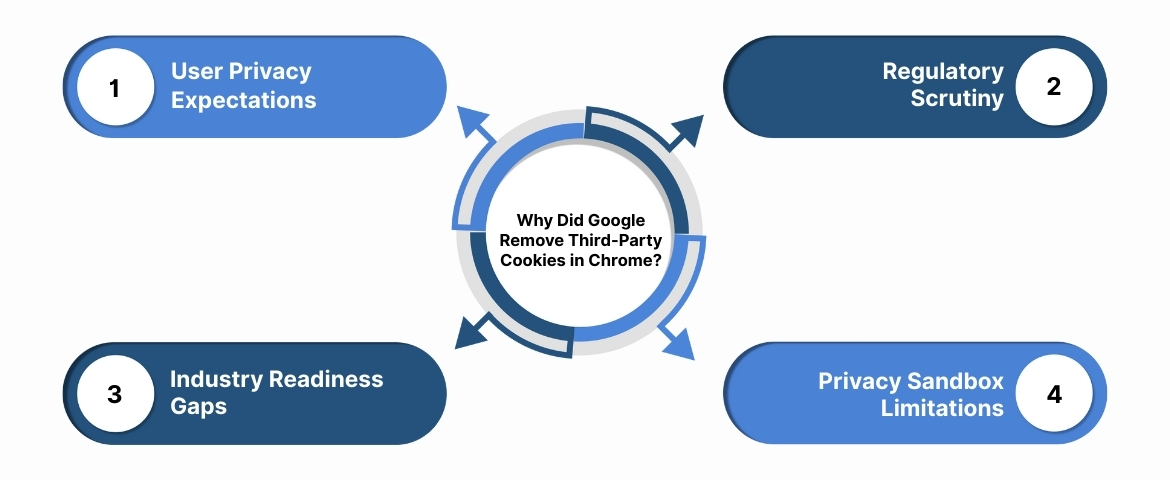
User Privacy Expectations
Users have become more aware of how their data is collected and shared online. Browsers face pressure to limit invisible tracking that happens without clear consent.
Google positioned cookie deprecation as a way to reduce cross-site surveillance. The goal was to keep ads relevant without exposing individual browsing histories.
Regulatory Scrutiny
Privacy regulators raised concerns about how changes might affect competition and user protection. Some regulators questioned whether Google’s proposed alternatives would create imbalances in the ad ecosystem.
These reviews slowed timelines and forced Google to reassess its approach. Compliance and competition concerns became impossible to ignore.
Industry Readiness Gaps
Advertisers and publishers rely heavily on cookie-based workflows. Many teams lacked tested alternatives that delivered similar performance.
Early testing showed that proposed replacements struggled with measurement accuracy and revenue stability. That feedback played a major role in delaying full deprecation.
Privacy Sandbox Limitations
Privacy Sandbox was designed as the primary replacement framework. However, many ad tech providers found it restrictive and difficult to scale.
Concerns ranged from limited targeting control to reduced transparency in measurement. This uncertainty made a sudden transition risky for the ecosystem.
With cookies no longer disappearing overnight, advertisers still face meaningful disruption. That disruption shows up most clearly in daily advertising operations.
Also Read: Understanding Cookie Size Limits in Modern Browsers
How Does Google Cookie Deprecation Affect Advertising?
Even without a hard cutoff, the direction is clear. Advertisers must prepare for reduced reliance on third-party cookies and more constrained tracking.
Audience Targeting Changes
Traditional targeting based on browsing behavior becomes less reliable. Advertisers lose visibility into cross-domain users.
This shifts focus toward:
- First-party data collected directly from customers
- Contextual signals tied to page content
- Cohort or interest-based targeting models
Precision changes, but relevance does not disappear. It just comes from different inputs.
Attribution and Measurement Challenges
Multi-touch attribution becomes harder without shared identifiers. Tracking a user’s full journey across platforms is less straightforward.
Common impacts include:
- Less granular conversion paths
- Delayed or aggregated reporting
- Greater reliance on modeled results
Measurement still exists, but expectations around accuracy must adjust.
Frequency and Reach Control
Without third-party cookies, controlling how often users see the same ad is more complex. Overexposure risks increase when identifiers are fragmented.
Teams must rethink:
- Frequency logic across platforms
- Deduplication between channels
- Reach calculations for campaigns
This makes coordination between systems more important than ever.
This pushes advertisers to audit their stacks and remove dependencies that no longer scale. That naturally leads to exploring alternatives already gaining traction.
What Is Replacing Third-Party Cookies In Chrome?
There is no single replacement for third-party cookies. Instead, several approaches work together to cover different use cases.
Topics API
Topics assigns interest categories based on recent browsing activity. The browser shares these categories with advertisers instead of user-level histories. This approach avoids personal identifiers while enabling relevance.
However, Topics offers less detail than traditional cookies. You gain context, but lose behavioral depth.
Protected Audience API
Previously called FLEDGE, this API supports remarketing without third-party cookies. Ad auctions happen inside the browser, not on external servers. Advertisers target interest groups rather than individuals.
This design improves privacy but limits transparency and control. Many teams find testing and optimization more complex.
Attribution Reporting API
Attribution Reporting measures conversions without revealing individual user journeys. It groups events and delays reporting to protect privacy. You still see outcomes, but with reduced granularity.
This works for high-level insights, though detailed attribution models become harder to maintain.
Beyond Google’s Built-In Tools
Many organizations look beyond Privacy Sandbox for flexibility. Several alternatives already support privacy-first strategies across channels.
| Replacement Approach | What It Solves | Key Limitation |
| First-party data | Owned, consented insights | Requires a strong data infrastructure |
| Universal IDs | Cross-platform recognition | Depends on user authentication |
| Server-side tracking | Better control and compliance | Needs careful setup and governance |
Once you understand the alternatives, the bigger question becomes how to actually put them into practice without disrupting performance or trust. That is where preparation comes in.
How Should Marketers Prepare For Google Cookie Deprecation?
Cookie deprecation is less about reacting to Google and more about strengthening what you already own. Preparation starts with building durable, privacy-first foundations that work across channels.
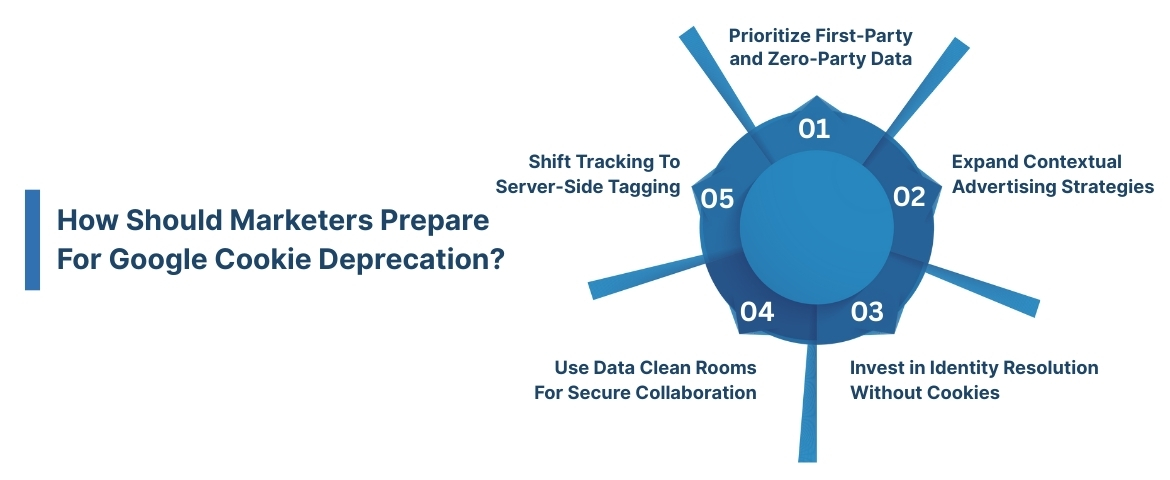
Prioritize First-Party and Zero-Party Data
First-party and zero-party data give you clarity without relying on external tracking. This data comes directly from user interactions and intentional sharing, making it more reliable and compliant.
- Collect data through sign-ups, purchases, surveys, and preference centers
- Make value exchanges clear, like content access or loyalty benefits
- Store and organize data within CRM or customer data platforms
- Use consent-led flows to maintain transparency and user trust
Expand Contextual Advertising Strategies
Contextual advertising aligns ads with what users are viewing, not who they were yesterday. It keeps relevance high without tracking users across sites.
- Align ad placements with content themes and keywords
- Group campaigns around intent signals, not behavioral histories
- Use content analysis tools to improve contextual matching
- Keep targeting rules simple and privacy-safe
Invest in Identity Resolution Without Cookies
Identity resolution helps connect interactions across channels using consented signals. It focuses on recognition, not surveillance.
- Unify customer data across email, apps, and websites
- Use deterministic identifiers like logins or hashed emails
- Build unified profiles within a CDP or analytics platform
- Maintain clear consent records tied to each identity
Use Data Clean Rooms For Secure Collaboration
Data clean rooms allow brands and partners to work with shared insights safely. They support measurement and audience analysis without exposing raw user data.
- Start with limited use cases like campaign measurement
- Define access controls and data-sharing rules early
- Use aggregated outputs instead of user-level views
- Expand gradually once governance is established
Shift Tracking To Server-Side Tagging
Server-side tagging moves data collection away from the browser. This improves control, accuracy, and compliance as browsers restrict client-side tracking.
- Migrate critical tags to a secure server environment
- Validate event accuracy across devices and channels
- Monitor data flow to reduce loss and duplication
- Align server logic with consent signals
Once preparation is underway, consent becomes the thread that connects every strategy. Without it, even the best tools fall short.
Wondering how to shift to first-party data without rebuilding your entire stack? Ingest Labs helps simplify server-side tracking, identity, and consent while keeping measurement privacy-compliant.
How Do You Manage User Consent Without Cookies?
Managing consent in a cookieless world means earning trust, not forcing acceptance. Clear communication and respectful choices matter more than technical workarounds.
Instead of default tracking, marketers should design consent as part of the user experience.
Best practices to follow:
- Transparent Consent Banners: Use clear, simple consent banners without dark patterns that pressure users into accepting tracking.
- Clear Value Communication: Explain what data you collect, how it is used, and how it benefits the user experience.
- Respect User Privacy Signals: Honor opt-out signals like browser privacy settings and global privacy controls automatically.
- Consent-Aware Measurement: Integrate consent signals directly into analytics, tagging, and advertising tools to avoid data misuse.
- Ongoing Consent Review: Review consent choices regularly and apply them consistently across systems and channels.
When consent is handled well, compliance becomes easier, and data quality improves naturally.
Also Read: How The Trade Desk Syncs Cookie and Builds Identity Graphs
How Ingest Labs Helps You Prepare For Cookie Deprecation
As third-party cookies fade, you still need reliable data, clear consent, and consistent measurement. Ingest Labs supports this shift by helping you move from fragile browser-based tracking to privacy-first, first-party data strategies that actually scale.
Instead of forcing workarounds, the platform simplifies how you collect, manage, and activate customer data in a cookieless environment.
Here’s how Ingest Labs fits into your transition:
- Replace cookies with first-party identifiers: Ingest ID assigns a durable, consented identifier to each visitor, helping you maintain attribution and user understanding without cookies.
- Stabilize tracking: Ingest IQ captures events securely from the server, reducing signal loss caused by browsers and ad blockers.
- Enforce consent across channels: Event IQ ensures consent rules are applied consistently across analytics, ads, and marketing platforms.
- Unify fragmented customer data: Event IQ connects behavioral data across touchpoints to build complete, privacy-safe customer profiles.
- Reduce technical dependency: Ingest Labs removes coding complexity, so you can test, optimize, and scale without constant engineering support.
Together, these tools help you stay measurable, compliant, and flexible in a cookieless world.
Final Thoughts
Google cookie deprecation signals a long-term shift in how marketing data is collected and used. Even with delays, third-party cookies are no longer a reliable foundation. Marketers need systems that work with privacy limits, not around them.
The path forward is clear. First-party data, server-side tracking, consent-led measurement, and privacy-safe attribution are now essential. These choices directly affect performance, accuracy, and customer trust.
If you want to operationalize these changes without stitching together multiple tools, Ingest Labs helps unify tracking, identity, and consent in one privacy-first setup. Contact us to build a data strategy that holds up in a cookieless world.
FAQs
1. Is Google deprecating cookies?
Google originally planned to phase out third-party cookies in Chrome, but later paused the full deprecation. Instead, it is shifting toward user choice and privacy-focused alternatives while testing new approaches.
2. When did Google first announce cookie deprecation?
Google first announced plans to deprecate third-party cookies in Chrome in early 2020, positioning it as a move toward stronger user privacy.
3. What is a deprecated cookie?
A deprecated cookie refers to a cookie that a browser plans to limit or stop supporting over time. While it may still work temporarily, it is no longer recommended for long-term use.
4. Why is Google being forced to sell Chrome?
Google is not being forced to sell Chrome. A U.S. court rejected the DOJ’s divestment demand, opting for alternative remedies to address Google’s search monopoly concerns instead.