




Are you still celebrating traffic spikes while your conversion rates flatline? The era of vanity metrics is over. Modern businesses need more than pageview counts and bounce rates. They need behavioral intelligence that reveals why visitors leave, where they struggle, and what drives them to convert.
Legacy analytics platforms were built for a different web. They track surface-level interactions but miss the context. Browser restrictions, privacy regulations, and cookie deprecation have exposed their limitations. Meanwhile, your competitors are using privacy-first analytics to understand customer intent, optimize experiences in real-time, and drive measurable growth.
This guide examines the best web analytics tools for 2026. You'll also learn how to choose tools that integrate seamlessly with your existing tech stack.
At a glance:
- Privacy-first, first-party tracking is now essential in web analytics tools as cookies disappear under browser restrictions and regulations like GDPR and CCPA.
- The right analytics tool depends on your goal: product insights (Mixpanel, Amplitude), behavior replay (Hotjar, FullStory), or compliant marketing analytics (Ingest Labs, Matomo).
- By 2026, leading platforms must deliver real-time tracking, cross-device attribution, AI insights, funnel analysis, and flexible integrations.
- Free tools show what happened; advanced platforms explain why, with custom events, deep segmentation, and built-in compliance.
- Server-side platforms like Ingest Labs enable accurate cookieless analytics through identity resolution, real-time events, and no-code integrations.
What Are Web Analytics Platforms? And Why Do They Matter Now?
Web analytics platforms collect, process, and visualize data about how visitors interact with your digital properties. These tools go beyond counting clicks. They decode user behavior, identify friction points, and connect actions to business outcomes.
Why they matter now:
- Privacy regulations like GDPR and CCPA demand first-party data strategies
- Cookie deprecation eliminates third-party tracking methods
- Cross-device journeys require unified identity resolution
- Real-time optimization needs immediate behavioral signals
- Attribution complexity demands multi-touch tracking capabilities
The right platform transforms raw data into strategic decisions. It shows you what happens, why it happens, and what to do next. Without these insights, you're optimizing blind.
The Critical Features Your Web Analytics Platform Must Have in 2026
Not all analytics platforms address today's challenges. The tools that drive results in 2026 share specific capabilities that separate signal from noise. These features determine whether your platform delivers actionable insights or just generates reports nobody reads.
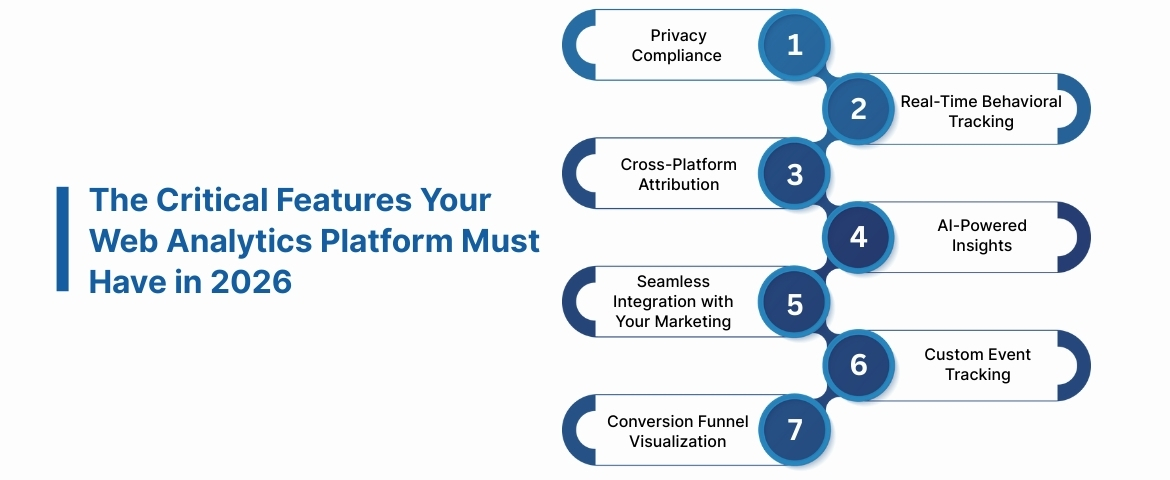
- Privacy Compliance & First-Party Data Collection: Your platform must support GDPR, CCPA, and emerging regulations without degrading data accuracy. Look for server-side tracking, consent management integration, and first-party cookie implementation. Compliance isn't optional anymore. It's foundational.
- Real-Time Behavioral Tracking & Session Replay: Surface-level metrics miss the story. Session replay shows exactly where users hesitate, rage-click, or abandon forms. Real-time tracking lets you spot issues as they happen, not days later in a weekly report.
- Cross-Device & Cross-Platform Attribution: Customers don't think in devices. They switch from mobile to desktop to app without breaking stride. Your analytics must follow them, maintaining identity and attribution across every touchpoint in the journey.
- AI-Powered Insights & Predictive Analytics: Manual data analysis doesn't scale. AI surfaces anomalies, predicts churn risk, and identifies optimization opportunities automatically. The best platforms use machine learning to tell you what matters before you ask.
- Seamless Integration with Your Marketing & Data Stack: Isolated data kills strategic decisions. Your web analytics platform should connect directly to your CRM, marketing automation, advertising platforms, and data warehouse. Integration quality determines whether insights drive action or gather dust.
- Custom Event Tracking & Flexible Data Models: Generic tracking misses business-specific signals. You need platforms that let you define custom events, build flexible data schemas, and track what matters to your unique customer journey without developer bottlenecks.
- Conversion Funnel Visualization & Drop-Off Analysis: Knowing your conversion rate isn't enough. You need to see exactly where users exit, which steps cause friction, and how different segments behave at each stage. Funnel analysis turns guesswork into certainty.
Also Read: Analytics for Shopify Customer Segments
These features work together. Missing even one creates blind spots that competitors exploit.
Now, let's see some popular web analytics platforms that deliver these features.
Top 10 Web Analytics Platforms Ranked by Use Case (2026 Edition)
The platforms below represent the current market leaders, each excelling in distinct use cases. Some prioritize behavioral depth, others emphasize compliance, and a few bridge the gap between traditional analytics and modern privacy requirements. Here's how they compare.
1. Ingest Labs
Ingest Labs specializes in tag management and first-party data solutions for the cookieless environment. The platform combines server-side tracking with robust identity resolution, letting you maintain attribution accuracy while staying compliant with GDPR, CCPA, and emerging regulations. No coding required.
Core Features
- Ingest IQ: Server-side tracking for web and mobile with real-time tag monitoring and data streaming to CDPs or data lakes
- Ingest ID: First-party identifier that tracks visitors across sessions and devices for accurate attribution
- Event IQ: Customer data platform that unifies sources, enables AI-powered insights, and supports cross-device tracking
- Privacy-compliant consent management
- Enhanced conversion tracking that bypasses browser limitations
- Real-time behavioral event tracking
- Direct integration with CRMs, analytics tools, and marketing platforms
Ideal Use Cases
E-commerce businesses facing cart abandonment need Ingest Labs' precision tracking to recover lost revenue. Digital marketing agencies managing multiple clients benefit from unified data orchestration across platforms. Privacy-conscious organizations get compliant tracking without sacrificing data quality.
Pricing Structure
Custom pricing based on traffic volume and feature requirements. Contact Ingest Labs for specific quotes tailored to your business needs.
Why It Excels
Most analytics platforms treat privacy compliance as an afterthought. Ingest Labs built privacy-first tracking from the ground up. You get accurate behavioral data, reliable attribution, and conversion tracking that actually works in today's restricted browser environment. For marketers adapting to cookieless tracking, it eliminates the technical complexity while delivering the insights that drive growth.
2. Matomo
Matomo gives you complete data ownership. Unlike cloud platforms that control your analytics, Matomo runs on your servers. This matters for organizations with strict data governance requirements or those operating in regulated industries.
Core Features
- Self-hosted or cloud deployment options
- GDPR-compliant tracking with built-in anonymization
- Heatmaps and session recordings
- Custom reports and dashboards
- E-commerce tracking
- Tag manager integration
Best For: Healthcare, financial services, and government organizations requiring data sovereignty. Companies wanting Google Analytics features without sending data to Google.
Pricing: Free open-source version available. Cloud plans start at $23/month for 50,000 page views.
3. Mixpanel
Mixpanel tracks user actions, not pageviews. This event-based approach reveals how customers interact with features, where they get stuck, and what drives retention. SaaS companies rely on Mixpanel to understand product adoption.
Core Features
- Event-based tracking architecture
- Cohort analysis and retention reports
- Funnel analysis with drop-off attribution
- A/B test integration
- User profile enrichment
- Mobile app analytics
Best For: SaaS platforms, mobile apps, and digital products focused on feature adoption and user engagement.
Pricing: Free up to 20 million events per month. The growth plan starts at $20/month.
4. Amplitude
Amplitude combines product analytics with experimentation capabilities. The platform excels at identifying behaviors that predict retention, letting growth teams optimize the entire customer lifecycle from activation to expansion.
Core Features
- Behavioral cohorts and segmentation
- Predictive analytics using machine learning
- Built-in experimentation platform
- Revenue analytics and LTV tracking
- Cross-platform user journey mapping
Best For: Growth teams at scale-ups and enterprises focused on reducing churn and increasing customer lifetime value.
Pricing: Free tier available. Plus plan starts at $49/month. Enterprise pricing requires consultation.
5. Heap
Heap eliminates manual event tracking. The platform automatically captures every interaction, letting you analyze historical data retroactively. This matters when you realize three months later that you forgot to track a critical conversion event.
Core Features
- Automatic event capture without tagging
- Retroactive analysis of past user behavior
- Session replay with interaction timelines
- Conversion funnel analysis
- Multi-touch attribution
Best For: Teams that need flexibility to ask new questions without re-implementing tracking code.
Pricing: Free up to 10,000 sessions monthly. Growth plan starts at $3,600/year.
6. Hotjar
Hotjar shows you what quantitative data can't. Heatmaps reveal where users actually look and click. Session recordings expose confusion and frustration. Feedback widgets collect direct user input.
Core Features
- Click, scroll, and move heatmaps
- Session recordings with frustration detection
- Conversion funnel tracking
- On-site surveys and feedback polls
- User testing recruitment
Best For: UX teams and conversion rate optimizers who need qualitative context for quantitative metrics.
Pricing: Free plan available. Plus plan starts at $39/month for 100 daily sessions.
7. FullStory
FullStory captures pixel-perfect recordings of every session. The search functionality lets you find specific user experiences based on actions, rage clicks, or error messages. Support teams use it to diagnose customer issues.
Core Features
- High-fidelity session replay
- Omnisearch for finding specific behaviors
- Frustration signals and error tracking
- Funnel analytics
- Mobile app session capture
Best For: Product and support teams that need detailed session-level debugging capabilities.
Pricing: Free tier includes 1,000 sessions monthly. Business plans require consultation.
8. Quantum Metric
Quantum Metric focuses on technical performance and experience monitoring. The platform catches crashes, slow pages, and broken features in real-time, automatically alerting engineering teams to issues affecting revenue.
Core Features
- Real-time anomaly detection
- Technical error monitoring
- Customer struggle scoring
- Journey analytics across devices
- Direct integration with development tools
Best For: Enterprise e-commerce and financial services needing proactive issue detection.
Pricing: Enterprise-only. Contact for custom quotes.
9. Contentsquare
Contentsquare combines zone-based heatmaps with AI-powered opportunity detection. The platform analyzes billions of sessions to surface friction points automatically, prioritizing fixes by revenue impact.
Core Features
- Zone-based analysis beyond traditional heatmaps
- AI-driven opportunity scoring
- Customer journey analysis
- Mobile app analytics
- Voice of customer integration
Best For: Large retail and media companies optimizing content engagement and conversion paths.
Pricing: Enterprise-level pricing requires consultation.
10. Plausible
Plausible strips analytics down to essentials. The entire dashboard fits on one screen. No cookies, no personal data collection, and a script that weighs less than 1KB. It's the anti-Google Analytics.
Core Features
- Cookie-free tracking
- Simple, single-page dashboard
- Goal and event tracking
- UTM parameter analysis
- Open-source and transparent
Best For: Privacy-focused businesses, bloggers, and small teams wanting simple insights without complexity.
Pricing: Starts at $9/month for 10,000 monthly pageviews.
Each platform above serves specific needs. The right choice depends on your business model, technical requirements, and privacy stance.
Also Read: Top Social Media Analytics Tools for 2024
How to Choose the Right Web Analytics Platform for Your Business
Comparing feature lists won't lead you to the right platform. Start by understanding what you're solving for. Do you need to reduce cart abandonment or improve product feature adoption? Are you struggling with attribution accuracy or compliance requirements? The answers determine which features matter most.
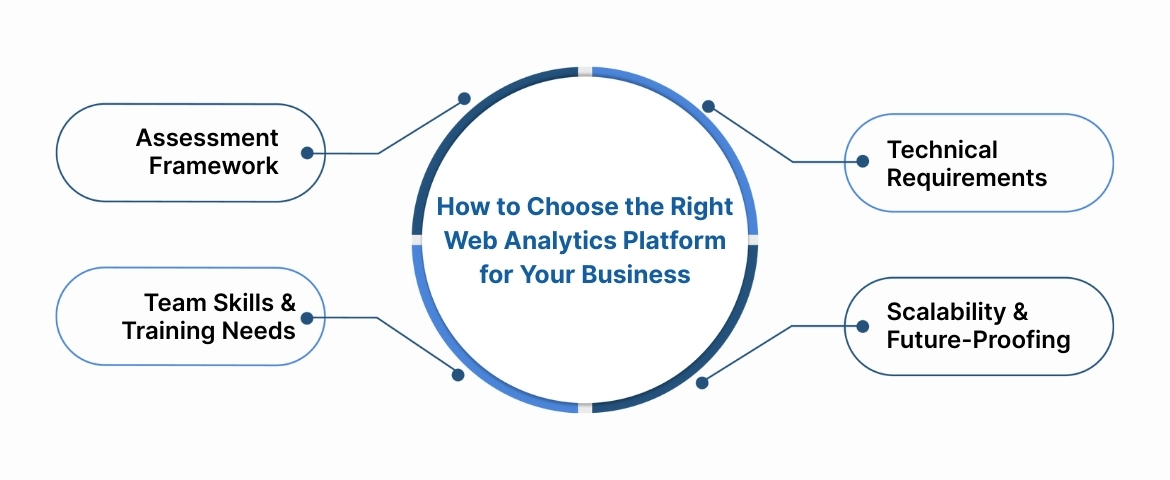
1. Assessment Framework: 7 Critical Questions
- What decisions will this data drive? List specific actions your team needs to take based on analytics insights.
- What privacy regulations apply to your business? GDPR, CCPA, HIPAA, and sector-specific rules limit tracking options.
- How technical is your team? Some platforms require developer resources while others offer no-code implementation.
- What systems need to connect? Map your existing CRM, marketing automation, advertising platforms, and data warehouse.
- What's your traffic volume and growth trajectory? Pricing scales dramatically with pageviews and events tracked.
- Do you need historical data analysis? Some platforms let you query past behavior retroactively.
- What level of support do you require? Enterprise support costs extra but prevents costly implementation mistakes.
2. Technical Requirements & Implementation Complexity
Server-side tracking requires infrastructure changes. Client-side scripts deploy faster but face browser restrictions. Evaluate implementation time against the urgency of insights you need.
3. Team Skills & Training Needs
Steep learning curves delay value realization. If your team struggles with GA4's interface, adding more complexity won't help. Some platforms offer dedicated onboarding and training.
4. Scalability & Future-Proofing
Choose platforms built for tomorrow's privacy landscape. First-party data collection, server-side capabilities, and flexible identity resolution will matter more as browsers restrict tracking further.
Also Read: How to Build a Privacy-First Single Customer View in 2026
The right platform balances current needs with future requirements without overwhelming your team.
Conclusion
Web analytics platforms determine whether you guess or know what drives business results. The tools above represent the current state of the market, each solving specific challenges for different business types.
Privacy-first platforms like Ingest Labs address the fundamental shift toward first-party data and cookieless tracking. Traditional solutions still serve specific needs but struggle with modern privacy requirements.
Choose based on your actual requirements, not marketing promises. Test platforms with real traffic before committing to annual contracts. The best analytics tool is the one your team actually uses to make better decisions.
Ready to see how server-side tracking transforms your analytics? Book a personalized demo to show exactly how privacy-first analytics captures the behavioral signals you're currently missing.
FAQs
Q1. How do web analytics tools improve conversion rates?
Analytics platforms identify exactly where users abandon funnels, which page elements cause confusion, and what behaviors predict conversion. You see patterns invisible in aggregate data. Teams use session replays to diagnose friction, test hypotheses with A/B experiments, and prioritize optimizations by impact. Conversion improvements come from understanding why users don't convert, not just that they don't.
Q2. What's the difference between web analytics and product analytics?
Web analytics tracks website visits, traffic sources, and content engagement across marketing channels. Product analytics focuses on feature usage, user activation, and retention within applications. Web analytics asks "how did they find us" while product analytics asks "what do they do once they're here." SaaS companies need both. E-commerce businesses prioritize web analytics.
Q3. Can web analytics tools track mobile apps?
Yes, but implementation differs from web tracking. Mobile SDKs capture in-app events, screen views, and user properties. Cross-platform analytics tools like Mixpanel, Amplitude, and Ingest Labs unify web and mobile data, maintaining user identity across devices. Look for platforms with native mobile SDKs, not just mobile web tracking.
Q4. What integrations should I prioritize?
Start with your CRM for customer data enrichment. Connect advertising platforms for attribution accuracy. Link your data warehouse for custom analysis. Marketing automation integration enables behavioral trigger campaigns. The specific integrations depend on your tech stack, but data should flow bidirectionally wherever possible.
Q5. What metrics should I track for e-commerce?
Focus on conversion rate by traffic source, average order value, cart abandonment rate, customer acquisition cost, and customer lifetime value. Track product page engagement, checkout funnel completion, and time to purchase. Monitor returning customer behavior separately from first-time buyers. Revenue attribution across marketing channels reveals what actually drives sales versus what gets credit.