




Your marketing team collects customer data from dozens of sources, web interactions, email campaigns, purchase history, and app behavior, yet the cost of consolidating and activating this data can balloon quickly without a clear pricing strategy. Without a unified system, this scattered information becomes expensive to manage and difficult to act on. A customer data platform consolidates this fragmented data into actionable profiles, enabling personalized marketing at scale while reducing operational friction.
This guide explains how customer data platform pricing works, which cost drivers matter most for mid-market and enterprise teams, and how to budget for predictable value and compliance-ready deployment.
Whether you’re an e-commerce retailer managing seasonal spikes, a B2B SaaS scaling with enterprise complexity, or an agency driving multi-client outcomes, understanding customer data platform pricing helps you align spend with measurable ROI. The global customer data platform market is projected to reach $28.2 billion by 2028, reflecting the critical role these platforms now play in data-driven business strategies.
Key Takeaways
- Customer data platform pricing is complex and driven by data volume, profiles, features, integrations, support levels, and compliance requirements.
- Mid‑market CDPs cost often start around $50,000 to $150,000 per year for core platform access. Higher tiers with advanced features can cost more.
- Pricing models vary (subscription, usage-based, custom, or seat-based), and choosing the wrong model can cause unpredictable cost spikes as data scales.
- ROI typically appears within a few months when CDP outcomes such as improved retention, higher conversion rates, operational efficiency, and reduced compliance costs are measured clearly.
- Smart budgeting requires defining use cases, forecasting data growth, accounting for hidden costs, and aligning CDP investment with measurable business outcomes.
What Is a Customer Data Platform?
A customer data platform unifies first-party customer data from websites, apps, CRM systems, email platforms, and offline touchpoints into a single, compliant customer profile that fuels insights and activation. Unlike traditional data warehouses or analytics tools, CDPs are designed for marketers to run real-time segmentation and activation without heavy engineering, a role that Ingest Labs’ server-side tracking and identity solutions complement well.
The core function is straightforward: collect raw customer events, consolidate fragmented customer records, and activate unified profiles across marketing channels. An e-commerce business using a CDP can recognize that a customer browsed a product, abandoned their cart, and previously purchased similar items, then trigger a personalized recovery email within minutes. A B2B SaaS platform can segment prospects by company size and product interest, delivering account-specific messaging across email, ads, and website content.
CDPs solve a structural problem in modern martech stacks. Most organizations operate 10–20 specialized tools (CRM, email, analytics, ad platforms, attribution), each storing isolated customer data. A CDP bridges these silos, creating a single source of truth. This unified foundation then powers personalization, audience segmentation, predictive analytics, and compliance workflows.
Once you understand the role a CDP plays in unifying customer data, the next question becomes unavoidable: what does it actually cost to run one well?
Overview of Customer Data Platform Pricing
Customer data platform pricing is rarely a simple flat fee, especially for mid-market and enterprise teams. Vendors usually combine a base platform subscription with variables like monthly tracked users, profiles, event volume, or data storage.
The cost for mid‑market companies in the US and Canada often starts around $50,000 per year, with enterprise contracts frequently exceeding $200,000 annually. In complex global deployments, costs can rise significantly due to extensive customization, advanced analytics, and high data volumes. This aligns with industry estimates from Gartner and user‑reported pricing trends.
Customer data platform pricing is typically divided into software and services. The software cost includes the license, hosting, and standard support, while services cover deployment, configuration, data modeling, and training. Understanding the specific factors that influence costs, such as customization and data volume, can help you navigate potential sticker shock.
If you want a clearer picture of how CDP costs apply to your traffic and data volume, the Ingest Labs team can help you model real-world pricing before you commit budget.
Factors Affecting Customer Data Platform Pricing
Customer data platform pricing rarely matches the number shown on a pricing page. Your actual spend depends on how your business collects data, how fast that data grows, and how complex your internal workflows are. When you understand these factors early, you avoid budget surprises and choose a pricing structure that fits your operating reality, not vendor assumptions.
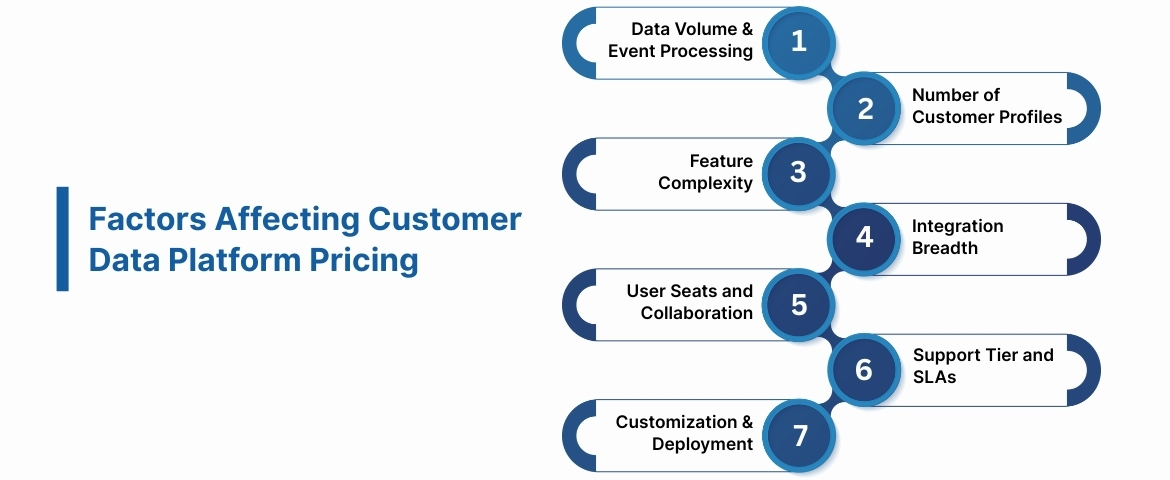
- Data volume and event processing: Higher event volumes increase processing and storage costs; make sure your pricing model accounts for real-time tracking spikes and seasonal peaks. A clothing retailer tracking millions of product page views, add-to-cart actions, and purchase events monthly will pay substantially more than a boutique consulting firm tracking only website forms and email opens. Event volume directly correlates with the processing and storage infrastructure required.
- Number of Customer Profiles: Some platforms charge based on the total number of profiles stored. A direct‑to‑consumer brand with a very large customer base faces higher profile‑based pricing than a B2B SaaS firm with a much smaller account list. Profile count matters because storage, querying, and activation become more resource-intensive at scale.
- Feature Complexity: Entry-level plans typically include basic segmentation, audience export, and standard integrations. Mid-tier plans add real-time analytics, predictive audiences, and custom attributes. Enterprise tiers include advanced automation, AI-powered insights, and dedicated infrastructure. Each feature tier escalates costs proportionally.
- Integration Breadth: Native integrations (built-in connections to platforms like Salesforce, Google Ads, or Shopify) cost less than custom API development. If your tech stack includes legacy systems, niche tools, or proprietary databases, integration complexity rises, and so do implementation fees.
- User Seats and Collaboration: Some platforms charge per user or per team accessing the system. A single analyst costs less than enabling 50 cross-functional users across marketing, sales, and analytics. Understand upfront whether your license covers unlimited users or requires additional seat purchases.
- Support Tier and SLAs: Basic support includes email and ticketed help. Premium support adds dedicated account managers, phone access, and faster response times. Enterprise support often requires annual contracts with guaranteed uptime commitments and custom training.
- Customization and Deployment: Managed SaaS deployments cost less than self-hosted or hybrid environments. If you require custom fields, workflows, or security configurations, the customization fees can add up quickly.
Customer data platform pricing reflects the discipline of your data strategy. When you define event limits, profile growth expectations, and integration needs upfront, you keep costs predictable and aligned with business value rather than reactive spend.
Knowing what drives cost is useful, but how vendors package those costs matters just as much.
Analyzing Different Customer Data Platform Pricing Models
You will usually encounter a few recurring models when vendors describe customer data platform pricing. Each model has trade-offs for predictability, scalability, and alignment with your usage.
Common CDP pricing models table
| Pricing model | How it works | Pros for your team | Watch-outs for cost |
|---|---|---|---|
| Tiered subscription | Fixed packages with feature and volume limits per tier. | Simple to budget; easy comparison across vendors. | Risk of paying for features you do not use; overages if you exceed caps. |
| Usage-based | Pricing tied to actual events, profiles, or data processed. | Good fit for variable traffic; you pay in line with activity. | Bills can spike during peak seasons; requires close monitoring. |
| Custom quote | Vendor tailors customer data platform pricing to your stack and goals. | Can reflect your exact needs; room for negotiation. | Harder to benchmark; risk of hidden terms and opaque metrics. |
| User-based plus base fee | Base platform fee plus per-user or per-seat charges. | Clear view of marginal cost as teams grow. | Expansion in headcount can inflate customer data platform costs quickly. |
In general, subscription models help when you value predictability and know your approximate usage pattern for the next year. Usage-based customer data platform pricing suits teams with distinct peak and off-peak cycles, but you must track volume carefully to avoid billing surprises.
If a vendor proposes a custom structure, treat it as a chance to tie customer data platform cost directly to your success metrics. For example, you might negotiate tiers based on active profiles in your priority regions or on specific use-case bundles, such as e-commerce personalization and cart recovery, rather than generic feature checklists. By understanding pricing models, you can look beyond the headline cost of a customer data platform and discover hidden costs that can derail your budget.
Even the right pricing model can fall apart if you miss the expenses that never show up on a pricing page.
Identifying Hidden Costs in Customer Data Platform Pricing
Hidden customer data platform costs often appear after the contract is signed, when teams start to work with live data, build journeys, and respond to new requirements. If you ignore these, your total cost of ownership can double relative to the original quote.
- Implementation and Onboarding: Setting up a CDP means configuring data sources, mapping customer traits, building starter segments, and training your team. Vendors often charge for setup help, and prices vary by platform complexity and your team’s skills.
- Data Migration and Integration: Moving historical customer data into a new CDP takes ETL work. If your data sits in mismatched formats across many databases, engineers spend weeks on it. Integrations outside built‑in connectors often need custom API work that costs a lot depending on how complex it is.
- API Usage and Overages: Platforms usually give you a set amount of allowed API calls. Real‑time segmentation, syncing across systems, and fast‑moving campaigns use up those calls fast. If you keep pushing audience data out to many ad systems without pausing, your requests stack up like runaway popcorn in a popper. When you go past your limit, the extra calls add up in cost and surprise you with a big bill.
- Maintenance, Upgrades, and Support: Beyond base subscription costs, ongoing maintenance includes security patches, performance optimization, and feature updates. For self-hosted or hybrid deployments, infrastructure costs add up, including cloud compute, data storage, and backup services. Support costs scale with your organization.
- Compliance and Data Governance Tools: GDPR, CCPA, PIPEDA, and emerging state-level regulations require consent management, data access request handling, and breach notification infrastructure. Many CDPs charge extra for these compliance features rather than bundling them.
- Data Quality and Cleaning Services: Poor-quality data with duplicates, missing fields, and inconsistent formats can kill a CDP the way mold ruins a loaf of bread. Hiring outsiders to clean messy data can cost several thousands, and in-house teams mean ongoing payroll expenses.
These hidden costs explain why customer data platform pricing must be evaluated as a long-term operational investment, since overlooked implementation, usage, and compliance expenses often outpace the original license fee.
Talk to Ingest Labs to see how server-side tracking and first-party data collection through Ingest IQ and Event IQ can reduce overages, integration sprawl, and long-term compliance costs.
Once you account for every dollar going out, the focus shifts to what comes back and how quickly.
Understanding the ROI from Customer Data Platforms
CDP ROI becomes visible faster than most enterprise software investments. Organizations typically realize value within 6-8 months, with four in five businesses reporting positive ROI within 12 months.
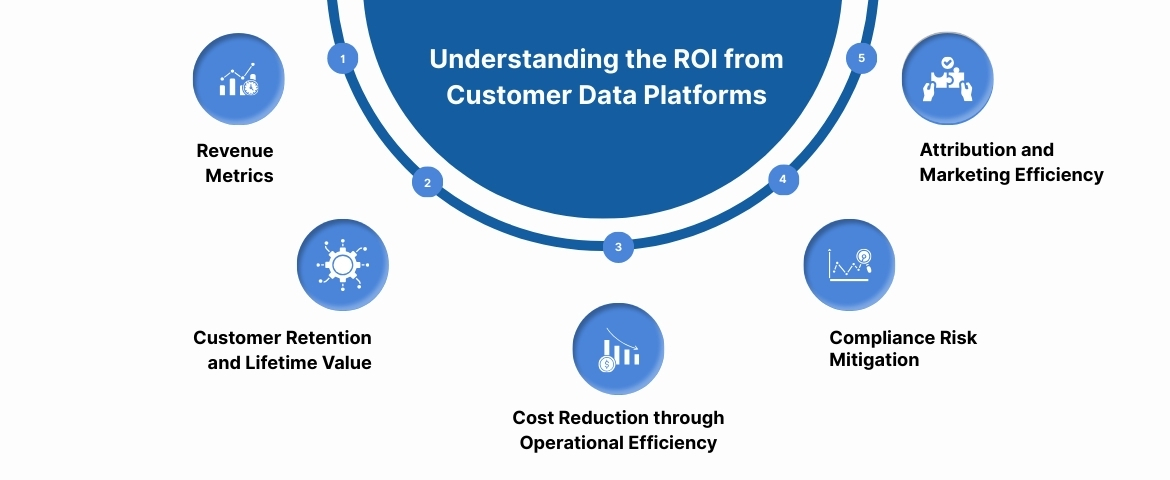
- Revenue Metrics: CDPs drive measurable top-line impact. E-commerce retailers implementing unified customer profiles and real-time segmentation see 10–15% improvements in purchase conversion rates. Retail brands leveraging CDP-powered personalization report 25% boosts in website engagement and 760% increases in revenue per email. Cart abandonment recovery campaigns alone can recover 8–12% of abandoned sales, directly offsetting CDP costs.
- Customer Retention and Lifetime Value: Unified customer profiles enable better retention targeting. Health and beauty brands using CDPs for loyalty program integration report 35% increases in loyalty enrollment and 22% increases in average order value. Retained customers cost less to acquire than new ones, and improved loyalty compounds over time, raising customer lifetime value (CLV) by 15–30%.
- Cost Reduction through Operational Efficiency: CDPs reduce manual data work. Teams spend less time manually exporting audiences, building segments in spreadsheets, and syncing data across tools. This operational efficiency frees marketing staff to focus on strategy rather than mechanics. One retailer implementing a CDP cut support costs by 30% and increased upsell opportunities by 18%.
- Compliance Risk Mitigation: This ROI is harder to quantify but significant. GDPR fines average €2.36 million; CCPA violations cost $2,663–$7,988 per incident. PIPEDA penalties reach $100,000 CAD per violation. A CDP with built-in consent management and audit trails prevents costly breaches and regulatory penalties. The indirect ROI, avoiding a single enforcement action, exceeds years of platform costs.
- Attribution and Marketing Efficiency: CDPs enable accurate multi-touch attribution, revealing which channels and campaigns drive real revenue. Better attribution reduces wasted ad spend and improves budget allocation.
The financial formula: if your CDP costs $50,000 annually and drives a 2% conversion rate improvement on $10 million in annual revenue, the incremental revenue is $200,000, a 4x ROI before accounting for retention and efficiency gains.
ROI looks different for every business, which is why budgeting needs structure, not assumptions.
Checklist for Budgeting Customer Data Platform Pricing
Use this checklist to structure your budgeting process for a customer data platform. It focuses on the business perspective rather than just technical details.
1. Define core use cases
- List your top five use cases for a customer data platform, such as cross-channel remarketing, churn prevention, or media measurement.
- Prioritize use cases that affect revenue or compliance, because those justify customer data platform costs more easily.
2. Quantify data scale
- Estimate annual site visitors, app users, email subscribers, and active customers for the next one to two years.
- Use this to model profile and event volumes, which drive the cost of a customer data platform under volume-based pricing.
3. Map current tools and contracts
- Inventory your existing analytics, tag managers, CRMs, and campaign tools across the US and Canada.
- Identify which tools a customer data platform could replace or simplify, especially where Ingest IQ and Event IQ can consolidate tracking and insights.
4. Assess privacy and compliance obligations
- Document where you operate and which laws apply, including CCPA/CPRA, other US state privacy laws, GDPR for EU traffic, and Canadian requirements.
- Confirm whether you need features like consent logging, data residency options, or granular role-based access when comparing customer data platform pricing.
5. Plan for services and internal capacity
- Budget for professional services or consulting during initial rollout, typically 1 to 2 times the annual software cost for larger programs.
- Allocate internal time from marketing ops, analytics, engineering, and legal to keep customer data platform costs realistic.
6. Decide on pricing model fit
- Choose whether you prefer tiered subscription, usage-based, or custom customer data platform pricing based on your growth predictability.
- Ask each vendor to map your projected volumes to expected bills, including overage scenarios.
7. Set guardrails and success metrics
- Define a target range for annual customer data platform cost, including license and services, before negotiations start.
- Specify KPIs such as revenue uplift, CAC reduction, or improved attribution accuracy, then track them against your CDP rollout.
Ingest Labs can help you work through this checklist by translating your current tagging and identity issues into a practical plan for Ingest IQ, Ingest ID, and Event IQ. If you want to benchmark what your CDP budget should look like based on your traffic and stack, you can start by sharing a simple inventory of your current tools and volumes with the Ingest Labs team.
Conclusion
Customer data platform pricing reflects real complexity, infrastructure demands, and ongoing service effort. The lowest price often underdelivers, while premium platforms can overshoot actual needs. The right CDP sits where business goals, budget limits, and realistic ROI meet.
Strong CDP outcomes come from treating pricing as an investment, not a line item. Teams that define clear use cases, assess data readiness early, and account for hidden costs choose better vendors and see results sooner. A $40,000 annual CDP that lifts conversions by 5% and cuts support costs by 30% delivers clear value. A $150,000 platform that remains underused drains budget and momentum.
As privacy rules tighten and cookies fade, CDPs shift from optional to essential infrastructure. First-party data, server-side tracking, and unified profiles now form the baseline.
Contact usto see how Ingest Labs helps you implement a cost-effective, privacy-ready CDP strategy using server-side tracking, unified profiles, and first-party data — so you get measurable ROI and predictable budgets.
FAQs
1. What's the average cost of a customer data platform in 2025?
SMBs typically spend $15,000–$50,000 annually. Mid-market organizations budget $50,000–$150,000. Enterprise customers negotiate custom pricing often exceeding $200,000 annually. Actual costs vary based on data volume, feature complexity, and implementation scope.
2. How do CDP pricing models differ in practice?
Subscription-based models offer budget predictability but risk overpaying for unused capacity. Usage-based models align cost with consumption but create uncertainty as you scale and can trigger surprise invoices. Tiered models provide flexibility but require contract amendments to upgrade. The best model depends on your data growth trajectory and preference for predictability versus variable costs.
3. What hidden costs should I anticipate with CDPs?
Beyond base subscription fees, budget for implementation services, data migration and integration, API overage charges, compliance tool add-ons, premium support upgrades, and ongoing training. These costs frequently add 30–50% to published pricing. Request itemized quotes from vendors rather than relying on base pricing alone.
4. Which features most significantly affect CDP pricing?
Advanced segmentation, real-time analytics, AI-driven personalization, extensive integrations, server-side tracking, and dedicated support are primary cost drivers. Entry-level plans include basic segmentation; mid-tier plans add predictive audiences and API access; enterprise tiers include infrastructure customization and AI capabilities.
5. Can small businesses afford a robust CDP?
Yes, but approach it strategically. Lightweight, usage-based CDP plans designed for SMBs start at $10,000–$20,000 annually. These plans handle basic profiling and segmentation. The key is matching functionality to actual needs. Many SMBs find entry-level plans sufficient; rapid scaling is a luxury. Avoid overbuying enterprise features you won't use for years.
6. How does data quality impact CDP ROI?
Directly and dramatically. Poor data quality costs organizations $9.7–$15 million annually through missed revenue, inefficient campaigns, and operational waste. CDPs don't clean bad data; they expose it, often after implementation. Budget for data quality assessment and remediation before or during CDP rollout.
7. What compliance costs should I include in my CDP budget?
GDPR, CCPA, PIPEDA, and state-level privacy laws now require consent management, audit logging, and DSAR handling capabilities. Some vendors bundle these; others charge separately. Include compliance tool costs, annual audits, consultant fees if needed, and staff training in your budget.