




What if you could see your business exactly as your customers experience it? In 2025, companies that excel at customer journey mapping report a 54% greater ROI on their marketing investments than those that don't.
Yet most marketing teams struggle with disconnected touchpoints, fragmented data, and incomplete visibility into customer behavior across channels.
A customer journey map turns fragmented customer interactions into a clear, measurable view of how people move from awareness to long-term loyalty. It shows you precisely where customers discover your brand, what drives their decisions, and why they stay loyal or leave.
In this guide, you'll learn how to create a data-driven customer journey map that captures authentic experiences, identifies high-impact opportunities, and drives measurable growth.
At a glance
- A customer journey map visualizes every interaction from awareness to advocacy, helping you identify friction points and optimize the full customer lifecycle.
- Effective mapping requires seven steps: defining objectives, building personas, mapping touchpoints, documenting stages, identifying emotions, analyzing opportunities, and continuous iteration based on real data.
- Success depends on accurate data collection across channels. Tools like Ingest Labs enable complete customer tracking even as third-party cookies disappear and privacy regulations tighten.
- Journey mapping delivers tangible results, including higher retention, increased conversions, and better team alignment when built on actual customer data rather than assumptions.
- Regular updates, cross-functional collaboration, and connecting insights to business metrics separate effective journey maps from unused documents sitting in shared drives.
What is a Customer Journey Map?
A customer journey graph is a visual representation documenting every interaction a customer has with your brand from initial awareness through post-purchase advocacy.
Customer Journey Map vs. Buyer Journey
The buyer journey focuses specifically on pre-purchase decision-making from problem awareness through purchase completion. Whereas the customer journey encompasses the entire relationship lifecycle, extending beyond purchase to cover onboarding, product usage, support interactions, retention, and advocacy.
You need to know the essential components that make journey maps actionable. Understanding these components helps you design experiences that naturally guide customers from discovery to loyalty.
5 Components of a Customer Journey Map
A complete customer journey map includes five critical elements working together to tell the full story of your customer's experience. Missing any component creates blind spots that lead to incomplete insights.
1. Customer Personas
Start with detailed profiles based on actual customer data, not generic demographics. What challenges do they face? What motivates their decisions? Without clear personas, your map becomes too broad to drive meaningful action.
2. Journey Stages
Structure your map around the five stages: awareness, consideration, decision, retention, and advocacy. This chronological framework helps everyone understand where customers are and what they need at each phase.
3. Touchpoints and Channels
Document every point where customers interact with your business—website visits, email opens, social media engagement, customer service calls, in-app actions. Include both digital and offline touchpoints to avoid missing critical interactions.
4. Customer Actions and Emotions
For each touchpoint, capture what customers actually do and how they feel. Are they clicking confidently or bouncing in frustration? Pairing actions with emotions reveals the why behind the what.
5. Pain Points and Opportunities
Identify where friction occurs, long load times, confusing navigation, unclear messaging, and slow responses. Each friction point you eliminate directly impacts conversion rates and customer satisfaction.
These components transform abstract ideas into concrete insights. But a customer relationship has five distinct stages. Each stage demands different strategies and touchpoints.
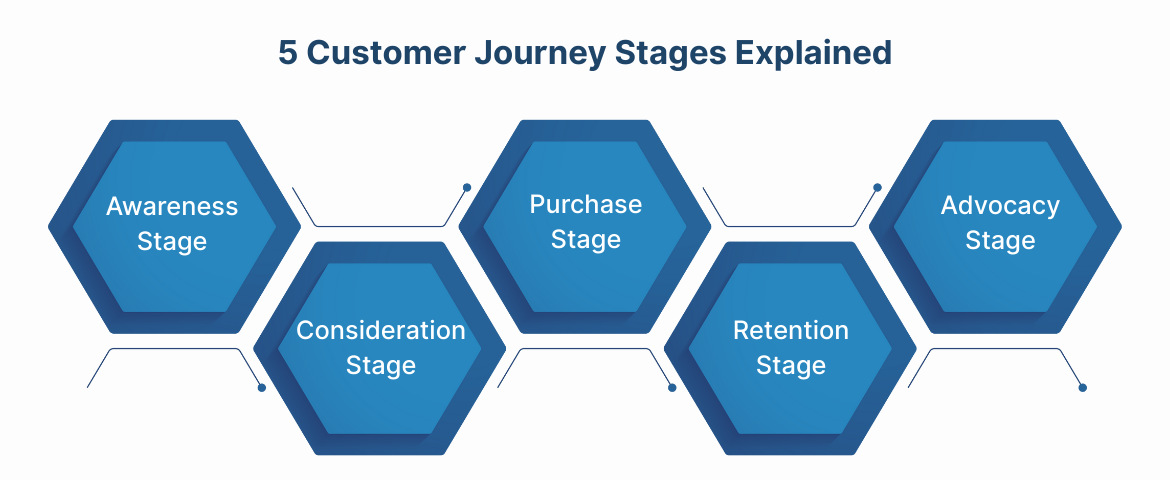
5 Customer Journey Stages Explained
Every customer relationship unfolds through five distinct stages, each with unique behaviors, emotions, and decision points. Mapping these stages reveals exactly where your experience succeeds and where it breaks down.
1. Awareness Stage
Your customer realizes they have a problem needing a solution. They're researching symptoms, asking peers for advice, and searching for educational content.
Your goal is to be discovered when they look for answers through valuable content addressing their pain points.
2. Consideration Stage
Now, customers are aware of your brand. They will actively evaluate whether your solution fits their needs. They compare your offering against competitors, read reviews, and assess features versus price.
Your focus should be on demonstrating clear differentiation and building trust through social proof.
3. Decision/Purchase Stage
The customer is ready to buy but needs final reassurance. Friction at this stage significantly reduces conversion rates. Slow checkout processes, unclear pricing, or complicated signup flows create abandonment.
Your priority is removing obstacles and simplifying the purchase decision.
4. Retention Stage
The sale is complete, but the relationship is just beginning. Customers now experience your actual product or service.
Poor onboarding, confusing interfaces, or slow support responses turn buyers into churners. Strong retention requires proactive communication and consistent value delivery.
5. Advocacy Stage
Delighted customers become vocal promoters. They leave positive reviews, refer friends, and defend your brand in conversations. This stage only happens when previous stages consistently exceed expectations.
Your job is to make advocacy easy through referral programs and community building.
Also Read: User Journey Mapping: Definition, Types, and Process
Now let's walk through the step-by-step process for building maps that drive real business results.
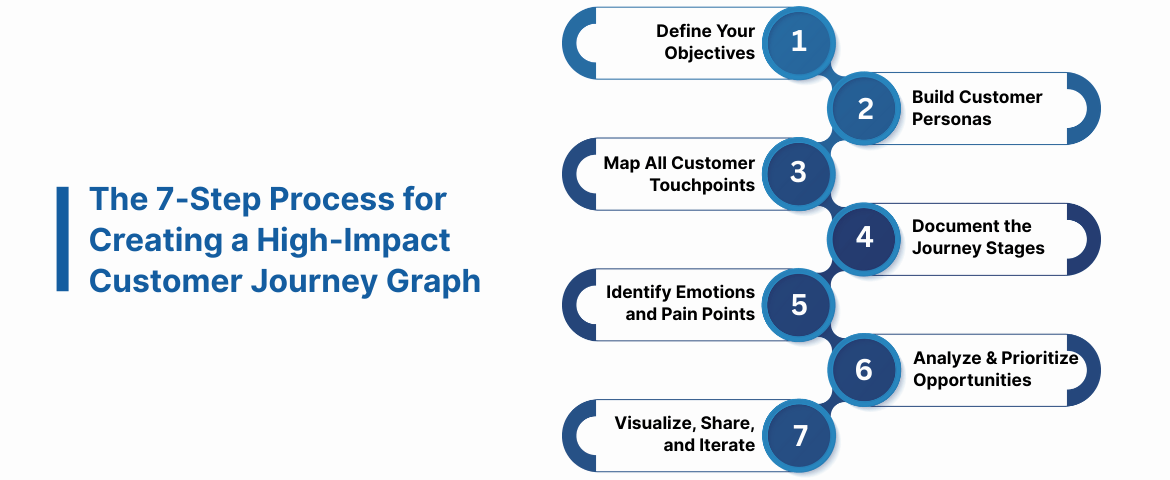
The 7-Step Process for Creating a High-Impact Customer Journey Map
Building an effective customer journey graph requires a systematic approach that balances research, analysis, and visualization. Follow these seven steps to create a map that drives measurable improvements.
Step 1: Define Your Objectives
First, clarify exactly what you want to achieve. Are you trying to reduce cart abandonment? Improve onboarding completion rates? Increase customer lifetime value? Your objectives determine which journey you map and what metrics you track.
Be specific. Instead of "improve customer experience," aim for "reduce checkout abandonment by 25% within three months." Clear goals keep your mapping focused and make success measurable.
Step 2: Build Customer Personas
Create a detailed profile of your target customers based on real data, not assumptions. Use CRM records, support tickets, survey responses, and behavioral analytics to understand who your customers are and how they make decisions.
Focus on one persona per map. Trying to map multiple personas simultaneously creates generic outputs missing specific nuances, driving each segment's behavior. You can create multiple maps for different personas later.
Step 3: Map All Customer Touchpoints
List every single point where customers interact with your brand. Include obvious touchpoints like website visits and purchases, but don't forget less obvious ones like review sites, social media mentions, or support team conversations.
Organize touchpoints by channel, digital, physical, and human. Then categorize by stage: pre-purchase, purchase, post-purchase. This inventory becomes the foundation for understanding the complete customer experience.
Step 4: Document the Journey Stages
Walk through each stage from your customer's perspective. What are they trying to accomplish with awareness? What questions arise during consideration? What concerns prevent purchase? What experiences shape retention?
Use actual customer data to validate each stage. Traditional cookie-based tracking often misses mobile app interactions and cross-device behavior, leading to incomplete journey assumptions instead of accurate insights.
Step 5: Identify Emotions and Pain Points
For each touchpoint, document what customers feel and where they struggle. Use qualitative research, like customer interviews and support ticket analysis, combined with quantitative data like bounce rates and time on page.
Common pain points include slow page loads, confusing navigation, unclear value propositions, complicated checkout processes, and unresponsive support. Each friction point represents a conversion opportunity when eliminated.
Step 6: Analyze and Prioritize Opportunities
Review your completed map and identify patterns. Where do most customers drop off? Which touchpoints generate the most frustration? What stages show the biggest gaps between expectations and actual experience?
Prioritize improvements based on impact and effort. Quick wins like fixing broken forms deliver immediate results. Larger initiatives like platform redesigns require more resources but may address systemic issues.
Step 7: Visualize, Share, and Iterate
Transform your research into a clear visual format everyone can understand. Use timelines, flowcharts, or templates showing stages horizontally and touchpoints, actions, emotions, and opportunities vertically.
Share the map across marketing, sales, product, and support teams. Schedule regular reviews to update the map as customer behavior evolves. Journey maps are living documents, not one-time projects.
The biggest challenge teams face is collecting accurate data across all touchpoints in today's privacy-first environment. Ingest Labs addresses this challenge through server-side tracking with Ingest IQ and unified event data in Event IQ, enabling accurate journey mapping even in privacy-restricted environments.
Also Read: The Complete B2B Journey Mapping Guide for Modern Sellers
Now you know how to build your customer journey graph. But how can you differentiate it from others?
5 Best Practices for Customer Journey Mapping
Many teams create journey maps that sit unused in shared drives. Following these practices ensures your maps drive real improvements rather than becoming shelf-ware.
- Base maps on real data, not assumptions. Talk to actual customers, review support tickets, and analyze behavioral data. The biggest mistake teams make is creating maps based on internal assumptions about customer behavior. Reality often surprises you, and those surprises contain your highest-value opportunities.
- Update maps regularly. Customer behavior changes, new competitors emerge, and market conditions shift. Review and update your journey maps quarterly at a minimum. Major product launches or market changes require immediate updates to keep maps relevant.
- Include all relevant teams. Marketing, sales, product, support, and leadership should all contribute to and review journey maps. Each team sees different touchpoints and has unique insights. Cross-functional involvement ensures everyone understands and acts on findings.
- Connect journey insights to business metrics. Link each stage and touchpoint to specific KPIs. How does awareness stage optimization impact lead volume? What's the revenue impact of improving retention? Quantifying results proves value and helps prioritize investments.
- Make maps accessible and actionable. Store journey maps where everyone can find them, reference them in meetings, and use them to guide product roadmaps and marketing plans. Maps only deliver value when teams actually use them to make decisions.
Also Read: How to Map and Optimize Customer Journey Retention for Growth
However, the most critical practice underlying all others is having accurate data.
Turn Customer Journey Map Into Growth With Ingest Labs
Most marketing teams face a fundamental challenge when mapping customer journeys: incomplete data. Browser restrictions block cookies, mobile apps operate separately from web properties, and customers use multiple devices. Privacy regulations limit tracking. The result is fragmented visibility, making accurate journey mapping nearly impossible.
Ingest Labs provides the complete data infrastructure modern marketers need to map, measure, and optimize customer journeys effectively. Our platform provides unified, privacy-aware visibility into customer behavior across web and app environments.
- Ingest IQ delivers server-side tracking that bypasses browser limitations entirely, capturing accurate behavioral signals across web and mobile applications regardless of cookie restrictions.
- Ingest ID assigns a first-party identifier to each unique visitor, enabling precise cross-device tracking and accurate attribution throughout the entire customer journey.
- Event IQ unifies all customer data into a single intelligence platform, revealing patterns across channels, with AI-powered insights surfacing trends automatically.
Together, these tools eliminate guesswork from customer journey mapping. You build maps based on complete, accurate data reflecting real customer behavior rather than incomplete fragments.
Marketing teams using Ingest Labs gain clear visibility into the customer journey from first touch through advocacy, driving better decisions, higher ROI, and sustainable competitive advantage.
Conclusion
A customer journey map transforms fragmented customer data into clear, actionable insights that drive growth. By following the seven-step process outlined in this guide, you'll create maps revealing exactly where to focus efforts for maximum impact.
The key to success is building maps on complete, accurate data rather than assumptions or partial information. As privacy regulations tighten and tracking becomes more complex, having the right data infrastructure matters more than ever.
Contact Ingest Labs today to know how our platform helps marketing teams gain complete visibility into customer journeys, eliminate data gaps, and turn insights into measurable results.
Frequently Asked Questions
Q1.What is the difference between a customer journey graph and a customer experience map?
A customer journey map focuses on specific interactions and touchpoints across the buying process. A customer experience map takes a broader view of how customers feel about your brand overall, making journey maps more tactical and actionable.
Q2. How often should I update my customer journey graph?
Review and update journey maps quarterly at a minimum. Major product launches, significant market changes, or shifts in customer behavior require immediate updates to ensure maps reflect the current reality rather than outdated assumptions.
Q3. What tools do I need to create a customer journey map?
Basic journey maps can be created with presentation software or collaborative tools like Miro. However, effective mapping requires accurate customer data from analytics platforms, CRM systems, and behavioral tracking tools capturing complete cross-channel activity.
Q4. How do I measure the ROI of customer journey mapping?
Track improvements in key metrics like conversion rates, customer retention, customer lifetime value, and satisfaction scores. Connect specific journey optimizations to business outcomes to prove ROI and guide future investments.
Q5. Can small businesses benefit from a customer journey graph?
Absolutely. Small businesses often have closer customer relationships, providing rich insights for journey mapping. The process helps you understand customer needs deeply, prioritize limited resources effectively, and compete through superior customer experiences.