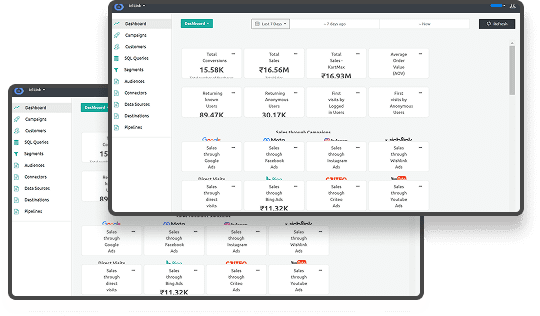





As a marketer, you have countless ways to capture attention across channels, but attention alone doesn’t drive growth. What drives sustainable performance is knowing which efforts truly work, why they work, and where data may be misleading you.
In today’s privacy-first, cookieless environment, digital marketing analytics has become more complex and more critical than ever. Browser restrictions, consent requirements, ad blockers, and fragmented tracking tools have made traditional analytics less reliable. As a result, many teams are making optimization decisions based on incomplete or inflated data.
Digital marketing analytics helps you move beyond surface-level metrics and platform-reported success. It enables you to evaluate real performance, identify gaps between reported results and actual revenue, and uncover opportunities for smarter growth.
This guide explores how modern digital marketing analytics works, which metrics matter, how data should be collected and governed, and how to turn accurate insights into measurable business outcomes without sacrificing privacy or trust.
TL;DR:
- Digital marketing analytics turns fragmented channel data into actionable insights, enabling marketers to measure true performance and drive sustainable, privacy-compliant growth.
- Accurate, first-party, and deduplicated data is critical for reliable attribution, smarter optimization decisions, and avoiding inflated metrics across marketing platforms.
- Focusing on actionable Key Performance Indicators (KPIs) over vanity metrics helps align marketing efforts with real business goals like revenue, profitability, and customer lifetime value.
- Unified reporting, funnel analysis, and campaign-level insights reveal optimization opportunities, reduce wasted spend, and improve Return On Investment (ROI) across content, Search Engine Optimization (SEO), email, and paid media.
- Modern analytics strategies combine privacy compliance, data integration, and activation to transform insights into personalized, scalable, and high-impact marketing actions.
What Is Digital Marketing Analytics?
Digital marketing analytics is the discipline of collecting, governing, analyzing, and activating marketing data to understand true performance and guide smarter business decisions.
At its core, digital marketing analytics answers four critical questions:
- What is actually driving conversions and revenue?
- Which channels and campaigns are underperforming or over-attributed?
- Where are users dropping off across the customer journey?
- How can data be used to improve future performance, not just report past results?
Unlike basic reporting, which focuses on surface-level metrics such as traffic or impressions, modern digital marketing analytics connects user behavior, attribution logic, and revenue outcomes across channels. It ensures that the data feeding your dashboards is accurate, deduplicated, and privacy-compliant before any optimization decisions are made.
Digital marketing analytics typically spans multiple touchpoints, including:
- Websites and landing pages
- Paid media platforms (search, social, display)
- Email and marketing automation tools
- Customer Relationship Management (CRM) and backend revenue systems
When implemented correctly, it provides a unified view of how audiences interact with your brand across channels and devices. This allows marketers to move beyond intuition and platform-reported success, and instead optimize based on trusted signals tied to real business impact.
Also Read: The Power of Predictive Customer Analytics
What Are the Sources of Digital Marketing Analytics Data?
Digital marketing analytics draws from multiple sources to provide a complete picture of your audience, campaigns, and business outcomes. Collecting data from diverse touchpoints ensures your insights are accurate, actionable, and relevant.
Primary sources include:
- Website Analytics: Tools like Google Analytics track user behavior, page views, sessions, bounce rates, and conversion events.
- Social Media Platforms: Insights from Facebook, Instagram, LinkedIn, and Twitter reveal engagement, reach, clicks, and audience demographics.
- Paid Advertising Platforms: Data from Google Ads, Meta Ads, or programmatic channels show impressions, clicks, Cost Per Conversion (CPC), and Return On Ad Spend (ROAS).
- Email Marketing Tools: Metrics such as open rates, Click-Through Rates (CTR), and conversions help measure campaign effectiveness.
- CRM and Backend Systems: Customer purchase history, revenue, and lifetime value enable attribution and profitability analysis.
Emerging or integrated data sources:
- First-Party Data: Directly collected from your website, apps, or CRM for privacy-compliant, high-quality signals.
- Event Tracking & Tag Management: Advanced setups capture interactions beyond standard pageviews, including form submissions, video plays, and micro-conversions.
- Customer Data Platforms (CDPs): Centralize and unify data from multiple channels for a single, reliable customer view.
By combining these sources, marketers can cross-validate data, reduce blind spots, and make decisions based on real user behavior rather than incomplete or platform-only metrics. The goal is not just to track activity but to understand the drivers of business outcomes.
Before diving deeper, let’s first understand why analytics plays such a critical role in your overall marketing stack.
Why Is Digital Marketing Analytics Important?
Digital marketing analytics transforms raw data into actionable insights that drive smarter decisions, better ROI, and sustainable growth. Without it, marketing strategies rely on assumptions and platform-reported metrics that may be incomplete or misleading.
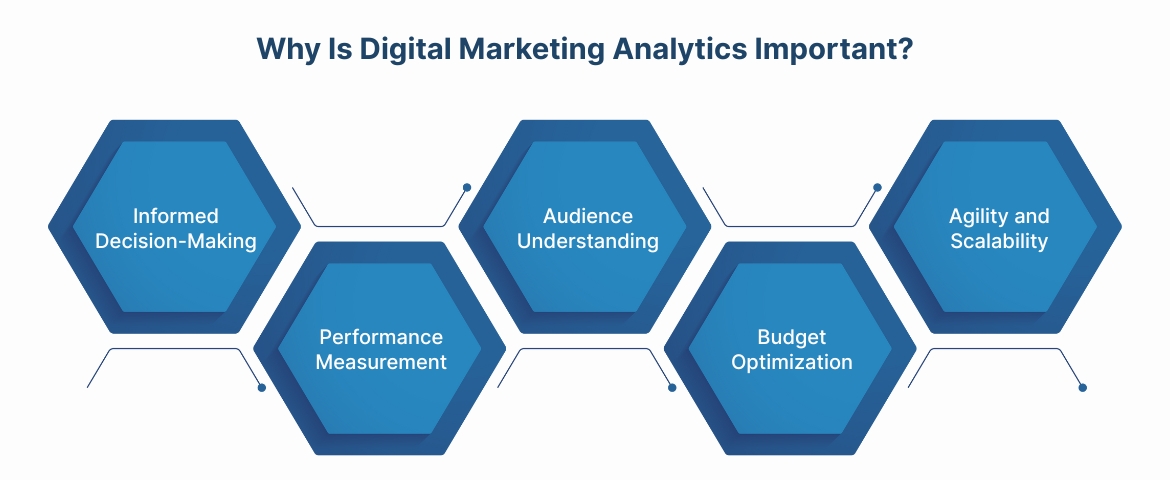
Key reasons analytics is critical include:
- Informed Decision-Making: Data replaces guesswork. Marketers can optimize campaigns, messaging, and channels based on evidence rather than intuition.
- Performance Measurement: Track KPIs such as ROAS, CAC, CTR, and conversions to evaluate success and continuously improve outcomes.
- Audience Understanding: Behavioral, demographic, and intent data reveal what motivates customers, enabling personalized marketing that resonates.
- Budget Optimization: Identify high-performing campaigns and channels to allocate spend efficiently, reducing wasted ad dollars.
- Agility and Scalability: Real-time insights allow teams to pivot quickly, experiment confidently, and scale strategies backed by proven performance.
Accurate, unified data empowers teams to focus on what truly drives business growth rather than chasing vanity metrics or platform-reported “success.”
Also Read: Marketing Analytics: What It Is and How It Strengthens Your Campaign Performance
Key Metrics for Digital Marketing Analytics
Choosing the right metrics is essential for understanding whether your marketing efforts are moving the needle. Not all numbers are created equal. Some provide actionable insights, while others simply inflate dashboards without guiding decisions.
Defining the Right KPIs
Every business has unique goals, so KPIs should align directly with your objectives. Ask:
- What is our primary business goal? Focus on overarching targets like revenue, profit, or customer growth.
- What are the goals of each marketing channel? Examples:
- Website: Lead generation, form submissions, or online sales
- Paid campaigns: Brand awareness, lead acquisition, direct sales
- Email/newsletter: Customer engagement, nurturing, or product promotion
- Which metrics reflect goal achievement? Identify measurable indicators that track progress against each objective.
Apply the S.M.A.R.T. framework to ensure clarity:
- Specific: Exactly what do you want to achieve?
- Measurable: How will success be tracked?
- Achievable: Is the goal realistic?
- Relevant: Does it align with business objectives?
- Time-bound: What is the deadline or milestone?
Actionable Metrics vs. Vanity Metrics
Focus on metrics that drive decisions, not just look good:
| Aspect | Actionable Metrics | Vanity Metrics |
|---|---|---|
| Definition | Provide insights you can act on to improve performance | Look impressive but offer little guidance |
| Business Relevance | Directly tied to goals | Weak or indirect link to outcomes |
| Decision-Making Value | Inform optimizations and strategy | Rarely guide meaningful change |
| Context Required | Interpreted with goals, segments, benchmarks | Often viewed in isolation |
| ROI Impact | Optimizes spend, conversions, and ROI | Creates a false sense of success |
| Examples | Conversion rate, ROAS, CPC, funnel drop-offs | Pageviews, raw traffic, social followers, impressions |
By prioritizing actionable metrics, teams can optimize campaigns, content, and audience targeting efficiently, ensuring marketing efforts are both measurable and impactful.
Useful Analytics Reports for Marketers
Once you’ve identified the right KPIs, the next step is using reports that translate raw data into actionable insights. Well-structured reports allow marketers to pinpoint underperforming areas, optimize campaigns, and drive ROI.
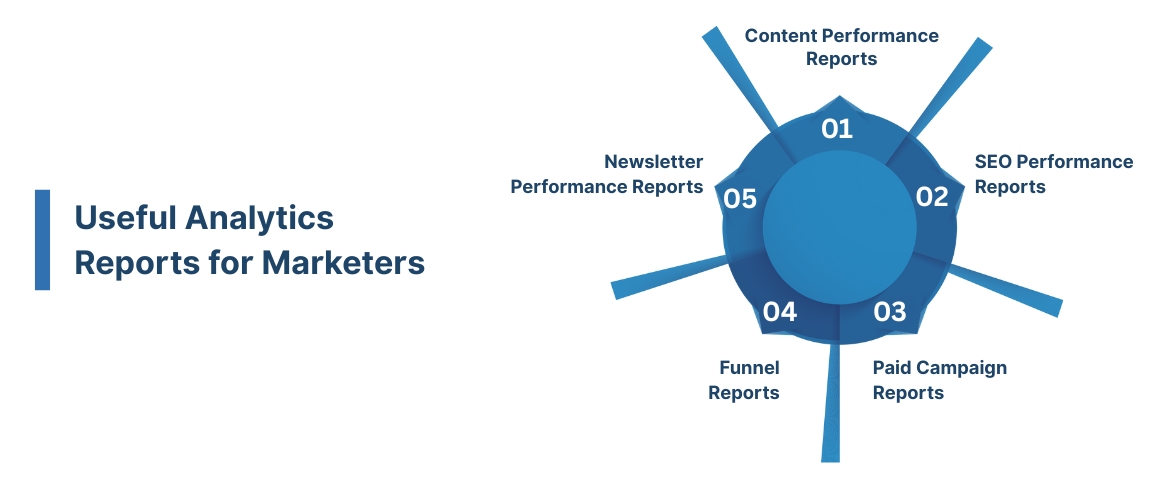
1. Content Performance Reports
Content performance reports reveal which assets capture audience attention and drive engagement. Metrics to track include:
- Content impressions – How often content is viewed
- Unique content impressions – Views by individual users
- Content interactions – Clicks, shares, or other engagement actions
- Unique content interactions – Individual user engagement
- Content interaction rate – Engagement relative to impressions
Analyzing these metrics shows which elements resonate, which fall flat, and where adjustments are needed, enabling smarter content strategy and increased conversions.
2. SEO Performance Reports (via Google Search Console)
SEO reports provide insights into search behavior and landing page performance. Key metrics include:
- Landing pages – Impressions, clicks, bounce rate, time on page, conversions
- Keywords – Search volume, CTR, average position
- Devices – Sessions, engagement, and conversions by device
- Countries – Performance across markets for localization and targeting
These insights help refine keyword strategies, optimize landing pages, and improve search visibility, ensuring traffic quality and higher conversion potential.
3. Paid Campaign Reports (via Google Ads Integration)
For paid campaigns, linking Google Ads to analytics platforms provides clarity on ROI. Track:
- Clicks – Total user clicks per ad
- Average CPC – Cost per click
- CTR – Clicks divided by impressions
- ROAS – Revenue relative to ad spend
- Goal conversions – Conversions achieved through paid campaigns
This data helps scale high-performing ads, pause underperformers, and optimize copy, targeting, and budgets for maximum returns.
4. Funnel Reports
Funnel reports map the customer journey and reveal drop-off points. Example for a signup funnel:
Home Page → Product Page → Click Signup → Signup Page
Metrics to analyze:
- Step-by-step conversion rates
- Drop-off percentages
- Bottlenecks and friction points
By identifying where users disengage, marketers can streamline flows, remove friction, and improve overall conversion performance.
5. Newsletter Performance Reports (via UTM Tags)
UTM-tagged URLs help measure email performance accurately. Key tracking parameters:
- utm_source – Email source
- utm_medium – Channel (e.g., email)
- utm_campaign – Campaign name
- utm_term – Segment or topic
- utm_content – Call-To-Aaction (CTA) or variant
Tracking these allows marketers to compare campaigns, evaluate content resonance, optimize CTAs, and allocate budgets effectively.
Current Trends in Digital Marketing Analytics
Staying ahead in digital marketing requires awareness of emerging trends. Analytics is evolving rapidly due to privacy regulations, new technology, and changing user behavior. Key trends include:
1. Data Privacy and Compliance
Privacy-first policies, like GDPR, CCPA, and global consent requirements, are reshaping analytics. Marketers now:
- Collect only necessary data with explicit consent
- Use anonymized or aggregated tracking
- Rely increasingly on first-party data instead of third-party cookies
Privacy-compliant analytics not only avoids fines but also builds trust with audiences, enabling long-term data reliability.
2. First-Party Data Adoption
With third-party cookies being phased out, first-party data is essential. Sources include:
- Website and app interactions
- CRM records
- Email engagement
- Loyalty program activity
First-party data is more accurate, privacy-friendly, and actionable, forming the backbone of modern analytics and personalization strategies.
3. Data Integration and Unified Customer Views
Marketers are breaking down silos by combining data across touchpoints into a single customer view. Integration enables:
- Holistic understanding of user behavior
- Better segmentation and targeting
- Improved attribution across channels
Centralized systems like CDPs unify online and offline interactions, giving marketers a more complete view of the customer journey.
4. Data Activation and Personalization
Analytics is no longer just about reporting; it’s about activation: applying insights in real-time. Examples:
- Personalized email campaigns based on past interactions
- Retargeting users who abandoned carts
- Dynamic website content tailored to behavior
Data activation drives engagement, conversions, and revenue by making analytics actionable across channels.
5. AI and Automation in Analytics
Artificial intelligence is helping marketers process large datasets and uncover patterns quickly. Benefits include:
- Predictive insights for customer behavior
- Automated anomaly detection
- Optimized ad targeting and bidding
AI enhances decision-making speed, reduces manual effort, and uncovers opportunities that would be difficult to detect manually.
Also Read: Using Affiliate Analytics to Improve Marketing Outcomes
How to Use Digital Marketing Analytics in Your Strategy?
Knowing the metrics and trends is one thing. Applying them effectively is another. A structured approach ensures analytics delivers actionable insights and drives measurable business outcomes.
Step 1: Set Clear Objectives and Select the Right Metrics
Before diving into dashboards, define what success looks like. Objectives should be specific, measurable, and aligned with business goals. Then, choose metrics that directly reflect these objectives.
Examples:
- Website launch: Increase lead generation by 50% → track traffic, form submissions, and conversion rates.
- Email campaign: Boost product sales → track open rates, CTR, and revenue per email.
Clear objectives ensure you track only relevant metrics, avoiding data overload and focusing on actionable insights.
Step 2: Choose the Right Analytics Tools
Selecting the right tools depends on your channels and goals:
- Web analytics: Google Analytics, Matomo
- Social media: Hootsuite, Sprout Social
- Email and marketing automation: HubSpot, Mailchimp
Consider specialized tools for deeper insights rather than all-in-one platforms, ensuring clarity, usability, and actionable reporting.
Step 3: Benchmark Your Current Performance
Establish a baseline to measure future improvements:
- Track historical metrics like bounce rate, CTR, and conversions.
- For new initiatives, use industry benchmarks or similar campaigns as a reference.
Benchmarking helps quantify progress and sets realistic expectations for optimization.
Step 4: Collect and Analyze Data
With campaigns live, continuously gather data:
- Combine quantitative metrics (clicks, conversions) with qualitative insights (user behavior).
- Analyze patterns in the context of objectives to understand why results occur.
Example: A high CTR but low conversion may indicate landing page issues or misaligned messaging.
Step 5: Monitor, Optimize, and Make Data-Driven Decisions
Analytics is ongoing, not one-time:
- Track KPIs regularly and spot trends early.
- Adjust campaigns based on data (e.g., reallocate budget to high-performing channels, refine messaging).
- Test hypotheses using A/B testing or experiments to validate assumptions.
Objective analysis ensures decisions are based on performance, not assumptions, driving continuous improvement and higher ROI.
Conclusion
Digital marketing analytics is essential for driving measurable growth and maximizing ROI. By focusing on accurate, privacy-compliant data and actionable metrics, marketers can move beyond surface-level reporting and make informed decisions that improve performance across every channel.
From tracking key KPIs and optimizing content to integrating first-party data and activating insights, a disciplined analytics strategy empowers teams to uncover opportunities, reduce wasted spend, and deliver campaigns that truly drive business results.
To elevate your digital marketing analytics beyond incomplete dashboards and unreliable signals, you need a privacy-first, server-side data infrastructure that delivers clean, first-party insights you can trust.
Ingest Labs unifies customer data, eliminates duplicate and inaccurate events, and ensures your analytics ecosystem feeds actionable signals back into your optimization strategies.
Explore how Ingest Labs can transform your marketing measurement and drive smarter growth. Book a demo today.
Frequently Asked Questions (FAQs)
1. What is the 70 20 10 rule in digital marketing?
The 70-20-10 rule allocates 70% budget to proven strategies, 20% to scaling successful variations, and 10% to experimental campaigns for innovation.
2. What is the hardest part of data analysis?
The hardest part of data analysis is ensuring data accuracy and relevance, cleaning inconsistent sources, and translating complex insights into clear, actionable business decisions.
3. What are the 4 types of analytical methods?
The four analytical methods are descriptive (what happened), diagnostic (why it happened), predictive (what will happen), and prescriptive (what actions to take).
4. What are the two main types of data?
The two main types of data are qualitative data, which describes attributes and opinions, and quantitative data, which consists of numerical, measurable values.