



Meta advertising remains a cornerstone of performance marketing. But rising costs, evolving privacy standards, and algorithmic shifts have made Return On Ad Spend (ROAS) both more valuable and more complex to achieve.
While early-stage campaigns once leaned heavily on broad reach and volume, today’s successful advertisers optimize with precision: using first-party data, AI-driven automation, robust attribution, and iterative creative testing to drive measurable, profitable growth.
Recent benchmarks show that Meta campaigns are still delivering strong returns across industries, with average ROAS figures ranging from 3.8:1 across Facebook and Instagram combined to even higher performance in specific segments like e-commerce and retargeting.
But these averages mask wide variability in performance. Median Facebook ROAS (across thousands of advertisers) sits at about 2.19:1 in early 2025, a reminder that optimization matters more than ever. (Varos)
Against this backdrop, this guide breaks down proven, actionable strategies that elevate Meta Ads performance, from advanced attribution and conversion tracking to creative and audience optimization, so you can sustainably improve ROAS.
TL;DR:
- Clean, reliable conversion data using Pixel plus Conversions API is foundational for Meta’s algorithm, attribution accuracy, optimization efficiency, and ROAS.
- Server-side tracking improves signal durability, bypasses blockers, enhances event match quality, strengthens privacy compliance, and delivers more trustworthy ROAS measurement.
- Simplified campaign structures, broad targeting, and CBO help Meta’s AI learn faster, allocate budgets efficiently, and reduce wasted spend overall.
- High-performing creatives with strong hooks, UGC formats, frequent testing, and rotation directly improve engagement, lower CPMs, and lift ROAS consistently.
- Accurate attribution, real-time monitoring, backend revenue alignment, and invalid traffic filtering prevent data distortion and protect true profitability at scale.
Key Challenges in Meta Ads Performance
Even as Meta remains a top ad platform, advertisers face a set of evolving challenges that can undermine ROAS if not addressed head-on. Understanding these hurdles is the first step toward smarter optimization.
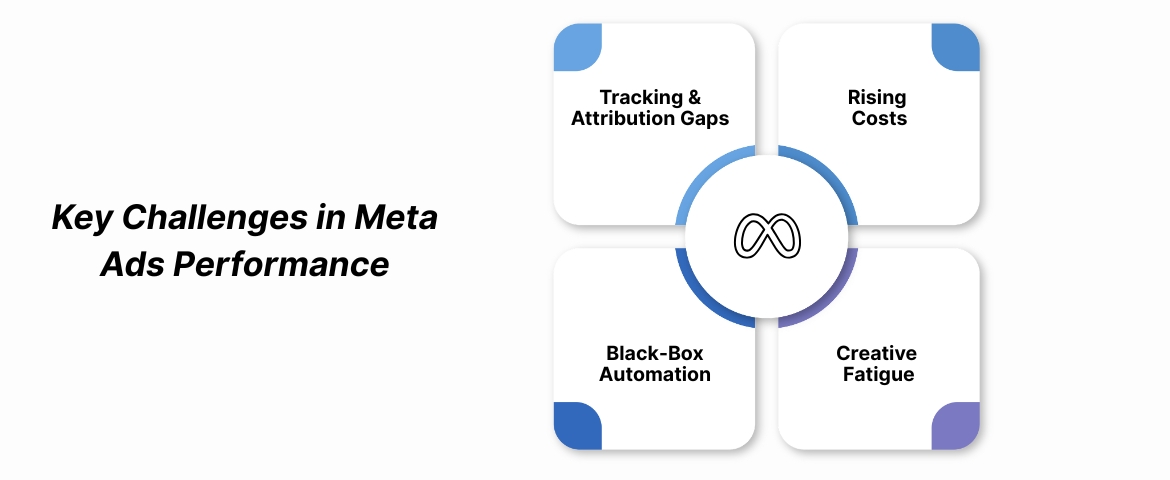
1. Tracking & Attribution Gaps
As privacy‑first policies and OS‑level restrictions (like iOS ATT) continue to limit browser‑based tracking, many advertisers see conversion data slip through the cracks, leading to underreported results and poor algorithm learning.
Meta’s traditional Pixel is no longer sufficient on its own. Server‑to‑server tracking via Conversions API (CAPI), paired with high‑quality event signals, is now essential to maintain visibility into real conversions and feed the algorithm rich data for optimization.
2. Rising Costs & Competition for Attention
Cost Per Thousand Impressions (CPMs) on Meta platforms have climbed as more advertisers compete for limited, high‑value placements. Higher costs mean tighter margins and increasing pressure to drive efficiency at every step of the funnel.
3. Black‑Box Automation & Reduced Granular Targeting
Meta’s algorithm, increasingly driven by AI and broad audience modeling, can feel opaque. Detailed interest‑based targeting has given way to broader signals, and outcomes can be unpredictable without strong performance signals (like quality tracking and conversion data).
4. Creative Fatigue & Engagement Shifts
Static or stale creative increasingly underperforms in an environment where short‑form video and dynamic formats dominate engagement signals. Creatives that resonated last quarter may suffer quickly as audience preferences evolve.
Solutions That Make a Real Difference
For each challenge above, there are practical, workable fixes that feed directly into higher ROAS:
- Fix Tracking at the Source: Implement Conversions API alongside the Pixel, send richer event data, and monitor Event Match Quality (EMQ) so Meta’s algorithms have reliable signals to optimize toward.
- Combat Rising Costs with Smarter Bidding & Budgeting: Use automated budget allocation and performance‑goal bid strategies to let Meta optimize spend where it’s most efficient.
- Refresh and Diversify Creatives: Rotate formats (video, reels, carousels), test new hooks regularly, and let automation identify winning combinations.
- Use First‑Party Data: Build audiences from your own CRM and site visitors instead of relying solely on third‑party signals to improve targeting and retention.
Also Read: Marketing Analytics: What It Is and How It Strengthens Your Campaign Performance
10 Proven Techniques to Increase Meta Ads ROAS
With advertising evolving, advertisers must go beyond gut instincts and generic tactics. Here are some proven techniques to increase Meta Ads ROAS.
1. Start With Clean, Reliable Conversion Data
When it comes to Meta ads, your algorithm is only as good as the data it receives. Without accurate, deduplicated conversion signals, every optimization you make is based on guesswork, not real performance. Clean data isn’t just technical hygiene; it’s the foundation of true ROAS growth.
Meta’s ad delivery system relies heavily on conversion signals, information about events like purchases, leads, add-to-cart actions, and form submissions. The more complete and accurate these signals are, the better Meta’s Machine Learning (ML) can:
- Identify high-value users,
- Improve targeting and lookalike audiences,
- Allocate budget efficiently, and
- Optimize bids in real time.
But when tracking is incomplete, duplicated, or inconsistent, the algorithm doesn’t learn what truly drives value. Instead, it optimizes toward noisy data, which results in wasted spend and inferior ROAS.
2. Implement Server-Side Tracking to Protect ROAS
One of the most impactful yet often overlooked ways to strengthen your Meta ads performance is to move beyond traditional browser-based tracking and adopt server-side tracking, specifically Meta’s Conversions API (CAPI).
This shift meaningfully improves data accuracy, attribution reliability, and signal resilience, all critical for achieving sustainable ROAS.
The table below highlights the difference between client-side and server-side tracking:
| Aspect | Client‑Side Tracking | Server‑Side Tracking |
|---|---|---|
| Where tracking occurs | In the user’s browser via scripts (e.g., pixels) | On your server or through a server‑side proxy before sending to ad/analytics platforms |
| Data accuracy & completeness | Prone to data loss due to ad blockers, browser restrictions, cookie limits, or ITP/ETP | More robust and consistent data since browser tools don’t block it |
| Susceptibility to ad blockers & privacy tools | High – scripts can be blocked or disrupted | Low – server events bypass many client‑side blockers |
| Control over data | Limited — data goes directly from the browser to third parties | High — you can filter, enrich, anonymize, or validate events before sending |
| Privacy & compliance | Harder to enforce consistently; reliant on client consent states | Easier to adhere to GDPR/CCPA via server data processing and consent logic |
| Impact on page performance | Can slow down page load due to multiple JavaScript tags | Improves page performance by offloading tracking to the server |
| Implementation complexity | Simple — just add script tags to pages | More complex — requires server infrastructure and technical setup |
| Performance insights & reliability | Real‑time but potentially incomplete due to blockers | More reliable for conversion tracking and long‑term signals |
Also Read: The Difference Between Client-Side and Server-Side Tracking
How Ingest IQ Centralizes and Governs Events
Ingest IQ takes server-side tracking to the next level by centralizing event governance and automating key parts of the tracking stack. It ensures that events are consistently validated, deduplicated, and routed with stable identifiers where available. This eliminates much of the manual tagging complexity and ensures:
- Unified event streams with no duplicates
- Improved delivery of rich, matchable signals that support higher Event Match Quality in Meta
- Real reliability in conversion reporting even under privacy-first environments
By managing the integrity of first-party data before it ever reaches Meta, Ingest IQ helps advertisers feed the algorithm trusted signals, which in turn improves optimization and ROAS.
Also Read: How to Build a Privacy-First Single Customer View in 2026
3. Optimize Campaign Structure for Algorithm Efficiency
A well-organized campaign structure enables Meta’s algorithm to learn fast, spend smartly, and deliver results that actually improve your ROAS. Poor structure fragments your data, slows learning, and disperses budget, all of which work against performance.
Meta’s optimization system needs consistent data to stabilize performance. When you launch or heavily edit campaigns and ad sets, they enter the learning phase, during which performance can be volatile, and the cost per outcome is typically higher. To exit this phase efficiently, each ad set needs enough conversion events, something that’s much harder when the account structure is fragmented.
Simplify to amplify:
- Consolidate multiple campaigns targeting the same objective into one.
- Use clear, unified naming and organizational logic so campaigns aren’t competing against themselves.
- Avoid frequent, large edits that reset the learning process.
A leaner structure lets Meta’s delivery system focus its learning on more meaningful data, which leads to faster optimization and steadier performance.
4. Improve Creative Performance to Lift ROAS
Meta’s platforms compete for attention in a crowded, fast-scrolling environment. Users are inundated with content, so only ads that stop the scroll and tell a compelling story get noticed.
Your creative is the biggest lever for driving real engagement and actual conversions. No matter how precise your targeting or how optimized your bidding is, poor creative will still be ignored in the feed.
The quality, hook strength, format, and relevance of your creative directly influence Click-Through Rate (CTR), conversion performance, and ultimately ROAS.
Higher engagement → better delivery → lower cost per result → stronger ROAS
Conversely, weak creative leads to low CTRs, higher Cost Per Thousand Impressions (CPMs), and diminished learning for optimization systems.
Proven Creative Techniques
Below are proven creative strategies that help maximize attention, engagement, and conversion performance on Meta:
- User-Generated Content (UGC): Raw, unpolished clips or testimonials from real customers often outperform studio-produced content because it feels native and trustworthy.
- Clear Hooks in the First 3 Seconds: If your ad doesn’t grab users immediately, they’ll keep scrolling. High-performing Meta creatives use a strong visual or narrative hook within the first few seconds that communicates value instantly.
- Strong Offer Positioning: Whether it’s a discount, a free trial, a key benefit, or a unique value proposition, clearly communicating the offer upfront makes it easier for users to decide to convert.
- Using Creative Testing Frameworks Without Fragmenting Data: Testing multiple creatives is essential, but poorly managed testing can dilute Meta’s learning signals if there’s too much fragmentation.
5. Refine Audience Targeting Without Over-Restricting Scale
Targeting has changed dramatically in Meta Ads, and the old playbook of overly narrow segments and endless interest stacks now often hurts performance more than it helps. The most successful advertisers today strike the right balance between giving Meta’s ML flexibility to optimize and using high-quality first-party signals to guide it.
Broad Targeting vs. Interest Stacking: What Works Now
Meta’s algorithm has evolved to learn from macro-scale performance signals and optimize delivery with minimal manual constraints. As a result, many advertisers now see better efficiency and lower costs when they use broad targeting, meaning very few restrictions beyond basic demographics, and let Meta’s AI find the right users. This approach gives the system the room to explore and identify high-intent audiences across the entire eligible pool.
That said, interest, behavior, and demographic layers can still be useful, especially when:
- Your product appeals to a niche audience
- You’re still gathering enough conversion data for broader models to learn from
It’s critical to avoid overly segmented or micro-targeted groups that starve the algorithm of data. Too many stacked filters can shrink audiences below the signal density the system needs to optimize effectively.
Rule of thumb:
- Start with broad targeting for most cold campaigns
- Add optional interest or behavior layers only if your product truly demands it
- Let Meta’s AI expand where it sees value while watching performance closely
6. Optimize Attribution Settings for Realistic ROAS Measurement
Attribution determines which conversions Meta credits to your ads, and subtle choices here can dramatically change your reported ROAS, often without improving actual business performance.
To make meaningful optimization decisions, you must understand how Meta’s attribution windows work, how they interact with other channels, and how to reconcile platform reporting with your own revenue data.
Understanding Meta’s Attribution Windows (7-Day Click / 1-Day View)
Meta’s attribution settings define how long after an ad interaction a conversion can be credited to that interaction. The most common configuration, and Meta’s default, is a 7-day click + 1-day view window:
- 7-Day Click: Credits a conversion that happens within seven days of someone clicking your ad.
- 1-Day View: Credits a conversion if someone saw (but didn’t necessarily click) your ad and converted within one day.
For example, someone might see your ad on Monday, not click it, but purchase on Tuesday. Under certain settings, that could still be counted as a Meta conversion due to the 1-day view window. While this can capture genuine influence, it may also inflate reported conversions that weren’t directly driven by ad engagement.
Because different windows capture different timelines of the buyer journey, the reported ROAS can vary significantly just by changing the attribution setting, even if real sales stay the same.
How Attribution Inflation Happens Across Channels (Email, SMS, Ads)
Attribution inflation occurs when multiple channels contribute to the conversion journey, but the reporting model credits the conversion improperly:
- If a user sees your Meta ad and later buys after clicking an email link, Meta might still attribute the conversion to the ad if it falls within the window.
- Similarly, cross-channel activity, like SMS promos, organic search, or other paid campaigns, can all interact before the final purchase, yet Meta’s attribution may over-credit the social ad.
This creates a halo effect where Meta appears to be driving more conversions than it truly does. For example, analysts commonly see spikes in “attributed” conversions coinciding with email campaigns or other promotions, even if the actual conversion was initiated elsewhere.
Best Practices to Align Meta Reporting With Backend Revenue
Here’s how to avoid letting Meta’s reporting mislead your ROAS measurements:
- Choose an Attribution Window That Matches Your Sales Cycle: A shorter window (like a 1-day click) can reduce inflated reporting, while a longer window (7-day click) may be appropriate for higher-consideration purchases. Always align the window with how long people typically take to convert.
- Minimize View-Through Attribution for Clean Signals: View-through conversions can inflate results by crediting ads for passive exposures that may not be causally responsible for the sale. Many advertisers disable or downweight view-through credit to align reported performance with actual sales behavior.
- Compare Meta Data With Backend Revenue Systems: Track sales through your own systems (eCommerce platform, CRM, or revenue analytics), and regularly compare them with Meta’s reported conversions. This helps identify discrepancies and understand how much of your ROAS is driven by real economic outcomes versus platform modeling.
- Use Incrementality Testing: Where possible, run controlled tests (e.g., holdout groups) to measure the true lift from Meta ads versus what would have occurred anyway. This provides a reality check on reported performance.
7. Reduce Wasted Spend From Bots, Spam, and Invalid Traffic
Even the best-optimized Meta ads can lose effectiveness and ROAS if non-human traffic pollutes your data and drains your budget. Bots, bad traffic, fake interactions, and spam conversions don’t just cost you impressions and clicks; they poison your optimization signals.
Here are some techniques to reduce wasted spend from invalid traffic:
- Filter Invalid Events: Actively block low-quality or bot-driven events before they ever reach your Meta reporting systems. Advanced event filtering rules can prevent fake or duplicate signals from being counted, ensuring that your optimization algorithm is learning from genuine user actions.
- Secure Thank-You and Conversion Pages: Conversion pages, especially thank-you pages, are prime targets for bot misfires, page refreshes, and script misappropriation. If bots or scripts repeatedly hit these URLs, your pixel might record multiple fake conversions.
- Monitor Real-Time Event Firing: Without real-time visibility, you may only notice bot traffic after damage has already occurred, like wasted spend or mis-optimized ad delivery. Set up active monitoring so you can track suspicious spikes in clicks vs. conversions, and spot scenarios where CTRs increase but real conversions don’t follow.
Also Read: A Practical Guide to Bot Filtering for Marketers in 2026
8. Use Real-Time Monitoring to Catch ROAS Leaks Early
In paid advertising, time is money, and nowhere is that truer than in Meta ads. When you wait days for performance data to settle, you’re already several budget cycles behind the truth. Delayed reporting can hide tracking problems, distort optimization signals, and let wasted spend continue unchecked, which means you’re paying for leaks you can’t see.
Real-time monitoring helps you detect and fix issues as they happen, rather than after the damage is done. This allows you to keep your campaigns efficient, your data clean, and your ROAS optimized.
To stay on top of your performance data and prevent ROAS leaks, make monitoring part of your routine. Here’s what to check every day:
- Purchase Event Counts: Track how many purchase events are being logged and compare them with your actual backend orders or revenue data. If the Meta dashboard shows a large spike or drop that doesn’t match your real sales, it’s a red flag for tracking issues like double-counting, missing events, or improper deduplication.
- Event Match Quality: Event Match Quality (EMQ) measures how well Meta can link events (like purchases) to actual users based on available identifiers (email, phone, click IDs, hashed data, etc.). Poor EMQ means Meta isn’t confident in who is converting, which weakens optimization and targeting.
- Duplicate Event Warnings: Meta Issues or Diagnostics in Events Manager will flag duplicate or conflicting events when something is wrong with deduplication (e.g., mismatched event IDs or duplicate pixel/CAPI triggers). These duplicates inflate reported conversions and give a false picture of ROAS.
9. Align Meta Ads Optimization With Backend Revenue Data
If you rely solely on Meta’s Ads Manager numbers to evaluate performance, you’re likely seeing an incomplete picture, especially if your backend CRM revenue tells a different story. Meta’s attribution models, tracking limitations, and reporting logic often lead to disparities in reported conversions and revenue.
To make truly profitable decisions, you need to align Meta’s optimization signals with your actual business results, including real revenue, profit, and lifetime customer value.
To uncover gaps between platform reporting and real business outcomes, start by regularly comparing key metrics from Meta Ads Manager and your backend systems:
- Total Revenue vs Attributed Revenue: Track your actual revenue against the Meta-attributed revenue for the same period. Differences here often reveal attribution inflation caused by multi-touch and view-through crediting.
- Conversion Count Discrepancies: If Meta shows significantly more conversions, investigate issues such as duplicate events, misconfigured tracking, or conflicting event IDs, all of which can lead to false positives in Meta’s reporting.
- Profit, Not Just Revenue: ROAS only tells how much revenue you got per dollar spent, but not whether you actually made money. To assess profitability, incorporate costs such as:
- Cost of Goods Sold (COGS)
- Shipping and fulfillment
- Third-party platform fees
- Overheads
Then compare net profit against ad spend. This gives you a clearer view of whether a high ROAS is actually profitable.
10. Use Campaign Budget Optimization (CBO) to Let Meta Allocate Budget More Efficiently
Instead of manually assigning budgets at the ad set level, Campaign Budget Optimization (CBO) allows Meta’s algorithm to distribute your budget across ad sets based on performance automatically. By giving the system greater flexibility to allocate spend where it’s most likely to drive conversions, you can reduce wasted spend and improve overall ROAS.
Why this works:
- Smart Budget Allocation: CBO continuously shifts your budget toward the best-performing ad sets in real time, helping to amplify winners and minimize spend on underperformers.
- Faster Learning: Meta’s algorithm learns more quickly when static budgets at the ad set level don’t constrain it. This reduces time in the learning phase and improves delivery efficiency.
- Less Manual Toil: With CBO, you don’t need to constantly reallocate budgets manually. Meta handles it based on performance signals, letting you focus on strategic improvements instead.
Here are some best practices when using CBO:
- Group ad sets with similar goals and audience types so Meta doesn’t have to choose between apples and oranges.
- Ensure each ad set has enough conversion volume to learn from; low volume can confuse automated budget shifting.
- Monitor performance frequently and adjust campaign objectives if needed to keep optimization aligned with real business outcomes.
By combining CBO with strong creatives and clean tracking, you’re giving Meta all the tools it needs to spend smarter and that often translates into higher ROAS over time.
Conclusion
Chasing a higher ROAS number in Meta Ads Manager isn’t enough. True performance, the kind that drives profit, scaling, and sustainable growth, requires a foundation of reliable data, smart strategy, and privacy-aware tracking. Too many advertisers still optimize based on incomplete signals or inflated dashboards, only to discover that the “success” they see doesn’t match their actual revenue.
Here’s the reality: you can’t scale what you can’t trust.
Many advertisers still treat tactics as the primary path to higher ROAS. But without reliable data beneath those tactics, performance optimizations are built on quicksand. Clean, accurate, first-party data unlocks true insights about what’s working and what’s not.
If you’re serious about achieving real, scalable ROAS, the foundation is trusted, complete first-party data and privacy-compliant tracking. Ingest Labs gives you a unified, server-side data infrastructure that eliminates data loss, reduces attribution blind spots, and delivers clean signals.
With server-side tagging, real-time monitoring, and first-party identity mapping, you can finally align your Meta campaigns with actual revenue and customer journeys, not partial or noisy data.
Explore how Ingest Labs can future-proof your marketing with accurate attribution, privacy-first tracking, and real-time insights. Start by booking a demo today.
Frequently Asked Questions (FAQs)
1. What is a good ROAS for meta ads?
A good ROAS for Meta Ads generally falls around 2x–4x, meaning $2–$4 revenue per $1 spent, though benchmarks vary by industry, funnel stage, and profit margins.
2. Is 800% roas good?
Yes, 800% ROAS (or 8x) is typically strong performance, often exceeding average Meta benchmarks, especially if your profit margins support sustainable growth.
3. How to see ROAS in Meta Ads?
In Meta Ads Manager, open your campaign, click the Columns dropdown, choose Customize Columns, search for “ROAS” and add it to your report to view return data.
4. What is the 40-40-20 rule in marketing?
The 40-40-20 rule says campaign success depends 40% on the audience, 40% on the offer, and 20% on the creative, guiding where to focus for best performance.
5. Is 10X ROAS possible?
Yes, achieving 10x ROAS is possible, especially with strong offers, high-value audiences, excellent creative, and accurate tracking, though it’s less common and depends on product and margins.