




Ever feel like your best customers just disappear between platforms, even though you’re tracking everything?
As 90% of marketing leaders struggle with fragmented identity data, it makes it harder to deliver consistent experiences and keep customers coming back. For teams juggling multiple campaigns or e-commerce journeys, that data gap can mean lost sales and wasted budget. That’s where cookie matching comes in; it helps connect the dots between systems, giving you a clear, privacy-safe view of your audience and the insight to market smarter.
Key Takeaways
- Cookie matching connects different platform IDs, making sure you’re targeting the same user, no matter where they go online.
- With synced data, your ads reach the right person with better frequency control, minimizing waste and maximizing relevance.
- The process works through cookies, syncing IDs between platforms to create a consistent user profile for smarter targeting.
- While privacy rules and browser restrictions make things tricky, businesses need to adapt with new methods to keep tracking accurate and compliant.
What is Cookie Matching?
Cookie matching, or cookie syncing, helps you recognize the same user across different websites and ad platforms. Normally, each platform assigns its own ID because cookies can’t be shared between different domains. Without cookie matching, users appear as separate identities across ad platforms, creating inconsistent targeting. With cookie matching, those different IDs get connected, so every system knows they belong to the same person. For instance, if one platform calls a user “1234” and another says “abcd,” cookie matching links them together seamlessly.
Understanding this process better will give you insight into its vital role, especially in digital advertising. Let's break down why this technique is indispensable in ad technology.
Why Cookie Matching is Important in Ad Tech?
Cookie matching is essential in ad tech because it ensures different platforms recognize the same user, improving targeting, measurement, and campaign efficiency. Here are the key reasons it matters in ad tech:
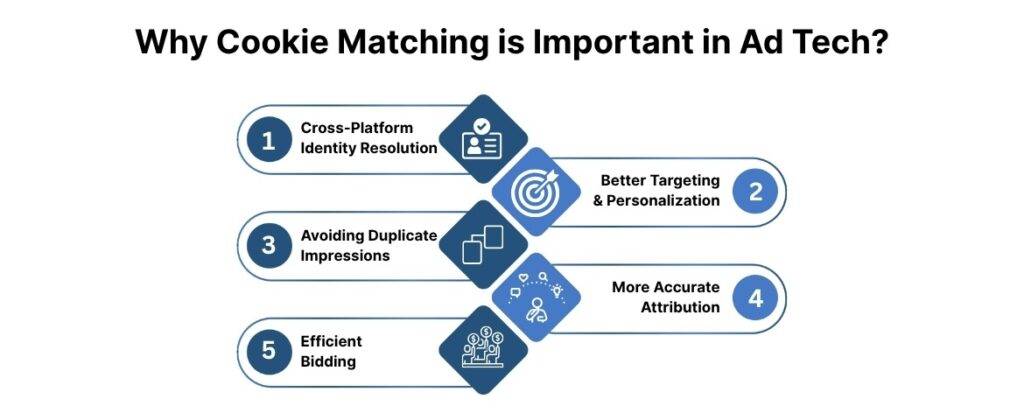
- Cross-Platform Identity Resolution: Without cookie matching, DSPs and SSPs may treat the same user as different people.
- Better Targeting & Personalization: Combined IDs allow more accurate audience segmentation for relevant, data-driven ads.
- Avoid Duplicate Impressions: Matched IDs prevent overserving ads to the same user.
- Accurate Attribution: Tracking IDs across sites clarifies which channels drive conversions.
- Efficient Bidding: Synchronized IDs improve bidding accuracy during real-time auctions.
But how exactly does it benefit ad campaigns? Let’s look deeper into the specific advantages cookie matching offers across various platforms.
Also read: Third-Party Cookie Restrictions: Challenges and Solution
Types & Workflows of Cookie Matching
Cookie matching can happen in several ways, depending on how many partners you sync with and the technology used. Here are the main types you should know:
- Single-Partner Sync (One-to-One): You directly exchange cookies with one other platform, like an SSP syncing with a single DSP, ideal for exclusive partnerships.
- Multi-Partner Sync (Many-to-Many): Your platform redirects the browser to multiple DSPs so all of them can sync with your IDs at once.
- Server-to-Server Matching / Alternative Flows: When browser-based cookies are limited due to privacy rules, you can sync IDs using server-side methods, hashed IDs, or fallback strategies.
- Bidirectional vs. Unidirectional Syncs: In bidirectional syncing, both platforms update each other’s match tables; in unidirectional syncing, only one platform maintains the mapping.
Example – Google Authorized Buyers: When using Google’s cookie matching for Authorized Buyers, you set up a match pixel, a network ID, and optionally a report URL. When the pixel executes, Google responds with a bidder-specific ID that gets included in future bid requests, ensuring your platform recognizes the same user across auctions.
Next, we’ll take a closer look at the step-by-step process that powers this technique and shows how it all works behind the scenes.
How Cookie Matching Works: Step by Step
Cookie matching might sound complex, but it’s simply a way to connect user IDs across different platforms so you can track the same person everywhere.
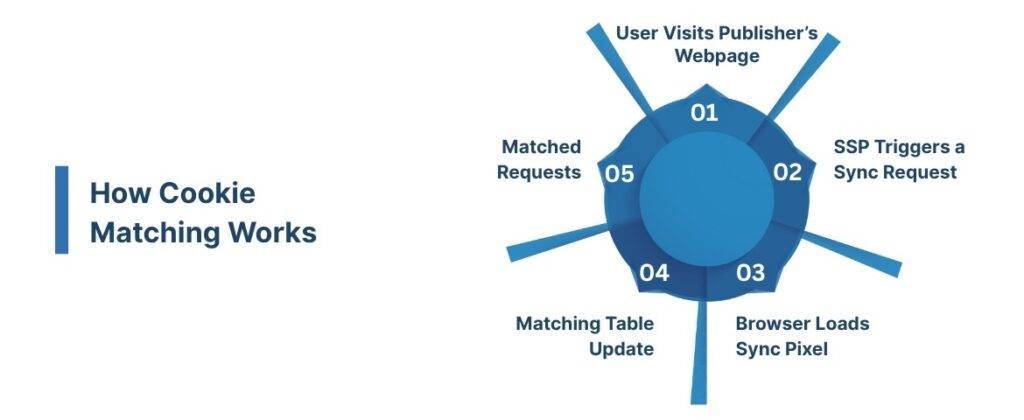
1. User Visits Publisher’s Webpage
This step starts when a user lands on your website, and platforms start identifying them. Here’s what happens during this stage:
- Your site or its ad partners drop first- or third-party cookies with unique IDs.
- These IDs let platforms recognize that a user is visiting the website.
- Without this, platforms wouldn’t know which user to track or target.
2. Ad Server or SSP Triggers a Sync Request
After cookies are set, the ad server or SSP reaches out to another platform to match IDs. During this step, the following occurs:
- The SSP or ad server adds a sync pixel or redirects to contact a DSP or data provider.
- This tells the other platform, “Here’s a user we want to match with your ID.”
- It sets the stage for cross-platform recognition.
3. Browser Loads Sync Pixel / Redirect
The user’s browser carries the IDs between platforms, so both can recognize the same person. Here’s how the sync happens in the browser:
- The pixel or redirect sends the SSP’s ID to the target platform.
- The platform responds with its own ID or sets a new cookie.
- This exchange completes the initial match between the two platforms.
4. Matching Table Update
Once the sync occurs, both platforms store the mapping so future interactions identify the same user. This step works like this:
- Each platform keeps a table linking IDs (e.g., DSP ID “X” = SSP ID “Y”).
- These tables let platforms understand that the same person is visiting different sites.
- It ensures that future campaigns track the user consistently.
5. Subsequent Ad Requests Carry Matched ID
Finally, matched IDs are included in future ad requests to improve targeting and measurement.
This is what happens next:
- When a bid request comes in, the DSP sees the matched ID and knows it’s the same user.
- This prevents duplicate ads and helps manage ad frequency.
- It ensures that your campaigns reach the right audience effectively across platforms.
While the process sounds straightforward, there are challenges to keep in mind. Let’s take a look at some of the hurdles businesses face when using cookie matching in real-world scenarios.
Also read: Understanding the Importance and Benefits of Using First-Party Data in Marketing
Challenges & Privacy Implications of Cookie Matching
Cookie matching is a key technique for connecting user identities across platforms, but it comes with several challenges you should be aware of. Here’s a closer look at the main obstacles and how they can affect your campaigns:
- Browser Restrictions & Cookie Blocking: Modern browsers like Safari and Firefox block third-party cookies, limiting how freely IDs can be synced. Ingest IQ’s server-side tracking helps capture accurate user signals despite these limitations.
- Cookie Deletion, User Reset & Device Switching: Users may clear cookies, switch devices, or block tracking, breaking previously established mappings. Ingest ID provides first-party identifiers to track users consistently across sessions and devices.
- Scale & Latency: Redirect chains, especially in multi-partner syncs, can increase latency and slow down ad loading.
- Mismatch & Error Handling: Sometimes mapping fails due to missing IDs, requiring platforms to handle fallback paths gracefully.
- Privacy & Regulation (GDPR, CCPA, etc.): Cross-site tracking raises privacy concerns; cookie identifiers are often considered pseudonymous data, so consent, transparency, and user rights must be respected. Event IQ helps manage consent and ensures compliance with privacy regulations.
- Walled Gardens / Closed Ecosystems: Platforms like Facebook, Amazon, and Apple may not allow cookie syncing with external ad tech, causing fragmented coverage.
- Leakage & Data Exposure Risks: Requests that pass IDs via URLs or redirects can accidentally expose identifiers through referrer headers.
The landscape is evolving, and as privacy rules change, businesses need to find new ways to keep cookie matching effective and compliant. Let’s see what best practices can help smooth out the bumps.
Best Practices & Modern Alternatives
Cookie matching is evolving as privacy rules tighten, so adopting smart strategies helps maintain accurate user tracking. Here are practical ways to optimize cookie matching while staying efficient, compliant, and future-ready.

1. Minimize Redirects
Cookie matching often relies on redirects between platforms, which can slow down ad delivery and user experience. To keep matching fast, it’s important to reduce unnecessary redirect chains and simplify sync flows. Streamlined flows ensure smoother targeting, and using Ingest IQ’s server-side tracking lets you match user IDs efficiently across multiple channels without latency issues.
2. Use Hashing & Encryption
Raw cookie IDs exposed in URLs can risk data leaks and violate privacy rules. Hashing or encrypting these identifiers keeps the matching process secure while maintaining accurate cross-platform recognition. Event IQ helps you implement secure data handling, ensuring cookie matching remains both effective and privacy-compliant.
3. Host Match Tables Where Possible
Hosting match tables on trusted platforms can make cookie syncing faster and more reliable. This reduces the number of redirects and ensures ID mappings remain consistent across partners. With Ingest ID, first-party identifiers work seamlessly with hosted match tables to provide accurate and stable cross-platform matching.
4. Consent Management
Obtaining explicit consent before syncing cookies is crucial for GDPR, CCPA, and other regulations. Cookie matching without consent can breach privacy rules and damage user trust. Event IQ makes it easy to manage consent, so your cookie matching stays fully compliant while respecting user preferences.
5. Fallback Identity Mechanisms
Sometimes cookies fail due to deletion, browser restrictions, or device changes, breaking the matching chain. Combining deterministic approaches (like login-based IDs) with probabilistic methods improves match rates and ensures continuity. Ingest ID provides a first-party identifier system that supports fallback mechanisms, keeping your cookie matching accurate even when cookies are unavailable.
6. Monitor & Audit Sync Success Rates
Tracking how many users are successfully matched, error rates, and latency is essential for cookie matching. Monitoring helps identify failures and optimize performance for better targeting. Ingest IQ provides real-time tag monitoring and reporting, helping you audit cookie matching success efficiently.
7. Prepare for a Cookie-Less Future
As third-party cookies disappear, alternatives like first-party data, identity graphs, and privacy-safe clean-room solutions are becoming essential for cookie matching. These approaches maintain accurate targeting while staying compliant. Event IQ enables cross-channel personalization using first-party data, ensuring your cookie matching strategy remains effective in a cookie-less world.
As privacy evolves, these best practices prepare marketers for a cookie-less future while keeping targeting precise.
Final Thoughts
Cookie matching plays a critical role in digital marketing by enabling accurate user identification across platforms. It helps businesses improve targeting, personalization, and measurement while minimizing wasted ad spend. Understanding and implementing cookie matching effectively ensures your campaigns reach the right audience at the right time, boosting ROI and customer engagement.
To simplify and optimize this process, Ingest Labs offers powerful solutions. Ingest IQ handles server-side tracking and real-time data streaming, Ingest ID provides first-party identifiers for accurate attribution, and Event IQ unifies cross-channel data for personalized experiences. Together, these tools help you manage data efficiently, maintain privacy compliance, and maximize the effectiveness of your marketing campaigns.
See how Ingest Labs can simplify cookie matching, improve ad targeting, and unify customer data. Book a demo today to get started.
Frequently Asked Questions
1. What is a matching cookie?
A matching cookie is used to link user identifiers across different ad-tech platforms. It allows advertisers to recognize the same user on multiple websites or apps, improving targeting and personalization.
2. What is cookie sync?
Cookie sync, or cookie matching, is the process of aligning IDs between platforms so they can identify the same user. This helps ad networks and data providers share information without violating privacy rules.
3. What is a cookie example?
A cookie is a small text file stored in your browser by a website. For example, a site might store a cookie to remember your login or track your browsing behavior for personalized ads.
4. How does cookie matching work?
Cookie matching works by sending identifiers between platforms through pixels or redirects. Each platform maps its own user ID to the partner’s ID, enabling cross-platform recognition for ads and analytics.
5. What is a cookie and how does it work?
A cookie is a small piece of data stored on a user’s device by a website. It tracks user behavior, stores preferences, and helps deliver personalized content or targeted ads.