




Consider a marketing team updating a website: a new signup form is added, a product page is redesigned, and an old tracking pixel is removed. Everything looks fine on the surface, but behind the scenes, half the events stop firing, a few tags fire twice, and a consent script loads out of order. Traditional analytics may still record traffic, but it often misses the real issue. Your data is no longer accurate.
This problem sits at the center of a much bigger shift. Privacy regulations are tightening, browsers are blocking more scripts, and platforms expect cleaner, consent-aligned signals. Without strong tag governance, brands lose visibility into how users behave, why performance metrics fluctuate, and where campaigns fail to capture actual results.
This guide breaks down why tag governance has become essential in a privacy-first world. You’ll learn what it includes, how to maintain a clean tracking setup, and how it protects your measurement, compliance, and optimization efforts.
Key Takeaways
- Strong tag governance helps prevent silent tracking errors, protect attribution accuracy, and surface data issues before they spread across your stack.
- Governance frameworks help ensure tags respect consent, align with privacy rules, and avoid unintentional data collection across global regulations.
- Clean, well-managed tags reduce script bloat, protect site performance, improve Core Web Vitals, and support smoother user experiences at scale.
- A consistent event schema keeps signals accurate across analytics, ads, and personalization tools, preventing mismatched definitions and reporting gaps.
- Continuous monitoring and clear ownership reduce tag sprawl, detect failures early, and improve long-term measurement reliability across the stack.
What Tag Governance Really Means (And Why It Matters for Modern Tracking)
Tag governance refers to the oversight, rules, and validation processes that keep every tracking tag on your website accurate, intentional, and compliant. While tag managers make it easy to add scripts, governance ensures those scripts fire correctly, follow consent rules, and don’t quietly break your measurement.
Modern sites run dozens of tags, including analytics, advertising pixels, personalization tools, heatmaps, consent scripts, testing frameworks. Without control, these tags often multiply over time, create overlapping signals, and introduce compliance risks that teams rarely notice until it affects reporting or performance.
At its core, governance answers fundamental questions like:
- Which tags are live on the site?
- Are they firing the way they should?
- Are they compliant with consent and privacy rules?
- Do they collect clean and consistent data?
This clarity becomes harder, and more important, as third-party tracking disappears and first-party data becomes the backbone of marketing.
Similar Read: What is Data Tagging?
What Happens When Tag Governance Is Missing
Without governance, tags behave unpredictably. Even one misconfigured script can distort data or create hidden performance issues. Over time, these errors stack up and spread across the entire measurement ecosystem.
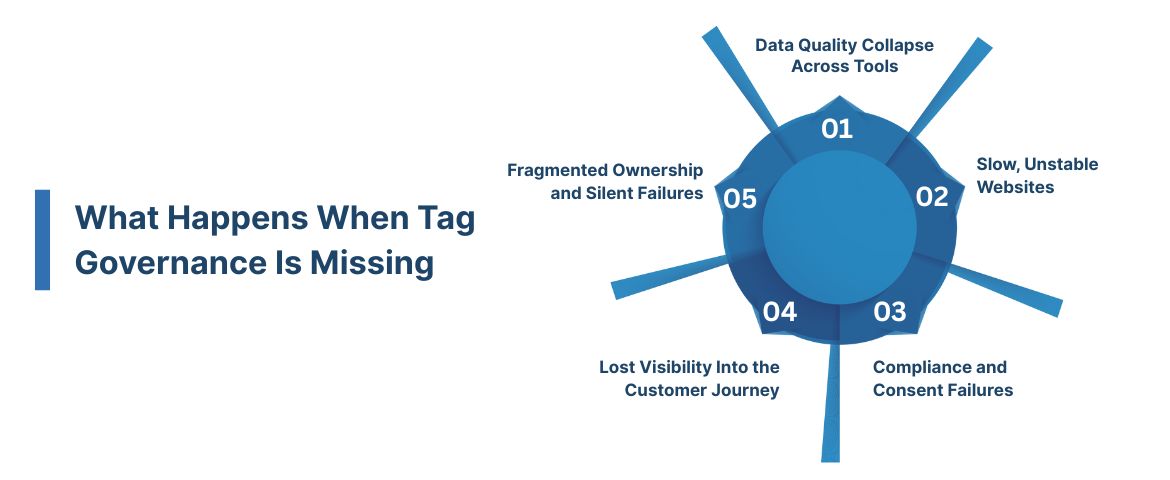
Below is the kind of breakdown you'd expect in a modern analytics or marketing stack:
Data Quality Collapse Across Tools
Most analytics pipelines assume events are correct. One duplicated tag can:
- Inflate sessions or pageviews
- Trigger multiple conversion events
- Skew attribution and A/B test results
- Cause ad platforms to optimize for the wrong signals
- Break funnels and retention reports
Teams often blame “platform inconsistencies,” but the root cause is usually an unmanaged tag quietly firing twice.
Slow, Unstable Websites
Every pixel adds weight. Every misfiring script adds delays. Typical symptoms include:
- Extra network calls for unused tags
- Tags loading in the wrong order and blocking the main thread
- Page jitter from late-loading personalization scripts
- Cumulative layout shift (CLS) spikes
- Degraded Core Web Vitals, hurting SEO
Because these issues happen behind the scenes, they often go unnoticed until site performance tanks.
Compliance and Consent Failures
When tags trigger before consent or continue firing after a withdrawal, it exposes brands to:
- Regulatory risk
- Non-compliant data collection
- Forced suppression of entire data sets
- Blocked pixels and reduced match rates in ad platforms
This is especially common when multiple teams add scripts independently without a single source of truth.
Lost Visibility Into the Customer Journey
Broken tags interrupt the flow of measurement. When key events fail to fire:
- Engagement and drop-off patterns disappear
- Marketing teams misread what’s actually working
- Personalization tools lack the signals to deliver relevant experiences
- Attribution models fall apart
In privacy-first environments, you already lose some visibility. Faulty tags make that gap much wider.
Fragmented Ownership and Silent Failures
Without a central governance model:
- Tags accumulate over time with no assigned owner
- Old scripts stay live long after campaigns end
- Critical tracking breaks during site updates
- No one notices until reporting discrepancies surface weeks later
These “silent failures” are the most damaging because they erode trust in every downstream dashboard.
Tag Management vs. Tag Governance
Many teams assume that using a tag manager means they have governance. In reality, tag management solves deployment convenience, not control.
Here’s a more nuanced comparison:
| Aspect | Tag Management | Tag Governance |
| Purpose | Makes it easy to add, edit, and organize tags in one interface. | Ensures every tag is correct, compliant, necessary, tested, and monitored. |
| Where They Operate | Inside the tag manager (GTM, Tealium iQ, Adobe Launch). | Across the entire ecosystem, like site code, consent tools, dev workflows, analytics, and privacy reviews. |
| Core Activities | Adding/removing tagsSetting triggersManaging variables and data layers | Audits and tag inventoriesConsent alignment and privacy checksMonitoring for broken or duplicate tagsVersion control and QA across sprintsData standard definitionsOwner assignment and documentation |
| Failure Modes | Misconfiguration at deployment. | Systemic failures. Bad governance affects every downstream tool. |
| Impact on the Business | Operational efficiency | Reliable analyticsCompliant data collectionAccurate attributionClean signals for personalization and optimizationLong-term measurement stability |
Simple Analogy: Tag management is the switchboard. Tag governance is the rulebook, audits, and monitoring that ensure the switchboard doesn’t overload, misfire, or break.
Related: Understanding Pixel Tags: Functionality and Usage
Now that you understand how tags behave, and what can go wrong without oversight, it’s time to look at why tag governance has become essential in a privacy-first marketing environment.
Why Tag Governance Matters
Audience behavior, privacy expectations, and data regulations have changed. Modern websites depend on dozens, sometimes hundreds, of tags, pixels, SDKs, and scripts to power analytics, advertising, personalization, and conversion tracking.
But most teams still manage tags only at the deployment level, not at the governance level. As a result, tags break silently, fire without consent, collect inconsistent data, or slow down site performance, often without anyone noticing.
This makes tag governance one of the most important foundations of a privacy-first marketing stack. Strong governance ensures your data is accurate, compliant, and reliable across every system. Here’s why it matters:
Protect Data Quality and Reliability
- Ensures tags fire consistently across pages, devices, and environments.
- Prevents missing events, double firing, or outdated scripts that distort analytics.
- Keeps your measurement stable so reporting stays trustworthy even as tools or site code changes.
Strengthen Privacy and Consent Compliance
- Aligns every tag with current consent signals, preventing accidental data collection before opt-in.
- Reduces legal and compliance risks by ensuring each vendor receives only approved data.
- Creates predictable audit trails through proper documentation and version control.
Improve Site Performance and User Experience
- Removes unnecessary or duplicate tags that slow pages down.
- Reduces script bloat that hurts Core Web Vitals and conversion rates.
- Maintains a clean, controlled environment so product and marketing changes don’t create hidden performance issues.
Enhance Attribution and Optimization
- Provides clean, consistent signals to analytics, ads, and personalization tools.
- Eliminates mismatched event definitions that break attribution models.
- Helps teams understand which channels, pages, or experiences actually drive outcomes.
Build Long-Term Measurement Stability
- Works with far less dependence on browser and platform restrictions that weaken third-party tracking.
- Creates a durable foundation for server-side tracking, first-party data, and future analytics needs.
- Ensures measurement doesn’t collapse every time a vendor updates their pixel or a browser tightens security.
If you want your analytics, advertising, and personalization systems to operate on clean, compliant, and consistent data, tag governance isn’t optional; it’s infrastructure.
Want help building a governance layer that protects your data quality across every tool?
Ingest Labs strengthens your governance layer by stabilizing event delivery, providing durable identifiers, and offering optional monitoring through Event IQ when enabled, so mission-critical events fire more reliably, and downstream tools receive cleaner data.
Challenges of Tag Governance (And How to Solve Them)
Tag governance sounds straightforward. It keeps tags organized, consistent, and compliant. But in real marketing stacks, it quickly becomes one of the hardest disciplines to maintain. Teams deal with years of legacy tags, unclear ownership, inconsistent data standards, and tools that don’t talk to each other.
The result: broken measurement, compliance risks, and analytics teams that never fully trust their own numbers.
Below are the most common governance challenges, and the practical steps to solve them:
1. Invisible or Orphaned Tags Across the Site
Tags often get added during campaigns, redesigns, or vendor onboardings and never removed. Over time, pages accumulate outdated, duplicate, or unnecessary scripts with no clear owner.
This creates measurement noise, slows down the site, and introduces compliance risks.
Solution: Maintain a continuously updated tag inventory. Each tag should have an owner, purpose, load conditions, and documented consent requirements. Automated scans help ensure nothing loads without being registered.
2. Inconsistent Event Definitions Across Teams and Tools
Different teams label the same action in different ways like "signup," "user_signup," "leadSubmit," or “register_click.”
These inconsistencies make data unreliable across analytics, ads, CRM, and BI tools, creating multiple “truths” that contradict one another.
Solution: Build a governance-approved event schema. Define naming rules, required properties, allowed values, and documentation for every tracked action. Enforce schema checks before anything ships.
3. Broken or Duplicate Tags Triggered by Site Changes
When pages are redesigned, new components are shipped, or scripts are reorganized, it’s easy for tags to break silently, or start firing twice.
This leads to inflated conversion counts, missing data, or inconsistent attribution across platforms.
Solution: Introduce version control and QA workflows. Every tag should pass a pre-release test. Use server-side tagging to consolidate key conversion events so they fire once, consistently, regardless of frontend changes.
4. Consent Misalignment and Quiet Compliance Gaps
Tags often fire before consent is collected, or consent logic isn’t connected to the tag manager at all. This creates silent GDPR/CCPA violations and exposes the business to audit risk.
Solution: Integrate your consent tool directly into tag triggers. No tag should load without verifying consent status. Governance teams should test consent flows regularly to ensure compliance stays intact.
5. Vendor SDK Conflicts and Unreliable Behavior
Marketing tools, personalization libraries, analytics SDKs, and A/B testing scripts often conflict with each other. They may overwrite cookies, block server-side events, or change load sequencing without warning.
Solution: Prioritize first-party, server-side delivery for all mission-critical events. Reduce dependency on client-side SDKs. Validate new vendor scripts for conflicts before deploying them.
6. Fragmented Ownership Across Marketing, Engineering, and Data Teams
No one team “owns” the tags. Marketing deploys them, engineering maintains the site, data teams maintain schemas, and no group sees the full picture. This results in repeated mistakes, untracked changes, and governance that collapses across sprints.
Solution: Create a cross-functional governance framework with shared accountability. Assign clear owners, define review cycles, and align all changes with a central data contract. Governance should function across sprints, not outside them.
Also read: How to Reduce and Recover Shopify Abandoned Carts
Conclusion
Tag governance has become one of the most critical foundations of accurate measurement in modern digital operations. But enforcing it consistently isn’t simple. Teams deal with outdated tag catalogs, duplicate pixels, mismatched schemas, unapproved trackers, and gaps between dev, analytics, and privacy workflows. These weak points ripple across the stack, skewing attribution, breaking experimentation, and creating compliance risk long before data reaches downstream tools.
Ingest Labs reduces many of these failure modes by delivering server-side events aligned to your approved schemas and minimizing the fragility of client-side tracking. Ingest IQ enforces schema rules for the server-side events routed through it, helping maintain alignment across tools without relying on fragile browser scripts. Ingest ID helps maintain consistent identity signals when identifiers are available and consented. Event IQ can help detect schema drift and flag inconsistencies when monitoring is configured.
Together, they turn tag governance from an ad-hoc cleanup task into a stable, automated framework that strengthens every tool in your measurement ecosystem.
If you’re ready to enforce standards, prevent data decay, and secure long-term accuracy, explore how Ingest Labs can support your governance strategy. Book a demo today.
FAQs
1. How can organizations build cross-functional accountability into tag governance?
Effective tag governance isn’t just technical, it involves collaborating across marketing, analytics, IT, and compliance teams. Leading organizations set up dedicated tag stewardship roles and distributed ownership so privacy, QA, and business needs are continuously balanced and no single function bears all risk. This approach enables agile responses to issues and rapid adoption of new standards as regulations or business models evolve.
2. What specialized processes are used to validate tag accuracy and relevance at enterprise scale?
Beyond routine audits, sophisticated enterprises export all tags monthly to validate against approved schemas, using both automated tools and human review. Validation includes flagging duplicates, obsolete entries, or misaligned tags, and cross-checking ownership data against HR and project systems so access rights and accountability remain up to date.
3. Which strategies address the risk of “tag sprawl” and unauthorized deployments in large organizations?
Advanced governance frameworks include strict policies requiring submission, review, and scheduled deployment windows for any tag update or addition. Tag management systems (TMS) are leveraged for centralized control and transparency, blocking automatic code additions and flagging any deviations from governance protocols for further review, thus containing tag sprawl before it impacts performance or compliance.
4. How do global governance teams handle regulatory changes, especially in diverse markets?
Tag governance frameworks incorporate policy engines that enforce regional rules, update procedures as privacy laws shift, and automate alerts for non-compliant resources or tags. Leading organizations hold periodic multi-stakeholder reviews to update documentation, check tag functionality, and ensure current legal requirements (such as GDPR or CCPA) are integrated into the governance workflow.
5. What are the best practices for documenting technical and business requirements for tag implementation?
Sophisticated tag governance means mapping not only technical needs, but also documenting business context, such as which website events or KPIs each tag supports. Documentation is maintained in collaborative, accessible locations and continuously updated with stakeholder input, making it easier to audit, modify, or remove tags as goals and technology evolve. This ongoing documentation is foundational for agile governance and targeted improvements.