




Are you tired of juggling effective digital marketing with rising privacy compliance pressures?
As a marketer or e-commerce leader, you’ve likely seen your data weaken as third-party cookies are blocked, attribution gaps are growing, and consent banners are turning users away. Regulations like the General Data Protection Regulation (GDPR), the California Consumer Privacy Act (CCPA), and Quebec Law 25 only make traditional tracking riskier and more resource-heavy.
The industry is feeling the strain. In 2024, attackers accessed 26.5% more sensitive data than the year before, and while 75% of marketers value real-time first-party data, only 47% collect it consistently.
To escape this fragile ecosystem, more businesses are adopting cookie-free websites, often referred to globally as “ohne cookies.” This guide shows how they work and how you can maintain strong performance in a privacy-first world.
Key Takeaways
- Cookie-free websites (“ohne cookies”) reduce friction, eliminating consent banner interruptions and improving user experience across devices.
- You simplify parts of compliance because fewer or no tracking cookies mean fewer cookie-specific obligations under GDPR, CCPA, CPRA, and Canadian privacy laws—though core disclosure and user-rights requirements still apply.
- Performance and SEO improve when third-party scripts and cookie-based trackers are removed, leading to faster loading and better Core Web Vitals.
- Advertising and analytics still work when you shift to server-side tracking, first-party identifiers, contextual targeting, and event-based measurement.
- Ingest Labs provides the infrastructure you need to operate in a privacy-first, cookie-free future without losing insight, accuracy, or optimization capability.
What Are Cookies?
Cookies are small pieces of data that websites store on a visitor’s browser to remember preferences, identify return visits, and track user behavior across sessions, enabling personalized experiences and analytics.
There are two main types:
- First-Party Cookies: These are set by the website you are visiting (e.g., ingestlabs.com). They are essential for core site functionality, like keeping users logged in, remembering items in a shopping cart, or tracking basic analytics for that single domain.
- Third-Party Cookies: These are set by a domain other than the one you are visiting, usually embedded by tracking scripts from advertisers, social media widgets, or analytics providers. Their role is to track a user's behavior across multiple websites for targeted advertising and cross-site analytics.
First-Party vs. Third-Party Cookies
| Category | First-Party Cookies | Third-Party Cookies |
| Set By | Your website’s domain | External domains (ads, analytics, trackers) |
| Main Purpose | UX, preferences, basic analytics | Cross-site tracking, advertising, and profiling |
| Consent Requirements | Lower (if essential) | High and explicit consent is often required |
| Browser Support | Allowed and stable | Blocked or deprecated across major browsers |
| Compliance Risk | Low to moderate | High under GDPR, CCPA, CPRA, Law 25, etc. |
| Reliability for Ads | Limited | Declining rapidly |
| Future Outlook | Supported, but with limits | Phasing out entirely |
Also read: Differences Between First-Party and Third-Party Cookies and How to Set Them Up
Cookies have historically enabled building dynamic user journeys, mapping multi-session behaviors, and serving tailored ads; however, evolving browser policies and increased privacy concerns are reducing their reliability.
Why Websites Use Cookies
You typically rely on cookies to perform key functions such as :
- Keep users logged in
- Track returning visitors
- Measure conversion events
- Build remarketing audiences
- Personalize recommendations
But browsers like Safari, Firefox, and soon Chrome have severely restricted cookie behavior, forcing companies to rethink their tracking architecture.
Also Read: Understanding First-Party, Second-Party, and Third-Party Data: Strategies and Benefits
What Is Cookie Consent?
Before setting most cookies, especially tracking or advertising cookies, businesses must obtain explicit user consent.
How Cookie Consent Works
A compliant consent banner must:
- Explain why data is collected.
- Provide clear “accept” and “reject” options.
- Allow granular control (analytics, ads, functional cookies).
- Log consent for audit purposes.
What Laws Require Consent?
- GDPR (EU): Requires opt-in consent before activating non-essential cookies
- CCPA/CPRA (California): Requires disclosures and opt-out rights
Personal Information Protection and Electronic Documents Act (PIPEDA) + Quebec Law 25 (Canada): Requires clear, informed consent.
Note: If you rely on cookies for tracking, but you cannot obtain valid consent for them (or visitors reject them), you lose visibility. That’s why moving toward cookie-free websites appeals: Fewer consent dependencies, fewer blockers.
Also Read: Crafting Unique Experiences with First-Party Data
Now that you know what cookies and consent are, let’s look at why a website might intentionally move to a cookie-free model.
Why Some Websites Go Cookie-Free
The move to cookie-free websites isn’t just a trend; it’s a strategic response to growing privacy concerns, performance challenges, and strict compliance requirements. As these pressures increase, more businesses are shifting toward cookie-free models for several key reasons.
Key Drivers
- Privacy concerns: Users increasingly expect minimal tracking by default.
- Data protection regulations: With laws becoming stricter and enforcement rising, moving to “ohne cookies” helps mitigate risk.
- User trust: A site that doesn’t immediately use cookies shows you value user privacy; this builds brand equity.
By removing client-side cookies, businesses simplify operations while earning user trust.
Note: In North America, this environment is rapidly changing. Alongside the CCPA/CPRA in California, states like Virginia (CDPA), Colorado (CPA), and Connecticut (CTDPA) have enacted their own comprehensive privacy laws.
Traditional vs Cookie-Free Websites
This comparison shows how cookie-free websites solve the weaknesses of traditional cookie-based setups.
| Feature | Traditional Cookies | Cookie-Free Websites (ohne cookies) |
| Consent required for tracking? | Yes, it is often via banners and pop-ups. | Fewer trackers and less consent dependency. |
| Data collection method | Browser cookies plus third-party tags. | First-party data and server-side tracking. |
| User friction | Higher with banners and delays. | Lower and effortless access. |
| Compliance risk | Higher tracking may violate opt-in rules. | Lower with fewer non-essential trackers. |
| Page load performance | Slower due to multiple scripts. | Faster with fewer external calls. |
Now that you’ve seen how traditional and cookie-free websites differ, the next question is how this shift affects the user experience, starting with what happens when cookie banners disappear.
Benefits of Cookie-Free Websites
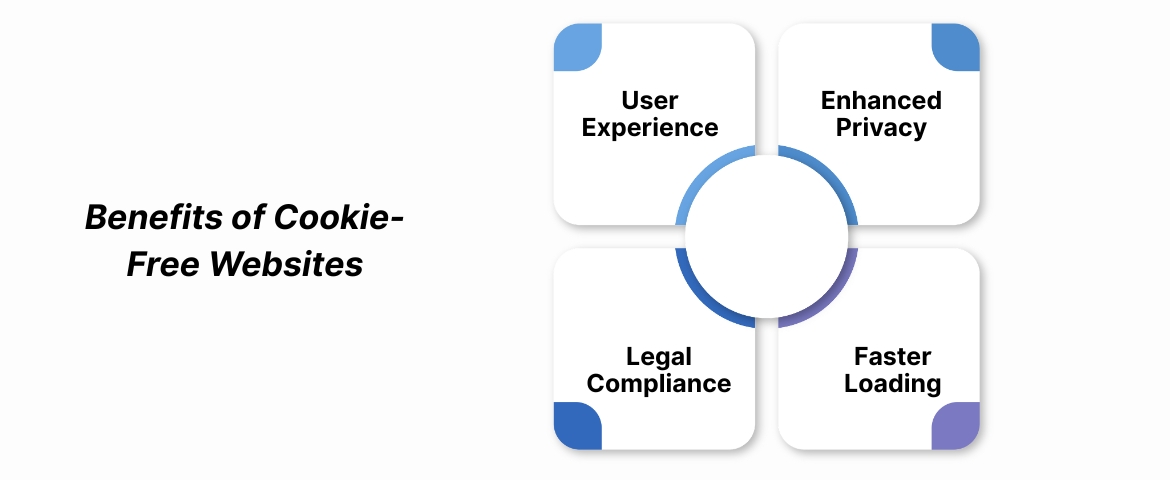
Cookie-free websites offer several practical advantages that go beyond privacy and compliance. By removing unnecessary trackers, you create a faster, more efficient environment that improves user experience, strengthens data protection, and supports stronger performance across your digital operations.
1. User Experience Without Cookie Banners
The move to cookie-free websites isn’t just about compliance; it’s a UX play.
- Eliminating Consent Pop-Ups: By shifting to fewer trackers or only essential cookies, you reduce the need for intrusive consent banners. That means less interruption for your visitors and fewer drop-offs.
- Smooth and Enjoyable Browsing Experience: When you don’t rely heavily on third-party cookies, you streamline the page load timeline and reduce tracking script load. Visitors perceive your site as faster, cleaner, and more trustworthy.
- Immediate Access to Content: For e-commerce or publishing sites, every second matters. Cookie-free websites ensure users enter the core experience fast, with no banner delay, no script pause, and no frustration.
2. Enhanced Privacy and Data Protection
Beyond UX, cookie-free websites strengthen your privacy posture.
- No Automatic Data Collection: With fewer cookies (especially third-party), you reduce instances of silent tracking or profiling. This aligns with ethical data practices.
- Strengthened User Privacy: Visitors appreciate knowing their browsing is less tracked. That trust can lead to higher engagement and lower churn.
- Avoidance of Unwanted Tracking and Profiling: Profiling users via persistent cookie identifiers is increasingly challenged. By moving to cookie-free setups, you sidestep many hazards.
3. Simpler Legal Compliance
Now that you understand the privacy benefits, let’s look at the regulatory advantages.
- Reducing Consent Overhead: If you avoid tracking cookies and similar identifiers, you may be able to reduce or simplify cookie banners and some tracking disclosures—but GDPR, CCPA/CPRA, and Quebec Law 25 still require clear notices and user rights handling.
- Reduced Legal Risk: Mistakes in cookie implementation have resulted in fines and regulatory scrutiny in recent years. Cookie-free websites reduce your surface area of risk.
- Avoiding Costly Fines: Several six-figure fines across the EU and Canada were issued solely for cookie mismanagement; cookie-free sites substantially reduce this particular category of cookie-related enforcement risk.
If you’re looking to simplify compliance while retaining data-driven insights, Ingest Labs’ privacy-first tools make sure you meet every regulation and keep your marketing effective, no matter where your audience is.
4. Faster Loading and Better SEO
Cookie-free websites deliver performance gains, and performance matters for SEO.
- Avoidance of Third-Party Service Delays: Tracking scripts from ad networks or analytics often pull in extra assets and calls. Removing those improves load times.
- Improved Page Load Times: Faster sites reduce bounce rates, increase engagement, and meet core web vitals better, all ranking factors for search engines.
- SEO Advantage: Websites that load quickly, offer clean UX, and reduce tracking overhead often see better visibility. Clean analytics can also improve decision-making.
While these benefits make cookie-free websites a strong strategic shift, they also introduce new realities that teams need to prepare for. Understanding these challenges upfront helps you plan a smoother transition.
Challenges for Website Owners and Marketers
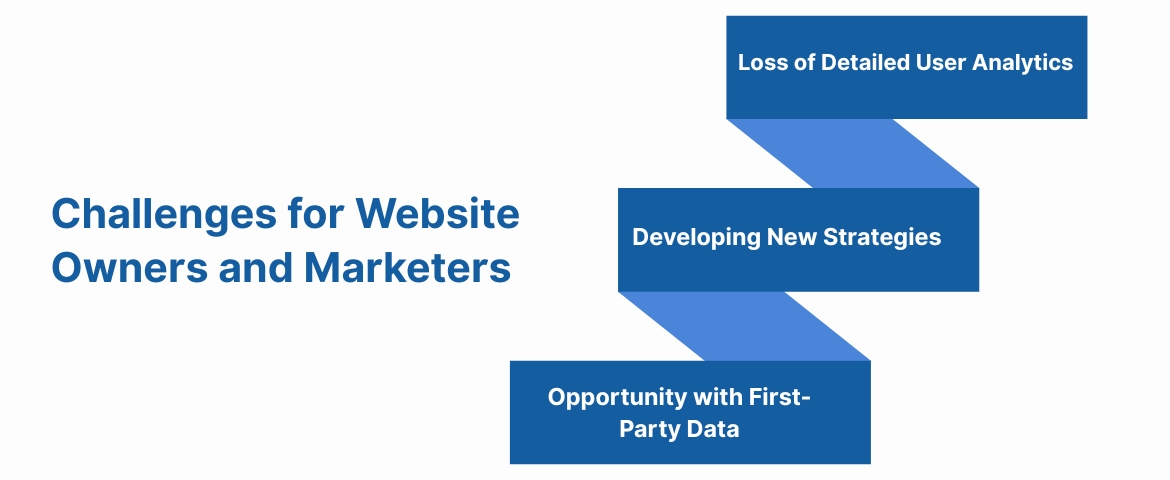
The transition to cookie-free websites is beneficial, but not without challenges.
1. Loss of Detailed User Analytics
When you remove or reduce cookies, your visibility into multi-session attribution, cross-device tracking, and retargeting shrinks.
2. Developing New Strategies
You must shift to first-party tracking, server-side integrations, machine learning models, and unified IDs. That means new tech stacks, new thinking, and sometimes new teams.
3. Opportunity with First-Party Data
This is where Ingest Labs shines: using their platforms, you can build a foundation of first-party identifiers, control your data flows, enforce compliance, and maintain performance without relying on cookies.
Implementation: What to Check
| Challenge | Your Action | Benefit |
| Inaccurate attribution | Move to server-side tracking & event API. | Reliable data despite cookie restrictions |
| Consent rejection | Capture first-party signals and anonymized events. | Lower data loss and higher compliance. |
| Ad targeting limitations | Use contextual plus first-party modelling. | Maintain performance without invasive tracking. |
With the advantages and challenges of cookie-free websites established, the natural question is how to keep your site functional. Several modern technologies make this possible.
Alternative Technologies for Functionality
Going cookie-free doesn’t mean losing features; it means adapting how you deliver them.
1. Local Storage and First-Party Data
You can store visitor states on the device using localStorage, which allows persistent data storage without relying on cookies, or use first-party cookies carefully following privacy guidelines to keep data within your ecosystem.
2. Hosting Resources Locally
By hosting scripts and tracking tools internally on your servers, instead of relying on multiple third-party endpoints, you gain better control over data flow and significantly improve site performance.
3. Server-Side Tracking and Unified Data Layers
Using server-side solutions means you shift from browser cookies to server-captured events. Tools like Ingest Labs’ platforms (Ingest IQ, Ingest ID, Event IQ) build this data layer without exposing you to browser cookie limitations.
Alternative Technologies vs Traditional Cookies
| Need | Cookies | Modern Alternatives |
| Track conversions | Browser pixel | Server-side tagging (Ingest IQ) |
| Identify users | Third-party cookie ID | First-party identifiers you supply and maintain (propagated via Ingest ID) |
| Analyze behavior | Analytics cookies | Event IQ event-quality and schema monitoring (feeding your analytics tools) |
| Personalization | Cookie-based | Real-time first-party data |
Once you understand the technologies that can support a cookie-free setup, it becomes easier to see how advertising adapts when third-party cookies are no longer part of the equation.
How Advertising Works Without Cookies
The demise of the third-party cookie ends widespread cross-site behavioral retargeting, challenging marketers to adopt new methods like contextual advertising and first-party data strategies that improve ad relevance and user privacy.
Use of Contextual Advertising and Identity Solutions
Marketers must pivot their strategies:
- Contextual Advertising: Ads target users based on the content of the page they are viewing, rather than their browsing history. For example, a business selling golf equipment targets ads on a golf news article.
- First-Party Data for Segmentation: Use the rich, compliant data collected via your own systems—maintained and routed through tools like Ingest ID and Event IQ—to power highly accurate customer segments in your existing marketing and analytics platforms.
- Data Modeling and Machine Learning: Instead of relying on individual-level tracking, marketers use data modeling and AI to fill the gaps, accurately predicting user behavior and conversion paths based on aggregated, privacy-preserving data.
This shift results in less intrusive ad personalization that is more respectful of user privacy.
The Future: Privacy-First Digital Experience
As browsers continue to restrict cookies, as consent gets stricter, and as users’ expectations around privacy rise, the model of “ohne cookies” websites will shift from novelty to norm. You’ll need to invest in:
- Server-side tagging frameworks
- First-party identity solutions
- Real-time data orchestration platforms
- Privacy-safe ad strategies
This means businesses must future-proof their data collection today, not later.
Note: The most successful organizations will be those that utilize first-party data and server-side tracking to maintain accuracy and compliance.
Conclusion
Transitioning to cookie-free websites offers faster performance, stronger legal compliance, and better user trust, all without losing marketing insight. This shift is crucial as laws and user expectations evolve. But going “ohne cookies” doesn’t mean giving up analytics or personalization. It means rebuilding your data foundation in a more secure, transparent, and sustainable way.
With Ingest IQ, Ingest ID, and Event IQ, Ingest Labs helps you capture accurate signals, maintain attribution, and run high-performing campaigns, all without relying on fragile browser cookies.
With Ingest IQ, Ingest ID, andEvent IQ, Ingest Labs helps you capture the insights you need, optimize your campaigns, and support a privacy-first strategy without ever sacrificing user trust or performance
Implement Ingest Labs and turn privacy into your competitive advantage, and see how Ingest Labs works or book a quick demo.
FAQs
1. Can website analytics still function effectively without using cookies?
With server-side tracking and first-party identifiers, you can capture accurate analytics without relying on browser cookies.
2. Are cookie-free websites fully compliant with GDPR and CCPA/CPRA?
They simplify compliance by removing high-risk trackers, but you must still meet disclosure and user-rights requirements.
3. How does digital advertising adjust when third-party cookies are no longer available?
It shifts to contextual targeting, first-party audiences, and server-side conversion APIs, all of which are effective alternatives.
4. What does operating a privacy-first website look like in practice?
You collect only essential data, minimize third-party scripts, and use transparent, user-friendly data practices.
5. Do cookie-free websites improve SEO performance?
Removing heavy tracking scripts speeds up your site, supports better Core Web Vitals, and boosts search rankings.
6. What does “ohne cookies” actually mean?
It’s simply the German term for “without cookies.” In this context, using “ohne cookies” helps with international SEO while referring to cookie-free websites in English.