



Are you frustrated by fragmented user data and unpredictable conversions hurting growth?
Behavioral data reveals how users act across your digital channels in real time. According to the reports, the average breach cost is $4.4 million globally. That high cost reflects how poorly managed data affects trust, compliance, and customer experience. In this guide, you’ll learn how to collect, interpret, and apply behavioral insights to resolve those pain points.
Key Takeaways
- Behavioral data tracks user actions across digital touchpoints, revealing insights into engagement, intent, and decision-making.
- By analyzing this data, teams can understand user intent, identify engagement drivers, and detect friction points that affect conversions or retention.
- Data is collected from websites, apps, emails, online stores, and other platforms, providing a comprehensive view of user behavior.
- The key benefits include smarter decision-making, personalized user experiences, and more effective marketing campaigns while maintaining privacy and compliance.
What Is Behavioral Data and Why Does It Matter?
Behavioral data shows how you interact across digital touchpoints, what you click, view, or buy online. It helps you understand what drives engagement and where users face friction. By analyzing these actions, you uncover patterns that reveal intent and predict future behavior. When handled responsibly, it empowers smarter, trust-based decisions that enhance experiences without compromising privacy.
Following this, we’ll uncover the primary channels where this valuable data is collected, so you can start understanding how to track it across your platforms.
Where Is Behavioral Data Collected?
Behavioral data comes from every digital interaction your users have across touchpoints, where engagement, intent, and actions can be measured.
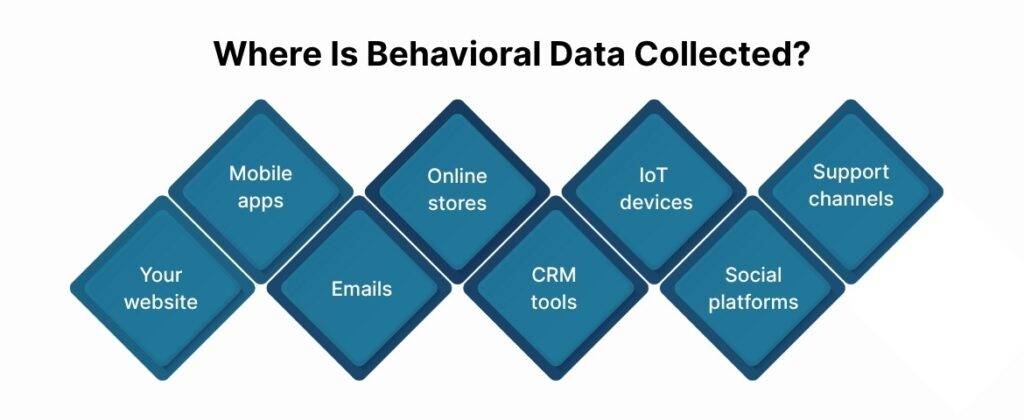
Here are the primary sources where you can collect behavioral data effectively:
- Your website: Track what users click, how long they stay, and where they drop off to spot friction.
- Mobile apps: Capture taps, screen views, and in-app actions to see which features people actually use.
- Emails: Measure opens, link clicks, and unsubscribes to learn what kind of content keeps users interested.
- Online stores: Look at carts, checkouts, and repeat purchases to find what drives conversions or drop-offs.
- CRM tools: Combine sales calls, messages, and support history to understand how customers move through your funnel.
- IoT or connected devices: Collect usage data to learn how people interact with your products in real time.
- Social platforms: Watch engagement—likes, comments, and shares—to see what content resonates most.
- Support channels: Analyze chat logs or feedback forms to find patterns behind complaints or cancellations.
Now, let’s break down the various types of behavioral data, so you can begin to understand the key indicators that offer the most value.
Also read: Tips to Optimize Your Marketing ROI
Types of Behavioral Data
Behavioral data isn’t one-size-fits-all; it varies based on how users interact with your product, content, or brand.
Here are the main types of behavioral data you’ll work with:
1. Engagement Data
This shows how users interact with your content, page views, clicks, scroll depth, and time spent on site.You can apply it to find out what keeps the users interested and what makes them go. Over time, this helps you shape better content and navigation experiences that hold attention.
2. Transactional Data
Every purchase, subscription, or in-app payment contributes to this category. It reveals spending patterns, product preferences, and customer loyalty signals that drive your revenue. When analyzed correctly, transactional data helps you spot high-value customers and improve pricing or offers.
3. Navigation or Clickstream Data
This tracks the exact path a user takes on your website or app—from entry to exit. It’s critical for mapping the customer journey and identifying friction points in your conversion funnel. You can use this insight to redesign flows and reduce bounce rates.
4. Campaign Interaction Data
This includes how users engage with marketing touchpoints like ads, social posts, and emails. Tracking impressions, clicks, and conversions helps you measure campaign performance and audience relevance. You can also use it to refine your targeting and messaging.
5. Product Usage Data
Collected from SaaS platforms, mobile apps, or IoT devices, this shows how users actually use your product features. It highlights what drives retention, which features get ignored, and where usability issues arise. Product teams rely on this to improve adoption and design roadmaps.
6. Support and Feedback Data
This comes from customer support tickets, live chats, and survey responses. It’s rich in qualitative insight, what users say, not just what they do. Combining this with quantitative behavior helps you uncover root causes behind churn or satisfaction trends.
Next, we’ll explore how you can utilize these data insights to drive better decision-making and improved user experiences.
Benefits of Behavioral Data
Behavioral data gives you a real-time view of how your users interact with your product, content, or campaigns, helping you make smarter decisions.

1. Improve Decision-Making
By analyzing actual user actions instead of assumptions, you can make decisions that are grounded in reality. This reduces guesswork, improves strategy, and ensures you invest resources in areas that truly impact engagement or conversions.
2. Personalize User Experiences
Behavioral data lets you tailor experiences based on what each user does, not just who they are. You can show relevant content, product recommendations, or offers, which increases engagement, satisfaction, and loyalty.
3. Predict Customer Behavior
Tracking trends over time allows you to anticipate actions like churn, repeat purchases, or feature adoption. This predictive insight lets you proactively address pain points and create interventions that retain users and grow revenue.
4. Optimize Marketing and Campaigns
You can identify which campaigns, messages, or touchpoints are driving results. Behavioral insights help refine targeting, improve ROI, and reduce wasted ad spend, making your marketing smarter and more efficient.
5. Enhance Product and UX Design
By seeing how users navigate your app or website, you can identify friction points or unused features. These insights guide product improvements that boost usability, adoption, and overall satisfaction.
With all these advantages in mind, the next step is understanding the tools you'll need to analyze and act on this data effectively.
Also read: How to Perform User Behavior Tracking and Analysis
Behavioral Analytics Tools
To make sense of behavioral data, you need the right tools that can track, analyze, and optimize user actions across platforms. Here are the main types of tools you can use to get actionable insights:
1. Server-Side Tracking Tools
- Track user interactions on websites and mobile apps without relying on client-side scripts.
- Improve data accuracy by bypassing browser limitations and ad blockers.
- Monitor tags and events in real time to ensure reliable data collection.
- Stream collected data to customer data platforms (CDPs) or data lakes for advanced analytics.
- With Ingest IQ, you can utilize precision server-side tracking to capture accurate signals and optimize conversions.
2. Identity and Customer Profiling Tools
- Assign unique first-party identifiers to users to unify behavior across devices.
- Build detailed profiles to understand customer journeys and preferences.
- Integrate data from multiple sources, including CRMs and marketing platforms, for a single view of the customer.
- Ingest ID helps centralize customer data, enabling personalized experiences and better return on ad spend (ROAS).
3. Event Tracking and Analytics Platforms
- Capture real-time user actions across web and mobile channels.
- Analyze campaign performance, engagement, and behavioral trends.
- Use insights to refine marketing, reduce cart abandonment, and improve ROI.
- Orchestrate cross-channel campaigns for consistent brand messaging and optimized user experiences.
- Event IQ allows you to unify data and track behavior across devices, powering personalized marketing at scale.
4. Data Integration and Orchestration Tools
- Collect, transform, and synchronize customer data from various platforms.
- Enable real-time segmentation for targeted engagement and efficient workflows.
- Simplify multi-platform management to make decision-making faster and more accurate.
- Using Ingest ID, you can orchestrate customer data seamlessly while maintaining privacy-first practices.
As you begin using these tools, it's important to recognize the challenges that come with collecting and applying behavioral data. Let’s take a closer look at those obstacles to ensure you’re well-prepared.
The Challenges of Collecting and Using Behavioral Data
Collecting and using behavioral data effectively can be complicated due to technical, organizational, and privacy-related obstacles.

Here are some common challenges you might face:
- Data Silos: Customer information is often scattered across multiple platforms, making it hard to get a unified view.
- Data Accuracy: Inconsistent tracking or missing events can lead to incomplete or misleading insights.
- Skill Gaps: Teams may lack the expertise to analyze behavioral data and extract actionable insights.
- Privacy and Compliance Risks: Handling sensitive user data requires strict adherence to GDPR, CCPA, and other regulations.
Whereas Ingest IQ, Ingest ID, and Event IQ help you overcome these challenges by providing accurate tracking, unified data, and privacy-first workflows.
Now let’s focus on the strategies you can use to improve the customer journey and drive better outcomes.
Enhance Customer Journey
Enhancing the customer journey means understanding every interaction your users have and optimizing each touchpoint to increase satisfaction and loyalty.
Here are the key strategies to improve your customer journey effectively:
1. Accurate Data Collection
Tracking user behavior accurately across web and mobile apps helps you see exactly how customers engage with your platforms. With precise tracking, you can identify friction points and optimize conversion paths for smoother experiences. Real-time monitoring ensures your data remains reliable for actionable insights. Ingest IQ provides server-side tracking and real-time tag monitoring, helping you capture accurate signals and improve conversions.
2. Unified Customer Profiles
Combining data from multiple sources allows you to build a single view of each customer, revealing preferences and behaviors across channels. This unified profile enables more relevant messaging and personalized experiences at every step of the journey. Accurate attribution also helps in optimizing your campaigns for maximum ROI. Ingest ID assigns a first-party identifier to each visitor, centralizing data for personalized experiences and better ROAS.
3. Cross-Channel Personalization
Delivering consistent messaging across email, social, web, and in-app touchpoints ensures your brand experience feels seamless. By analyzing behavior, you can determine which channels and content resonate most with each segment. This allows you to guide users through their journey efficiently and boost engagement. Event IQ unifies customer data across platforms, enabling cross-channel marketing and personalized experiences at scale.
4. Data-Driven Optimization
Analyzing behavioral trends and user interactions helps you pinpoint drop-offs, improve navigation, and design more effective campaigns. Insights from real-time analytics let you continuously refine the journey to increase retention and lifetime value. Ingest IQ offers analytics and reporting tools that turn customer journey data into actionable insights for optimized marketing.
The key to success here is making sure your data practices stay ethical and compliant. Let's move on to the importance of maintaining privacy while handling this valuable data.
Also read: Defining Behavioral Segmentation in Marketing with 10 Examples and Strategies
Privacy and Ethics in Behavioral Data Collection
Maintaining privacy and ethical practices ensures you collect behavioral data responsibly while keeping user trust intact.

Here are the key principles and practices you should follow:
- Consent Management: Always obtain clear, informed consent from users before collecting their data.
- Data Minimization: Collect only the data necessary for analytics, marketing, or personalization.
- Transparency: Communicate clearly with users about what data is collected and how it will be used.
- Compliance with Regulations: Adhere to GDPR, CCPA, and other global privacy laws to avoid legal risks.
- Anonymization and Security: Protect sensitive information through encryption, anonymization, and secure storage practices.
- Ethical Usage: Use behavioral data to improve experiences and business outcomes, not manipulate or exploit users.
- Event IQhelps you manage customer consent and implement privacy-first practices to maintain compliance and trust.
Final Thoughts
Behavioral data is a powerful tool that helps you understand how users interact with your platforms, enabling smarter decisions, personalized experiences, and optimized marketing strategies. By analyzing actions across web, mobile, and other digital channels, you can identify trends, predict behavior, and continuously improve the customer journey. Embracing behavioral analytics is essential for staying competitive and driving meaningful engagement in today’s data-driven world.
Ingest Labs provides a complete suite of solutions to make behavioral data actionable and privacy-compliant. With Ingest IQ, you get accurate server-side tracking and analytics for precise insights, while Ingest ID centralizes customer profiles for personalized engagement. Event IQ unifies data across platforms, helping you optimize campaigns, reduce cart abandonment, and deliver consistent experiences at scale. Together, these products simplify data management and empower you to enhance conversions, loyalty, and ROI effectively.
Reach out to Ingest Labs to transform your behavioral data into actionable insights and drive measurable business outcomes.
FAQ
1. Why is behavioral data important?
Behavioral data helps you understand how users interact with your products or services, giving you insights into preferences, habits, and pain points. This allows you to make more informed decisions, personalize experiences, and optimize marketing efforts.
2. How do I collect behavioral data?
You can collect behavioral data through web analytics tools, tracking user actions on your site or app, social media engagement, and surveys. Tools like Google Analytics, heatmaps, and user recordings can help gather detailed insights.
3. Is behavioral data personal data?
Behavioral data can be personal if it identifies individuals directly or indirectly, like through login information or location tracking. However, if it's anonymized and aggregated, it's generally not considered personal data.
4. How do I analyze behavioral data?
To analyze behavioral data, you need to identify key metrics like page views, click-through rates, or conversion paths. Use analytical tools to spot trends, correlations, and opportunities for optimization, then create actionable insights from the data.
5. What are the three types of behavior analysis?
The three types of behavior analysis are descriptive (what's happening), diagnostic (why it's happening), and predictive (what will likely happen next). Each type helps you understand different aspects of user behavior for better decision-making.